

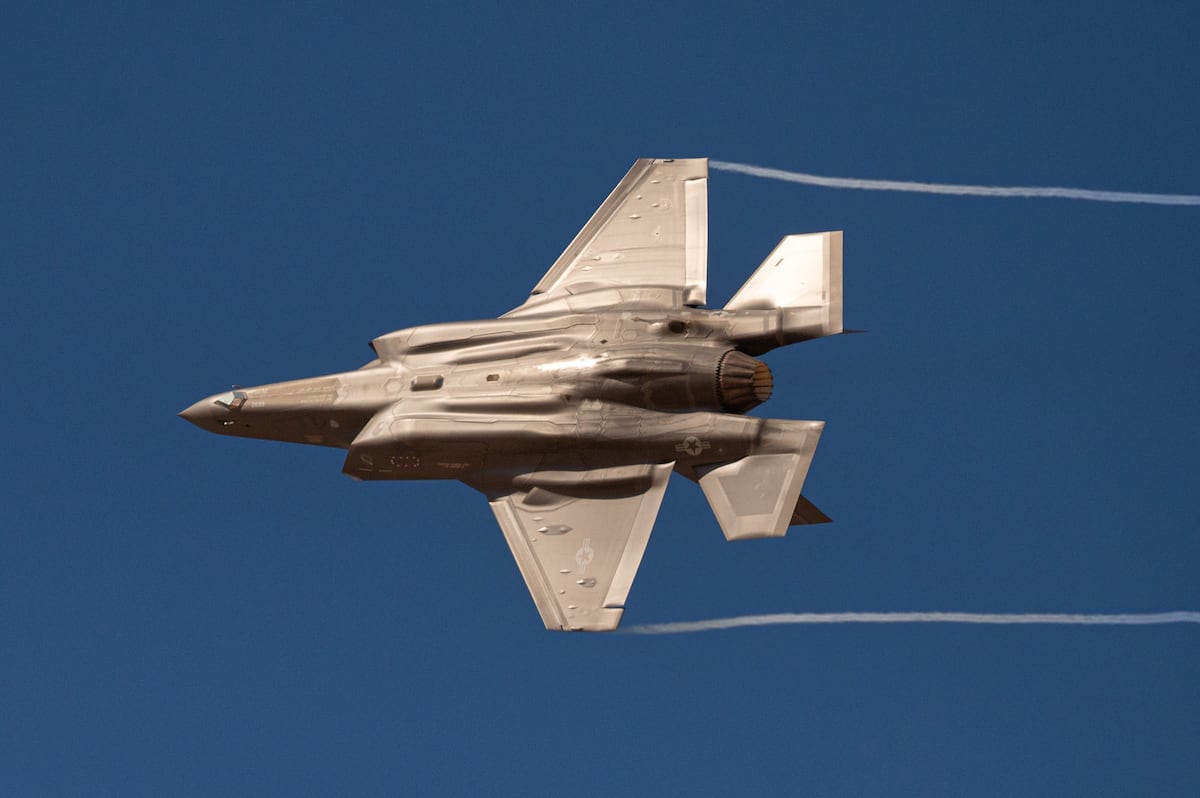

The U.S. military has deployed more of its most advanced fighter jets to the Middle East as it continues to strike Yemen’s Houthi rebels, an Iran-backed terrorist group attacking commercial ships in the Red Sea, according to multiple congressional aides.
The fifth-generation F-35A is the Air Force’s premier fighter, which includes stealth capabilities and advanced sensors and can carry a variety of air-to-air and air-to-ground guided weaponry.
The Pentagon previously surged the fighters to the Middle East amid the conflict in Gaza, while trying to contain a full regional war. While there, the fighters conducted airstrikes against the Houthis during the Biden administration’s campaign to reopen shipping lanes.
More than two weeks into the Trump administration’s intensified airstrike campaign in Yemen, Hegseth has rushed further military assets to U.S. Central Command. He’s extended the deployment of the Harry S. Truman Carrier Strike Group in the Red Sea and announced the carrier Carl Vinson and its strike group would soon join it. The Pentagon has also sent multiple A-10 Warthogs to the region and at least six B-2 stealth bombers to Navy Support Facility Diego Garcia, a U.S. base in the Indian Ocean.
That means that roughly half of the Air Force’s B-2 fleet that is able to carry out missions is now deployed to Diego Garcia. The Air Force has 20 total B-2 Spirits, but only about 55% of them were mission-capable in 2024, according to service statistics.
At the same time, the U.S. has redirected multiple scarce air defense systems from South Korea to the Middle East, including two Patriot batteries and one Terminal High Altitude Area Defense, or THAAD, battery.
“Secretary Hegseth continues to make clear that, should Iran or its proxies threaten American personnel and interests in the region, the United States will take decisive action to defend our people,” Pentagon spokesperson Sean Parnell said in a statement Tuesday evening.
The posture changes send a clear signal to Iran, the Houthis’ main backer and America’s top adversary in the region. President Donald Trump has repeatedly threatened Tehran in recent weeks to cut its support for the group or risk American retaliation.
“The choice for the Houthis is clear: Stop shooting at U.S. ships, and we will stop shooting at you. Otherwise, we have only just begun, and the real pain is yet to come, for both the Houthis and their sponsors in Iran,” Trump posted on his Truth Social app on Monday.
The Houthis have been one of the most resilient parts of Iran’s regional proxy network, badly damaged after attacks from Israel over the last year.
Shortly after Israel’s war in Gaza began in the fall of 2023, the group began targeting commercial ships transiting the Red Sea with missiles and aerial drones. The Houthis continued those attacks despite repeated American strikes and a U.S.-led coalition launched to protect global maritime trade, which eventually rerouted elsewhere.
Still, despite two weeks of renewed U.S. strikes on Houthi sites across Yemen — hitting over 100 command posts, stockpiles, launch sites and even leaders — the group has not backed down and commercial shipping companies have not returned to the Red Sea.
Editor’s note: After publication of this story, an Air Force official called to inform Defense News that the country previously said to be hosting the fighters was incorrect. The official shared the true location, which is left out due to its sensitivity. The story has been updated to reflect the information.
Noah Robertson is the Pentagon reporter at Defense News. He previously covered national security for the Christian Science Monitor. He holds a bachelor’s degree in English and government from the College of William & Mary in his hometown of Williamsburg, Virginia.
Stephen Losey is the air warfare reporter for Defense News. He previously covered leadership and personnel issues at Air Force Times, and the Pentagon, special operations and air warfare at Military.com. He has traveled to the Middle East to cover U.S. Air Force operations.
Jen Judson is an award-winning journalist covering land warfare for Defense News. She has also worked for Politico and Inside Defense. She holds a Master of Science degree in journalism from Boston University and a Bachelor of Arts degree from Kenyon College.
Read the full article here
