

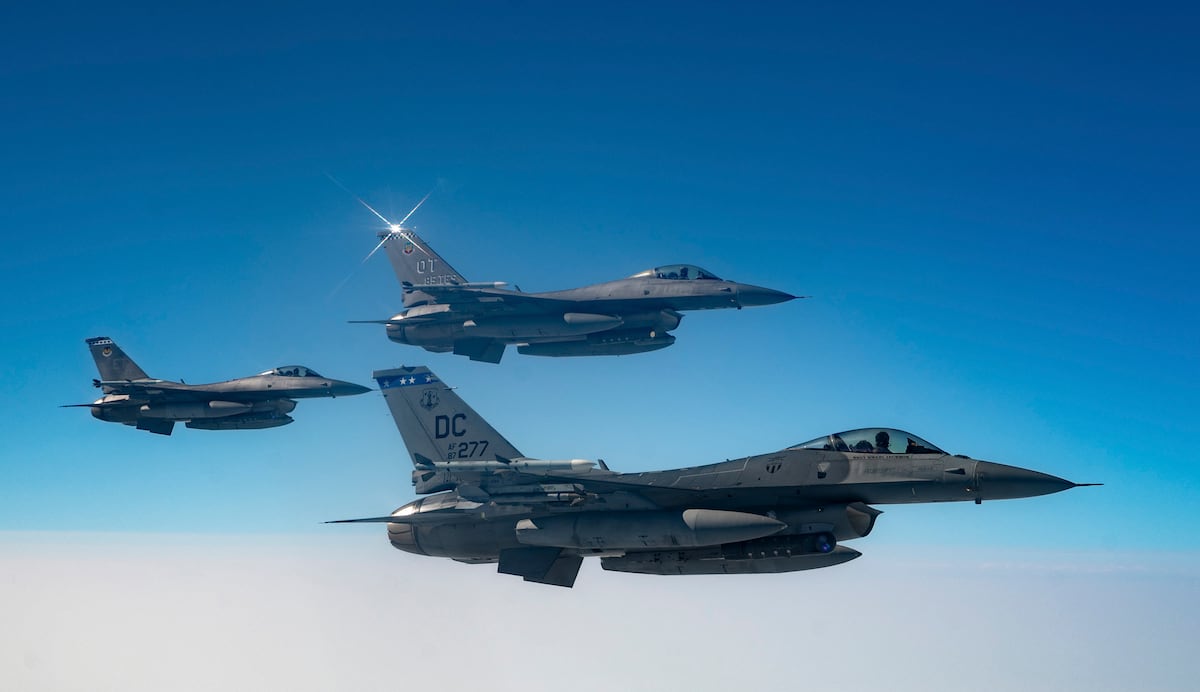

U.S. F-16 fighter jets intercepted Russian spy planes flying near Alaska two days in a row this week, North American Aerospace Defense Command said.
In separate incidents on Wednesday and Thursday, Russian IL-20 surveillance and reconnaissance planes flew into the Alaskan Air Defense Identification Zone, or ADIZ, prompting NORAD’s response.
On Wednesday, NORAD launched a pair of F-16 Fighting Falcons and a KC-135 Stratotanker for refueling as they identified and monitored the Russian plane. The following day, NORAD again sent up two F-16s and a KC-135, along with an E-3 Sentry Airborne Warning and Control System aircraft to intercept and monitor the Russian IL-20.
On both days, the Russian aircraft stayed in international airspace and did not enter into U.S. or Canadian sovereign airspace, NORAD said.
The Alaskan ADIZ, like other such zones, is a defined area of international airspace — which begins at the edge of sovereign airspace around the state — that requires any aircraft entering into it to be identified for national security reasons.
NORAD said Russia activity regularly occurs in the Alaskan ADIZ, and is not considered a threat. Russian aircraft last entered the Alaskan ADIZ on July 22, according to NORAD statements. There were also back-to-back Russian flights in the ADIZ in February, as well as another Russian flight in April.
NORAD uses a layered network of satellites, fighter aircraft and ground-based and airborne radars to detect and track aircraft that come near the U.S. These systems then inform military leaders so they can take appropriate actions.
Stephen Losey is the air warfare reporter for Defense News. He previously covered leadership and personnel issues at Air Force Times, and the Pentagon, special operations and air warfare at Military.com. He has traveled to the Middle East to cover U.S. Air Force operations.
Read the full article here
