

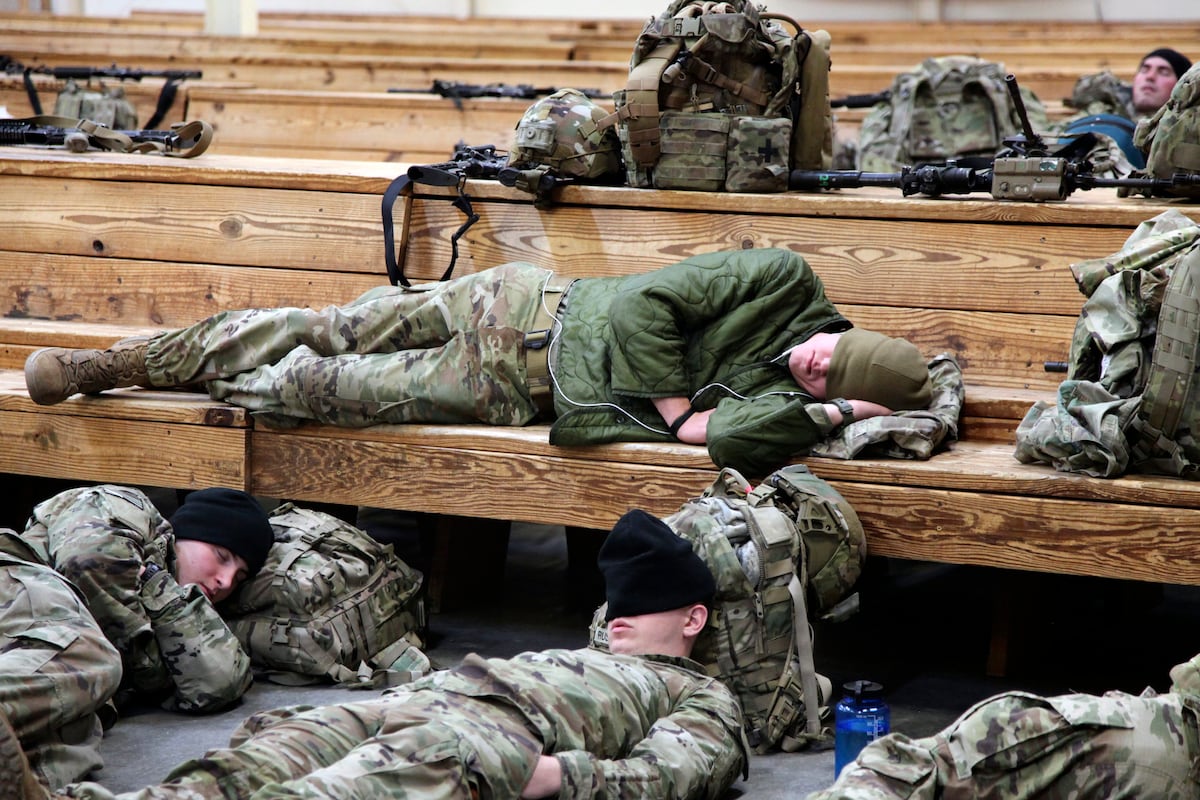

The 18th Airborne Corps published a memo over the weekend that says soldiers on staff duty have to sleep for at least four consecutive hours.
The memo lays out the logistics for who’s in charge of making sure soldiers clock out to take their slumber and explicitly states that units can’t hold soldiers past their shift to sleep. Typically, during staff duty, soldiers man the front desk and conduct checks of unit headquarters within their unit’s area of operation.
Maj. David Nixon, an operations officer for the 18th Airborne Corps, recommended the sleep guidelines as part of his field officer of the day duties, according to Capt. Victoria Horn, an Army spokesperson. The duties require him to identify issues and recommend solutions.
Nixon suggested signing a policy that would mandate strict sleep requirements for soldiers to improve their mental acuity and reduce the possibility of accidents while on the job. The memo was signed by Lt. Gen. Christopher Donahue, the commanding general of the 18th Airborne Corps, on May 13 and will be implemented across the corps, said Horn.
Nixon wrote an opinion column in Military Times in 2023 about the lack of sleep for service members.
Sleep — and the lack of it — has been a constant thorn in the military’s side.
Improper fatigue management was determined to have played a role in the fatal Fitzgerald and John S. McCain destroyer collisions in 2017, according to National Transportation Safety Board accident reports.
The U.S. Government Accountability Office published a comprehensive report earlier this year identifying specific areas of sleep deprivation issues in the military. The report found that a majority of service members say they sleep 6 hours or less, which falls below the Department of Defense’s recommended 7 or more hours of sleep each day.
“Fatigue caused by inadequate sleep can negatively affect a service member’s performance and has contributed to accidents resulting in deaths and hundreds of millions of dollars in damage to ships, vehicles, and aircraft,” said the report, which also likened impairment from fatigue to alcohol intoxication
The report, which Nixon referenced in his recommendation to the 18th Airborne, also called on the Department of Defense to delegate fatigue-solving responsibilities to specific departments within the services.
The effects of sleep deprivation go beyond short-term repercussions, according to Vincent Mysliwiec, director of sleep medicine at the University of Texas Health Science Center in San Antonio. Mysliwiec spent 27 years as an Army doctor — 10 of them focusing on sleep and sleep medicine — and served as the sleep medicine consultant to the Surgeon General of the United States Army.
“I think we do see a higher rate of chronic medical disorders later in their career,” Mysliwiec said of service members, citing physical ailments and mental disorders.
Addressing sleep, said Mysliwiec, helps prevent problems such as these later down the line.
Mysliwiec, who researches sleep and sleep disorders in service members and veterans, was effusive in his praise of the 18th Airborne Corps requirement, calling it the best policy he’d seen regarding a structured framework for sleep requirements.
There are three major hurdles to fixing sleep deprivation in the services, said Diana Maurer, director of the defense capabilities and management team for the U.S. Government Accountability Office.
There are operational difficulties that are just a part of the job. A soldier, for instance, might be deployed near loud noises that make it difficult to sleep.
There’s also a cultural tide that’s hard to shift.
“A whole suck-it-up-buttercup approach,” said Maurer.
And there are organizational problems, like deciding who to put in charge of addressing sleep deprivation when the responsibilities cover so many troops and require so much oversight.
Regarding the 18th Airborne Corps’ new sleep requirement, she confessed she didn’t know enough to offer much of a comment. But she was optimistic.
“Four is a start.”
Riley Ceder is a reporter at Military Times, where he covers breaking news, criminal justice, investigations, and cyber. He previously worked as an investigative practicum student at The Washington Post, where he contributed to the Abused by the Badge investigation.
Read the full article here
