
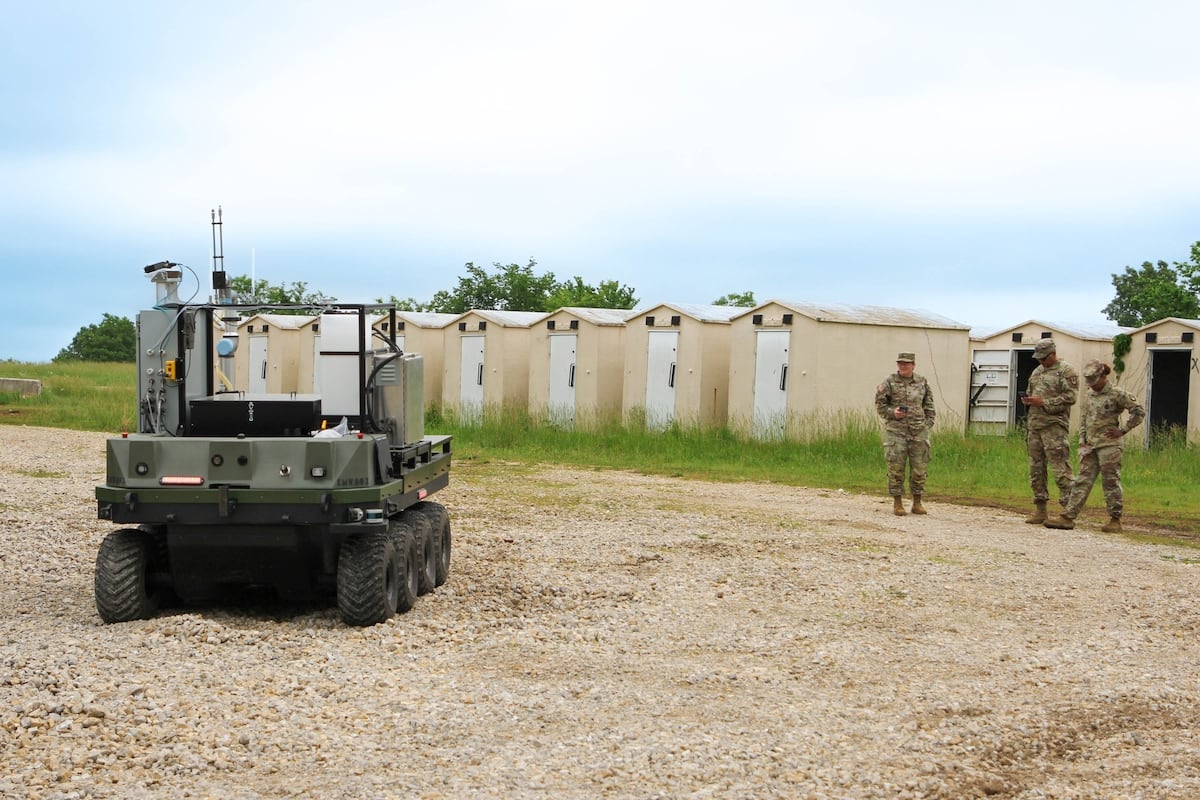

The U.S. Army is looking to have autonomous airborne drones and ground robots clean up chemical and biological weapons.
The Autonomous Decontamination System, or ADS, would scrub vehicles, critical infrastructure and key terrain.
Equally important, it would allow troops in the field to protect themselves and thus ease the strain on Army chemical warfare units that might not be available when needed.
“The goal of the ADS is to allow squad-sized elements to provide a platoon-sized decontamination capability for critical mission equipment,” according to an Army Request for Information, which is due Feb. 20.
“Contamination mitigation operations are extremely resource-intensive in terms of time, logistics, and personnel,” the document continues. “The ADS will reduce manpower and optimize resources required for decontamination operations while mitigating the risk of exposure of warfighters to chemical and biological warfare agents through robotic means.”
The Joint Project Manager for Chemical, Biological, Radiological, and Nuclear Protection, or JPM CBRN Protection, is aiming for mobile systems — including both tethered and untethered robots — that can be transported by light or medium tactical vehicles.
Decontamination bots must perform four functions. These include pre-washing contaminated vehicles or equipment with water, and mapping contamination footprints.
In addition, they must apply decontamination agents while “ideally leveraging the contamination footprint data to apply decontaminants precisely to areas,” the RFI said.
Finally, they must perform a “post-wash with water and a post-decontamination assessment using existing/fielded detector technology.”
The Army is asking contractors to describe the technical capabilities of their systems, such as whether they use GPS, Real-Time Kinematic, Visual Simultaneous Localization and Mapping, or other navigational aids. The level of autonomy should also be specified, including fully autonomous, operator in the loop or manual remote control.
Also important are details on decontamination components, such as the type of nozzle, flow rate and pressure.
ADS robots should be compatible “with various decontaminants, including solids, liquids, and foams (e.g. High Test Hypochlorite (HTH), M333 Joint General-Purpose Decontaminant for Hardened Military Equipment (JGPD-HME),” according to the request.
The U.S. already faces a variety of threats from weapons of mass destruction, ranging from rogue nuclear states such as North Korea — and possibly Iran — to terrorist groups utilizing AI to develop biological weapons. Thus, the Army is looking to modernize its CBRN defense capabilities.
In addition to the Automated Decontamination System project, the Army is upgrading the CBRN version of the Stryker armored vehicle.
The Nuclear, Biological and Chemical Reconnaissance Vehicle Sensor Suite Upgrade, or NBCRV SSU, includes equipping the Stryker with onboard drones that can scout ahead for contaminants without exposing the crew.
“The upgrades will improve maintainability, reliability, and remote maneuverability from threats by including unmanned aerial vehicles, modular mission payload (a system where different equipment components can be easily swapped or added to a platform), a data processing unit, and more,” the Army announced in January 2025.
Yet curiously, the Army recently made CBRN training optional. The updated Army Regulation 350-1 specifies that training modules will be available as needed, but commanders can decide whether to include them in unit readiness.
Read the full article here
