

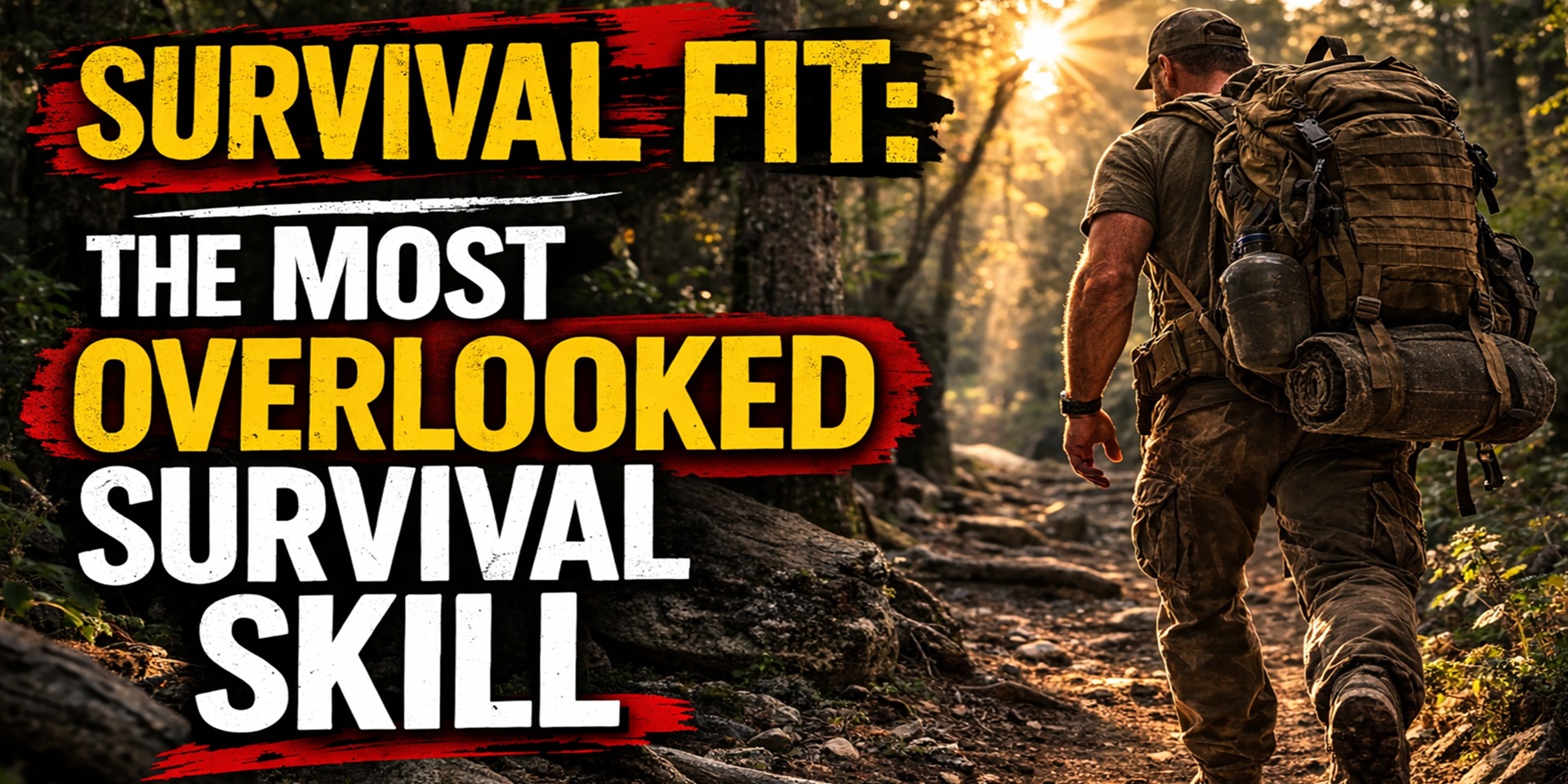

Most preppers have the gear sorted. They have a bug-out bag, a water filter, a fire starter, and enough food stored to last months. What many of them cannot do is carry that bug-out bag five miles through broken terrain without stopping, outrun a threat on foot, or work a physically demanding job for twelve hours straight when the grid goes down and there is no other option.
Physical fitness is the survival skill that does not fit in a bag and cannot be bought on Amazon. It is also the one that most preppers neglect because it takes longer to build, requires consistent daily effort, and delivers no immediate tangible product to put on a shelf. But in a real survival scenario, your body is the platform that every other skill runs on. If the platform fails, the rest of it does not matter.
This is not an article about getting abs or running a marathon. It is about building the specific physical capacities that determine whether you function or fail when things go wrong. Endurance to move. Strength to carry, build, and work. Resilience to keep going after the first few days of disruption. And the mental toughness that ties it all together when comfort and routine are gone.
The short version of the information is available in this clip:
For more details, keep reading:
The Fitness Gap in the Prepper Community
It is worth being direct about something that rarely gets said out loud in prepping circles: a significant portion of the prepper community is not physically prepared for the scenarios they are preparing for.
This is not a judgment. It is an observation based on what survival actually demands. Consider what a moderate-severity grid-down event would require in the first 72 hours. You might need to evacuate on foot carrying 40 to 60 pounds of gear. You might need to secure your property perimeter repeatedly through the night. You might need to help an injured family member move. You might need to work through physical tasks, cutting wood, hauling water, digging, that you have not done regularly in years.
None of that asks for elite athletic performance. But all of it asks for a baseline of functional fitness that many people simply do not maintain. The average American adult is sedentary for more than six hours per day. Cardiovascular fitness declines measurably after just a few weeks of inactivity. Grip strength, which is a reliable proxy for overall muscular fitness, has declined significantly in younger generations compared to their parents and grandparents at the same age.
If your preps are built around the assumption that you will be physically able to execute them under stress, that assumption deserves the same scrutiny you would give to any other part of your plan.
What Survival Actually Demands Physically
Before building a fitness plan, you need to understand what survival events actually require. The physical demands vary by scenario, but several capacities appear across nearly all of them.
Load-bearing endurance
Whether you are bugging out on foot, hauling water from a source to your camp, or moving supplies from a vehicle, survival work involves carrying weight over distance. A 72-hour bug-out bag typically weighs 30 to 50 pounds when properly loaded. A five-gallon water container weighs 41 pounds. A cord of firewood needs to be moved from where you cut it to where you use it. None of this is compatible with a body that struggles to carry its own weight comfortably.
The relevant fitness capacity here is not raw strength or cardiovascular endurance in isolation. It is loaded carrying capacity over time, specifically the ability to maintain functional movement under load without compromising judgment, slowing dangerously, or injuring yourself. Rucking, the military term for loaded walking or hiking, is the single most directly applicable physical training for this capacity.
Short-burst intensity
Survival scenarios sometimes require sudden high-intensity physical output: running from a threat, moving quickly through a dangerous area, climbing, lifting something heavy in an emergency. The body’s ability to generate short bursts of intense effort depends on anaerobic fitness capacity and neuromuscular power. A person who only trains slow steady-state cardio will be poorly prepared for this demand. A person who only lifts heavy weights in a gym will be poorly prepared for it differently.
The relevant capacity is often called work capacity: the ability to generate significant force quickly and then recover fast enough to repeat it if needed. Sprint intervals, kettlebell work, and loaded carries done at intensity all build this capacity effectively.
Sustained manual labor
This is the capacity that gets underestimated most consistently. Sustained manual work, the kind that fills a full day on a working homestead or a construction site, is grueling in a way that gym-based fitness does not prepare you for. Chopping and splitting firewood for three hours uses your shoulders, core, and grip in a way that a bench press program simply does not replicate. Digging a defensive position or a latrine requires hip hinge strength and sustained core stability under fatigue. Building or repairing a structure involves carrying, lifting, kneeling, reaching, and twisting in endless variation.
People who do physical outdoor work regularly are typically better prepared for this demand than people who exercise in gyms but have sedentary jobs. The implication for preppers is that productive physical work, gardening, chopping wood, building projects, hauling, should be part of the training approach whenever possible rather than treated as separate from fitness.
Functional mobility
The ability to move freely and without pain through a full range of motion is taken for granted until it is gone. Tight hips, limited shoulder mobility, and poor ankle stability are extremely common in adults who sit for most of the day. These limitations become acute problems in survival conditions, where getting up and down from the ground repeatedly, crawling, climbing, and moving through irregular terrain are not optional.
Mobility work is the fitness category most consistently skipped and the one with the most direct impact on injury prevention. An injury in a survival scenario, a twisted ankle, a pulled back, a shoulder that gives out, can be incapacitating in a way that has no good solution without medical infrastructure. Preventing those injuries by maintaining functional movement capacity is a more meaningful survival skill than most people recognize.
The Mindset Component: Why It Matters as Much as the Physical
Physical fitness and mental toughness are not separate categories. They develop together and degrade together. The research on this relationship is extensive. Studies of military personnel, emergency responders, and disaster survivors consistently show that physical conditioning correlates strongly with psychological resilience under stress.
There are several mechanisms behind this relationship. Regular intense physical training teaches the nervous system to tolerate discomfort without panic. It builds a reference library of experiences where things were hard and you kept going anyway. It reduces baseline cortisol and anxiety, which are the first casualties of a disrupted routine. And it builds a specific kind of confidence that cannot come from reading or planning: the knowledge that your body can perform when asked.
There is also a direct psychological cost to being physically unfit in a survival scenario that rarely gets discussed. When your body is struggling, when every physical task requires more effort than it should, when you are breathing hard doing things that should be manageable, your cognitive function is impaired by the metabolic demand, your emotional regulation degrades under the added stress load, and your decision-making suffers at exactly the moment when decisions matter most.
The prepper who has trained their body to function under physical stress has a meaningful cognitive and emotional advantage over the one who has not, and that advantage compounds over the duration of the scenario.
Building Survival Fitness: The Core Pillars
Pillar 1: Cardiovascular base
A solid aerobic base is the foundation everything else is built on. It determines how quickly you recover between intense efforts, how long you can sustain moderate physical work, and how your body manages the metabolic demands of sustained stress. Building this does not require running. Walking at a brisk pace for 30 to 45 minutes four to five times per week is adequate for building a functional aerobic base in most sedentary people. The goal is consistent moderate effort over time, not impressive performance numbers.
Once a basic walking base is established, progressive increases in duration, grade, and load build capacity further. Rucking, walking with a weighted pack, is the most direct cardio training investment for survival fitness because it simultaneously builds aerobic capacity, load-bearing muscle endurance, and feet and joints adapted to carrying weight.
Pillar 2: Functional strength
The strength qualities most relevant to survival are not the ones most gym programs develop. Isolation movements for specific muscle groups matter far less than the compound movement patterns: hinge (picking things up from the floor), squat (sitting down to the ground and standing back up, loading and unloading vehicles), push (moving objects away from you, getting up off the ground), pull (climbing, dragging, rowing), and carry (all of the above, while moving).
A simple program built around deadlifts or kettlebell swings, goblet squats, push-ups, rows, and farmer carries covers all of these patterns efficiently. Three to four sessions per week of 20 to 30 minutes is sufficient to build meaningful functional strength over three to six months for someone starting from a sedentary baseline. Compound movements done with correct form at progressive loads are far more valuable than extensive programs with many exercises.
Pillar 3: Work capacity
Work capacity is the ability to do hard physical things and recover quickly enough to do them again. It is built through interval-style training where periods of high effort alternate with recovery. This does not need to be complicated. Twenty minutes of kettlebell swings with alternating work and rest periods, or sprint intervals on a hill, or loaded box step-ups done at intensity, all develop work capacity effectively.
The key variable is intensity during the work intervals. The body adapts to the specific demands placed on it. Low-intensity training builds low-intensity capacity. If you want to be able to sprint when it matters, you need to practice sprinting in training. If you want to work hard for extended periods, you need to practice sustaining effort near your limit.
Pillar 4: Mobility and joint health
Ten minutes of deliberate mobility work daily prevents more injuries than any other single investment in physical training. The priority areas for most adults are hip flexors and hip external rotators (extremely tight in people who sit all day), thoracic spine (the mid-back, which stiffens and limits shoulder and neck movement), and ankles (which determine whether you can descend hills and uneven terrain without injury).
Yoga, mobility-specific programs like GROM or Simple Shoulder Solution, and daily hip and thoracic stretching routines are all effective. The specific protocol matters less than the consistency. Doing something every day is vastly more effective than an ambitious program done twice a week.
Pillar 5: Body composition
Excess body fat is a survival liability in a specific and practical sense. It adds weight that must be moved and powered without contributing to the capacity to move it. Carrying 30 extra pounds of body fat is equivalent to wearing a 30-pound weight vest that you cannot take off, cannot put down, and increases the metabolic cost of every physical task.
This is not about aesthetics. It is about the physics of survival work. A leaner body with equivalent or greater muscle mass performs better across every physical survival demand. The path to improving body composition is the same as always: consistent physical training combined with a diet that does not chronically exceed energy needs. No complicated protocols required.
Nutrition for Survival Fitness
What you eat determines your training capacity, your recovery, and your body composition over time. In a survival context, it also determines how your body performs during the actual event when normal food access may be disrupted.
The foundational principle is protein adequacy. Muscle mass is built and maintained through a combination of physical training and sufficient dietary protein. Most adults, particularly those over 40, need more protein than they typically consume to maintain muscle mass. A target of 0.7 to 1 gram of protein per pound of body weight per day is a practical starting point for someone actively training. Prioritizing protein at each meal, eggs, meat, fish, legumes, dairy, makes this target achievable without obsessive tracking.
Beyond protein, the most impactful nutritional change most people can make for both training performance and survival preparedness is reducing dependence on refined carbohydrates and ultra-processed food. These foods drive blood sugar instability, impair recovery, and contribute to the chronic inflammation that underlies most training-related fatigue and joint pain. They also have poor storage characteristics compared to whole foods and poor energy density per unit of satiety.
A prepper who has adapted their body to running primarily on whole foods, protein, fat, and complex carbohydrates, is better prepared for a scenario where processed food is unavailable and whole stored food is the primary caloric source. That adaptation takes months to develop but pays dividends in both daily fitness and scenario performance.
Age and Injury Are Not Excuses, They Are Variables to Manage
The fitness conversation in survival contexts often gets derailed by age-related objections or injury-based dismissals. These deserve a direct response.
Physical capacity does decline with age. Muscle mass decreases from the mid-30s onward at a rate of roughly 3 to 5 percent per decade without resistance training intervention. Cardiovascular fitness declines. Recovery takes longer. These are real factors.
But the decline is not fixed. Research consistently shows that older adults who engage in regular resistance training maintain significantly higher muscle mass, functional strength, and cardiovascular capacity than sedentary peers. The gap between a trained 60-year-old and an untrained 60-year-old is often larger than the gap between trained 30-year-olds and trained 60-year-olds. The decision to train or not train is a larger determinant of physical capacity than the year of birth.
For people managing injuries, the relevant question is not whether training is possible but what training is possible. Almost every injury has movement patterns it does not impair. A bad knee does not prevent upper body strength training. A shoulder injury does not prevent walking or rucking. A lower back issue managed carefully with appropriate hip hinge mechanics often improves with the right strength work rather than worsening with it. Working with a physical therapist or knowledgeable trainer to build a program around injuries rather than using them as a ceiling is an investment that pays off in long-term physical capacity.
The Practical Starting Point
If you are currently sedentary and the gap between where you are physically and where you need to be feels large, the starting point is simple rather than overwhelming.
- Walk every day. Thirty to forty-five minutes. Build to rucking with a 20-pound pack over six to eight weeks.
- Add three strength sessions per week. Deadlift or kettlebell swings. Goblet squat. Push-up or press. Row. Farmer carry. That is the entire program. Do it consistently for three months.
- Stretch your hips and thoracic spine daily. Ten minutes. Every day. Non-negotiable.
- Eat enough protein. Prioritize it at every meal. Everything else in nutrition is secondary to this.
- Do hard things regularly. Physical work on your property, cold exposure, heat tolerance, going longer than comfortable. Building the mental library of having done hard things is itself a survival preparation.
Three months of this, done consistently and without interruption, produces a measurably different physical platform than where most sedentary preppers currently stand. Six months produces a significant one. A year of consistent training produces a person whose body is genuinely prepared to execute on the skills and gear they have spent time and money developing.
Final Thought: Your Body Is Your Most Important Prep
Every piece of gear you own, every skill you have practiced, every plan you have made depends on your physical ability to implement it. The water filter is only useful if you can get to the water. The bug-out bag is only useful if you can carry it. The defensive plan is only useful if your body responds when called on.
Fitness is not a hobby that some preppers happen to have. It is the platform that all other preps run on. Treat it accordingly. Start now, be consistent, progress steadily, and in a year you will have built the most important piece of survival equipment you own: a body that works when everything else stops.
If this article made one thing clear, it’s this: gear doesn’t move itself.
You can own the best bug-out bag, the best rifle, the best water filtration system, and months of stored food… but none of it matters if your body cannot carry the load, hike the distance, or keep working when the situation demands it.
That’s the reality most survival discussions avoid. True preparedness is not just about equipment or plans. It’s about being capable of operating in the wild for days, weeks, or even months without modern infrastructure.
And that requires skills most people have never learned.
The Wilderness Long-Term Survival Guide was created specifically to teach those skills. It goes far beyond typical prepping advice and shows you how to survive when the environment around you becomes your only resource.
Inside the guide you’ll discover:
- How to locate water sources in nearly any terrain and purify them safely
- How to build long-term wilderness shelters that protect you from weather and predators
- Practical methods for hunting, trapping, and fishing without modern equipment
- How to identify edible plants and survival foods in forests, fields, and mountains
- Fire-starting techniques that work even in wet or harsh conditions
- How to craft tools, cordage, and equipment using materials found in nature
In other words, the kind of knowledge that allows a person not just to survive a short emergency… but to live off the land if necessary.
Many people prepare for disasters assuming they will stay near their home, their stored supplies, and their existing infrastructure. But history shows that sometimes survival means moving through unfamiliar terrain and adapting quickly to a new environment.
When that happens, the people who succeed are not the ones with the most gear.
They’re the ones who understand how the natural world works and how to use it.
If you’re serious about building the physical and practical survival capability this article talks about, the Wilderness Long-Term Survival Guide is one of the best places to start.
You can learn more about it here!
Because in the end, your gear may break, supplies may run out, and plans may change.
But the skills you carry in your head and the strength you carry in your body are the tools that will keep you alive.
You may also like:
 Join The Ask A Prepper WhatsApp Channel
15 Best Ways to Save Money Fast
Self-Defense Moves That Might Save Your Life Soon
High Protein Meal Prep on a Budget
Read the full article here
