

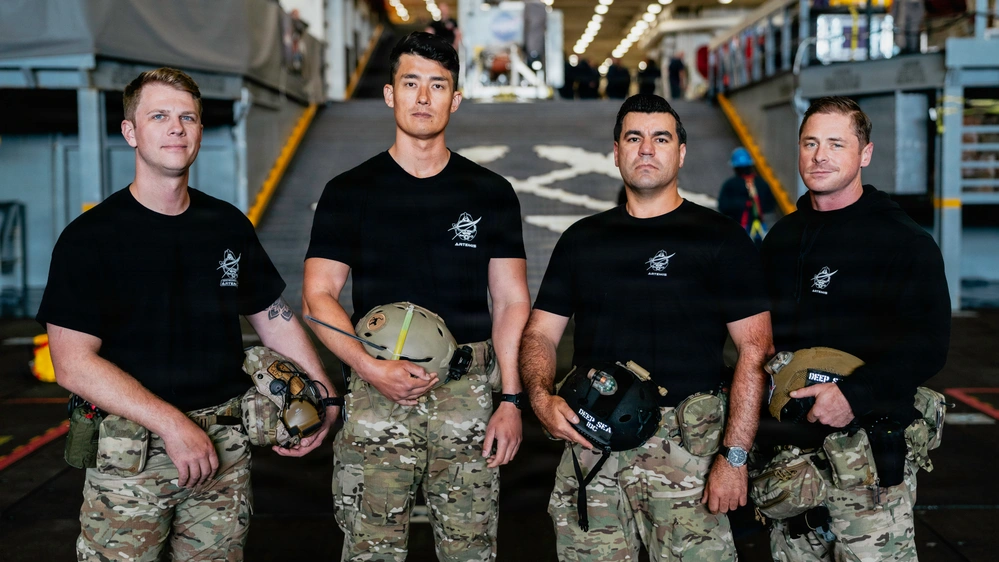

After a 10-day space journey around the moon, the Artemis II team will splash down in the Pacific Ocean on Friday night and be met by a team of U.S. Navy sailors, ready to give them a warm welcome home.
The first face that the four-person crew will see when they return to Earth will be Senior Chief Hospital Corpsman Laddy Aldridge, who will be the first of his team to open the Artemis II capsule, enter it and begin medical assessments, according to a Thursday release.
Aldridge, who comes from three generations of military service and is assigned to Explosive Ordnance Disposal Expeditionary Support Unit 1, will be among a four-person Navy dive medical team that will greet the astronauts and their Orion capsule to make initial medical assessments and safely escort them out of the capsule, per the release.
“This effort is the culmination of both our training to bring world class care to the Artemis II crew and countless dedicated years of Navy diving and Navy medicine,” Aldridge said in the statement.
The dive team that will assess the NASA astronauts Christina Koch, Jeremy Hansen, Reid Wiseman and Victor Glover consists of Aldridge, Lt. Cmdr. Jesse Wang, Chief Hospital Corpsman Vlad Link and Hospital Corpsman 1st Class Steve Kapala.
Navy dive medical personnel often work in expeditionary warfare communities, according to the release, and they are certified divers that undergo specialized training to make them experts in undersea medical issues, such as decompression illnesses.
Once Orion splashes down after reentering Earth’s atmosphere, the medical team will enter the capsule and perform initial exams on the Artemis II crew, give triage care if necessary and assist the astronauts in leaving the capsule onto the inflatable raft set up by Navy divers, the statement says.
After they are out of the capsule, first-contact medical providers will arrange the team to be airlifted by Helicopter Sea Combat Squadron 23 back to the amphibious transport dock ship USS John P. Murtha for further evaluations.
The Navy team will be led by Wang, a board-certified emergency medicine doctor assigned to Explosive Ordnance Disposal Group 1, who joined the Navy in 2021 and became an undersea medical officer in 2024, according to the release.
“As a proud member of the undersea medical community, I am particularly humbled to play a part in this mission,” Wang said in the release. “It is the honor of a lifetime to stand here today, ready to provide the absolute best care to the Artemis II crew.”
Alongside Wang, Aldridge, Link and Kapala are dive independent duty corpsmen who are trained in dive medicine, per the release.
Link is part of the Explosive Ordnance Disposal Mobile Unit 1 and has 18 years of dive medicine experience but believes this mission is “already a highlight of his career,” the statement reads.
“I have been exposed to the Navy since I was a young teenager, and I’m proud to represent both my family and hometown,” Link said in the release. “Contributing our efforts to NASA and the Artemis II mission is something we take great pride in as part of that legacy.”
Kapala, assigned to EODMU-11, has worked in dive medicine since 2018 and said in the release that the historic mission is a “unified effort.”
“I grew up reading sci-fi novels and watching space movies, never thinking that I would play a part in a recovery mission like this,” Kapala said in the statement.
“It is surreal to play a part in safely recovering the astronauts from the capsule to get them home safe to their families, an effort that really makes you realize this team is bigger than just the four of us,” Kapala continued.
Cristina Stassis is a reporter covering stories surrounding the defense industry, national security, military/veteran affairs and more. She previously worked as an editorial fellow for Defense News in 2024 where she assisted the newsroom in breaking news across Sightline Media Group.
Read the full article here
