

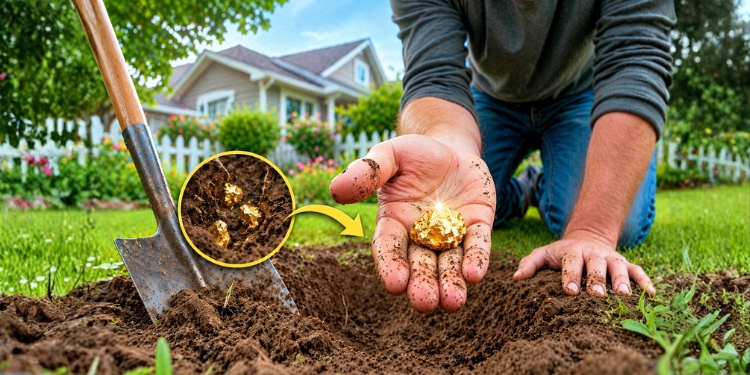

In 1799, a twelve-year-old boy named Conrad Reed pulled a heavy yellow rock out of Little Meadow Creek in Cabarrus County, North Carolina. He brought it home. His family thought it looked nice, so they used it as a doorstop.
For three years, a seventeen-pound gold nugget sat on their floor holding a door open. In 1802, a jeweler finally identified it and bought it from the family for $3.50 – a fraction of its actual value, which was closer to $3,600 at the time (around $626,000 worth today).
That creek is still there. The gold is still there, too – in that state and across dozens of others.
If you’re someone who thinks about what actually holds value when systems break down, this one’s for you. Because the ground under your property might be worth more than you realize.
The State Nobody Expects
Not California, not Alaska. Wait, we’ll get there. But this one earns the top spot for a reason most people have never heard of.
In 1828, gold was discovered in Lumpkin County, Georgia. That’s a full twenty years before the famous California Gold Rush of 1849. The deposit was so significant that the federal government built a branch mint in the town of Dahlonega in 1838. Real, government-operated production, right there in the mountains of north Georgia.
Forget Gold and Silver – This Cheap Metal Will Be King when SHTF
Here’s what’s even more interesting. That gold didn’t disappear – commercial mining slowed down because California offered easier, larger deposits. But the geological formations in north Georgia, particularly in Lumpkin, White, and Union counties, still contain placer gold and lode gold deposits.
Recreational gold panning is legal on many public waterways in Georgia. People pull flakes out of creeks to this day. Small flakes, sure, but real gold.
If you live in north Georgia and you’ve got a creek running through your property, there’s a legitimate chance gold has washed through it at some point.
The Most Obvious One
 This one won’t surprise anyone. California’s Mother Lode region – a gold-bearing belt stretching from Mariposa County up through El Dorado and Placer counties – is still active. Prospectors work claims there year-round and consistently find gold.
The American River, the Merced River, the Yuba River – together they produced millions of ounces during the Gold Rush. And the earth keeps giving.
Erosion exposes fresh material, floods shift gravel beds, and gold works its way down into bedrock cracks where it sits until someone pulls it out.
There’s a legal catch worth knowing though. The Bureau of Land Management allows recreational gold panning on many California public lands without a permit. That part is straightforward. But suction dredging has been banned statewide since 2009 under a moratorium that keeps getting extended. Panning and sluicing in certain areas is accepted, but motorized dredging is not an option at the moment.
Own property along the western Sierra Nevada foothills? Check your creek beds. Gold has been washing through that ground for thousands of years and it hasn’t stopped.
Where the Land Has Barely Been Touched
Alaska has been producing gold since before it was even a state. Nome, Fairbanks, Juneau, the Klondike trail – the history here is massive. But what’s interesting is how much of that gold is still untouched. There’s so much undeveloped land in Alaska that entire deposits have barely been explored, let alone mined out.
These 7 Seeds Will Be the Real Currency during the Next Great Depression
The Fortymile River district, the Kenai Peninsula, Crow Creek near Anchorage – these are all areas where prospectors are still actively finding gold today. BLM land across the state allows recreational panning in most areas, and some spots near Fairbanks are specifically set aside for public gold panning.
Remote locations, brutal cold, and short working seasons make Alaska harder to prospect than most states. But the gold is confirmed by the U.S. Geological Survey, not by YouTube videos and Reddit threads.
The One That Started Everything
 Remember Conrad Reed from the intro of the article? That seventeen-pound doorstop didn’t end up in his creek by accident. It was there because of what sits underground across the entire region.
The Carolina Slate Belt is a geological formation that runs from Virginia through the Carolinas and into Georgia. The whole thing is a known gold-bearing zone. Reed Gold Mine is now a state historic site, and visitors can still go there and pan for gold.
Gold has been found in over a dozen North Carolina counties, including Cabarrus, Mecklenburg, Stanly, Montgomery, and Randolph. Small-scale prospecting is still active across the area. The geology that put that nugget in Conrad Reed’s creek a couple of hundred years ago hasn’t gone anywhere.
Three More States Worth Knowing About
Colorado has gold in the mountains around Breckenridge, Cripple Creek, and the South Platte River. Clear Creek County is named that way for a reason. Miners found gold in those mountain streams going back to the 1850s.
Nevada produces more gold commercially than any other U.S. state right now. The Carlin Trend in northeastern Nevada is one of the most significant gold deposits on Earth. Recreational prospecting is more limited here because large mining companies hold most of the active claims. But public land prospecting is possible in certain areas.
Oregon has gold along the Rogue River, in the Blue Mountains, and on the beaches of the southern coast. Black sand deposits along the Oregon and northern California coast contain fine gold particles washed down from inland sources over thousands of years.
What About the Other 40-Something States?
 Gold exists in at least 40 of the 50 U.S. states, according to the U.S. Geological Survey data.
Now, most of those deposits are small. Trace amounts that interest geologists but won’t do much for someone with a pan.
Still, a handful of states beyond the big names hold enough gold to actually recover.
- Idaho has a long mining history in the Boise Basin. Gold was discovered there in 1862, and the area produced over $250 million worth at historic prices. Prospectors still work the creeks around Idaho City.
- Montana produced gold from places like Alder Gulch and Last Chance Gulch – which is now the main street of Helena, the state capital. That’s right. The capital city sits on a former gold deposit.
- South Dakota is home to the Homestake Mine in Lead, one of the largest and deepest gold mines ever operated in the Western Hemisphere. It ran from 1876 to 2002. Recreational prospecting happens in the Black Hills area.
- Arizona has gold scattered across the Bradshaw Mountains and along the Hassayampa River near Wickenburg. The desert might not look like gold country, but the geology says otherwise.
- Virginia was actually one of the earliest gold-producing states. The Virginia Gold Belt runs through several central counties, and gold was mined there commercially before the California rush pulled everyone west.
Even states like Alabama, South Carolina, and New Mexico have documented gold occurrences. Not enough to build a mine around, but enough that a knowledgeable prospector with a pan and patience can find color.
If your state isn’t on this list, don’t assume there’s nothing. Check the USGS mineral resource maps. You might be surprised.
Who Owns the Gold You Find?
This is where it gets serious. Finding gold is one thing. Keeping it is another.
The rules depend on where you find it:
- On your own private property: In most states, if you own the land and you own the mineral rights, the gold is yours. But here’s the catch – mineral rights and surface rights are often separated. When you bought your property, the deed may not have included mineral rights. Someone else might own what’s underground. Check your deed. Check your title. This is not optional if you’re serious.
- On public land (BLM, National Forest): Recreational gold panning is generally allowed without a permit on BLM and National Forest lands in most western states. “Recreational” means hand tools – a gold pan, a sluice box, maybe a hand classifier. No motorized equipment. No significant ground disturbance. Each state and each district can have its own specific rules, so check with the local BLM or Forest Service office before you start.
- On someone else’s private land: You need written permission. Gold found on someone’s property belongs to the property owner or the mineral rights holder. Taking it without permission is theft.
- On existing mining claims: Even on public land, someone may hold an active mining claim. The BLM’s LR2000 database lets you search for existing claims by location. If someone has a valid claim, that ground is off-limits to you.
- State parks and protected areas: Almost always off-limits to any kind of prospecting.
Luckily, America still offers small pockets of free land through local homesteading programs run by rural towns trying to bring in new residents. These opportunities come with rules about building and staying on the land, yet they still open a rare door that no longer exists in most of the world.
Gold-bearing regions remain tightly regulated, with mineral rights often separated from the surface land, yet if you legally acquire a free lot and happen to discover gold on your property, U.S. law generally allows you to keep and profit from what you find, as long as you follow state and federal regulations. 👉See the US Free Land Map here.
How to Actually Get Started
Gold prospecting isn’t about getting rich quick. If you’re a prepper, the value is somewhere else. It’s about knowing your land, understanding the geology around you, and building a skill that produces something with real, universal worth using nothing but your hands and basic tools.
A gold pan weighs almost nothing. It doesn’t need batteries or fuel. It doesn’t expire. And once you learn how to read a creek and recover fine gold, that knowledge stays with you no matter what happens to the grid or the economy.
Here’s where to begin:
- Learn your local geology. The USGS publishes free mineral resource maps for every state. That’s your starting point. Know what’s under your ground before you ever spend a dollar on gear.
- Practice reading water. Gold settles where water slows down, so look at inside bends, the areas behind large rocks, and cracks in exposed bedrock. This is basic physics, not guesswork.
- Pick up a basic kit. A 14-inch gold pan, a classifier screen, a snuffer bottle, and a small glass vial. You can get all of it for under $30.
- Know the law where you live. Rules vary a lot. Some counties in California require permits even for hand panning. Some states have zero restrictions on private land. Look it up before you go out.
- Think of gold as a barter asset, not a retirement plan. In a long-term grid-down situation, a small vial of gold flakes carries real trade value. It always has and that’s not going to change.
But here’s the thing – when a real crisis hits, food is gold. You can’t eat what you pan. Even the UN has been sounding the alarm about a coming global famine, and with prices climbing the way they are, it’s not hard to see where this is headed. Gold is useful, but if you can’t feed your family, none of it matters.
That’s why the My Survival Farm is worth a look. It’s not another raised bed guide or some overpriced hydroponic setup. It’s a closed-loop system – worms feed the soil, fish provide protein and fertilizer, and a filtration cycle keeps the water moving. You build it in about three hours for around $270, and it puts out fresh food year-round with almost no effort after that.

If you’re the kind of person who builds real skills and stacks real assets, this fits right in. It’s the food version of learning to pan gold – except it feeds your family every single day.
Check out the full blueprints for My Survival Farm here. It comes with a 60-day money-back guarantee, so there’s nothing to lose.
You may also like:
 The Overlooked Gold Mine of Post-EMP Survival
This Even Will Be Worse than the Dust Bowl of the 1930s (VIDEO)
Simple Home Tests to Determine Whether Your Gold Is Real or Fake
10 DIY Skills Worth Learning Before the Next Economic Downturn
Start Replacing Cash with THIS Right Now!
Read the full article here
