

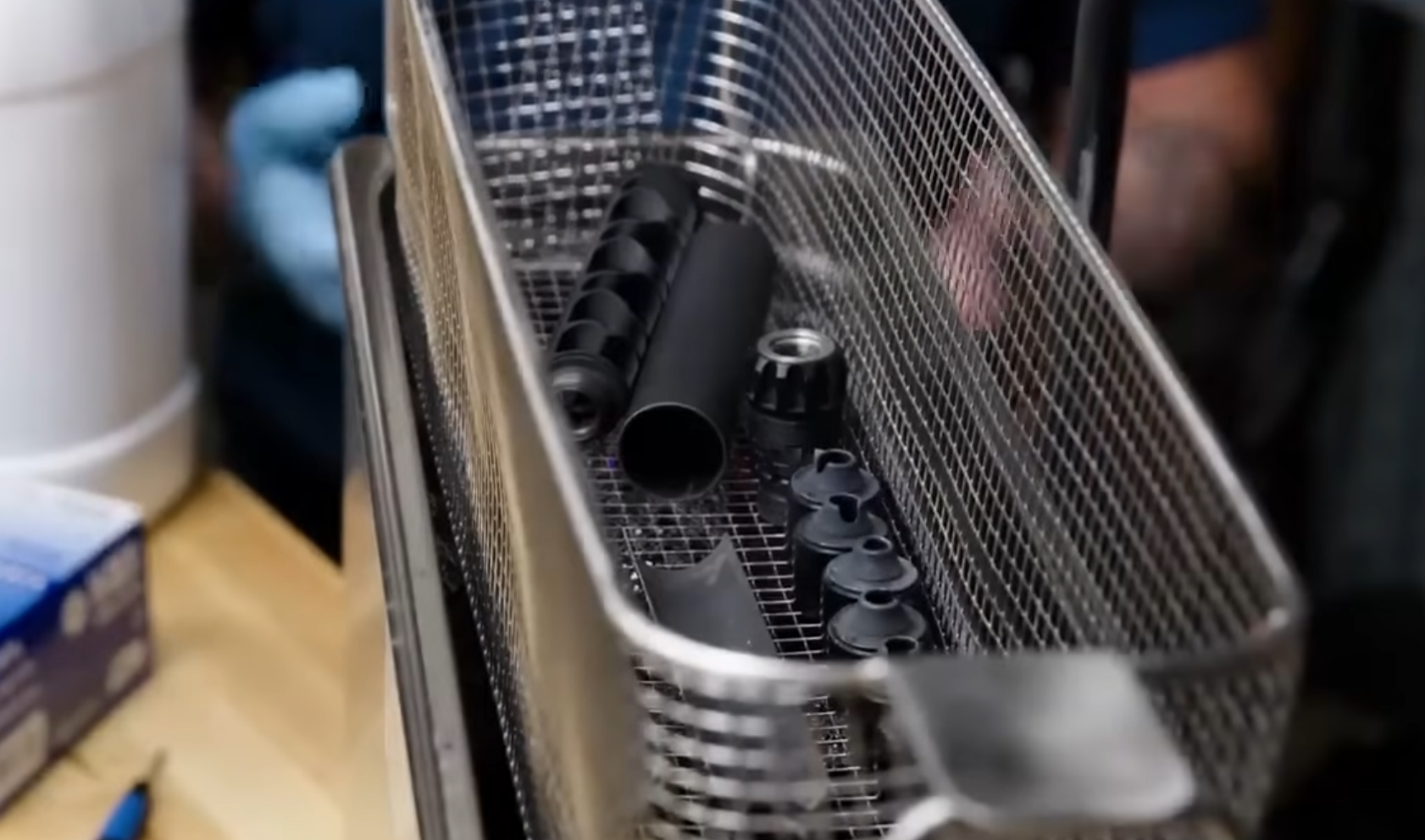

If you’ve already been lucky enough to put a few hundred rounds through your new $0 tax suppressor, you might be wondering how you’re supposed to clean it.
Just like many other firearm components, suppressors are subjected to a significant amount of fouling in the form of unburnt powder, carbon, as well as lead and copper residue. While they don’t need to be cleaned quite as often as some of your more sensitive firearm parts, suppressors still need regular maintenance. When it comes to fully welded or non-user-serviceable suppressors, one historically infamous yet cheap way to clean them was known as “The Dip.”
Today, we’ll discuss what it is, why you should probably avoid it, and some alternative cleaning methods you can use that won’t damage your suppressor or harm your health.
Kitchen Chemistry
The Dip is a double-edged sword of simplicity, cost savings, as well as a massive risk to your health, your suppressor, and the environment. The Dip is a very easy home-brew of a very strong acid, officially known as peracetic acid. Peracetic acid is a 50/50 mix of White Distilled vinegar and hydrogen peroxide, both items which you can find at virtually any grocery store. Peracetic acid is highly effective and can even break down softer metals like aluminum.
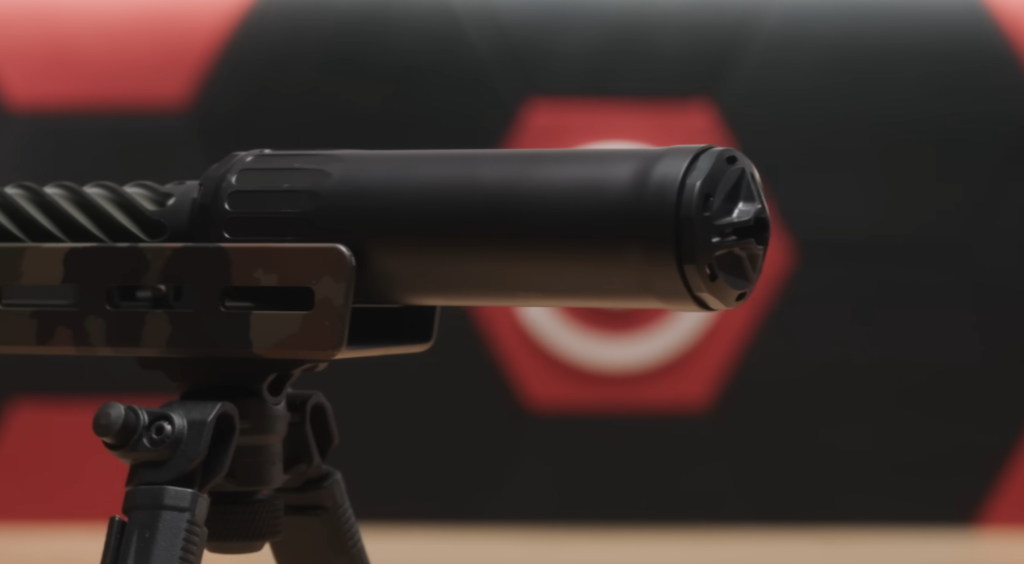
The resultant peracetic acid/dip can easily break down some of the more stubborn lead fouling you’ll typically find inside most suppressors and muzzle devices. The dip simply acts as an extremely powerful oxidizer, breaking down the lead, copper, and carbon deposits into smaller pieces that either fall off or dissolve into the mixture, creating lead acetate – an extremely toxic byproduct due to its ability to more easily absorb into skin than the base element itself.
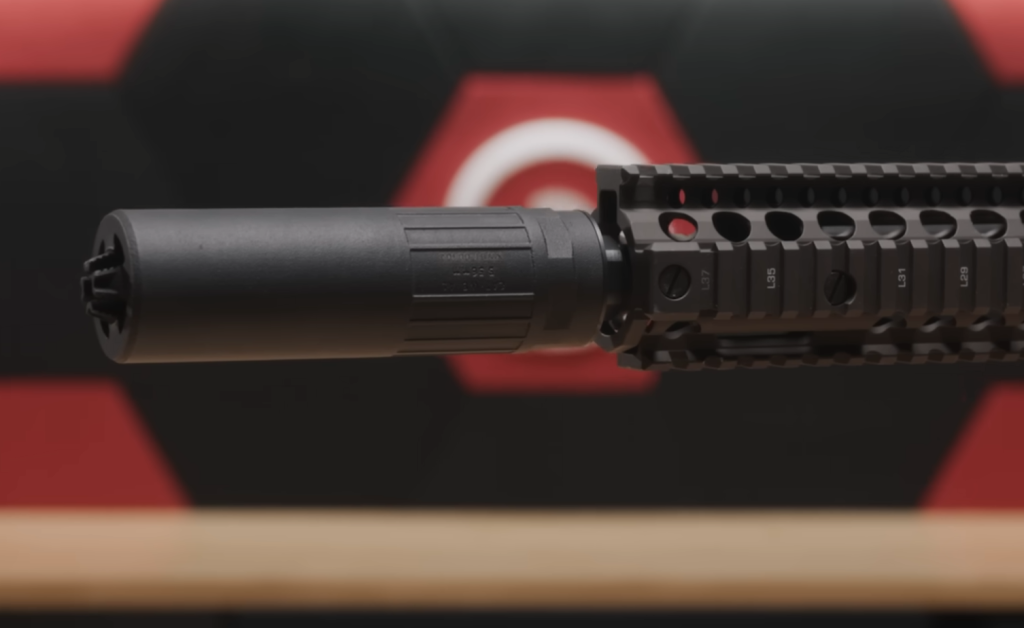
I think it goes without saying, but I highly discourage people from attempting to clean their suppressor this way. Aside from the health impacts from both the original and lead acetate leftovers, there is also virtually no good way to throw this stuff away outside of special household hazardous waste facilities, or your local recycling center that handles other toxic acids like those found in car batteries. So to along with its absolute dirt-cheap price point and almost unbeatable lead and carbon removal abilities, there is also a lot to consider from the health and disposal angles, as well as the fact that the dip can’t be used on certain kinds of suppressor materials, which we’ll talk about next.
Better Alternatives
Today, we have access to a whole suite of new tools and non-toxic chemicals that allow us to clean suppressors more safely, and oftentimes do so more quickly. Through advances in machining affordability, skill ceiling, and design ability, we now have access to user-serviceable suppressors which allow you to disassemble the can in order to more easily scrape carbon and built-up lead from baffles, and get a good opportunity to clean out the inside of the tube. If you’ve ever owned a rimfire suppressor, you’ll know that user serviceability is highly sought after as a feature in this corner of the market due to how absolutely filthy .22lr is. So, how do we clean the modern way?
Ultrasonic Cleaners
Ultrasonic cleaners are a great way to clean anything from a fully welded can to modular suppressors and even other firearm parts. Ultrasonic cleaners use high-frequency waves to create micro cavitations that dislodge the fouling from tougher components over time.
The huge advantage that ultrasonic cleaners have over manual brushing and picking is that the ultrasonic sound waves can get into every nook and cranny that you can’t, leaving your suppressor with a deeper clean. Ultrasonic cleaning solutions are also broadly non-toxic and much safer to use than acids and sometimes even picks and brushes.
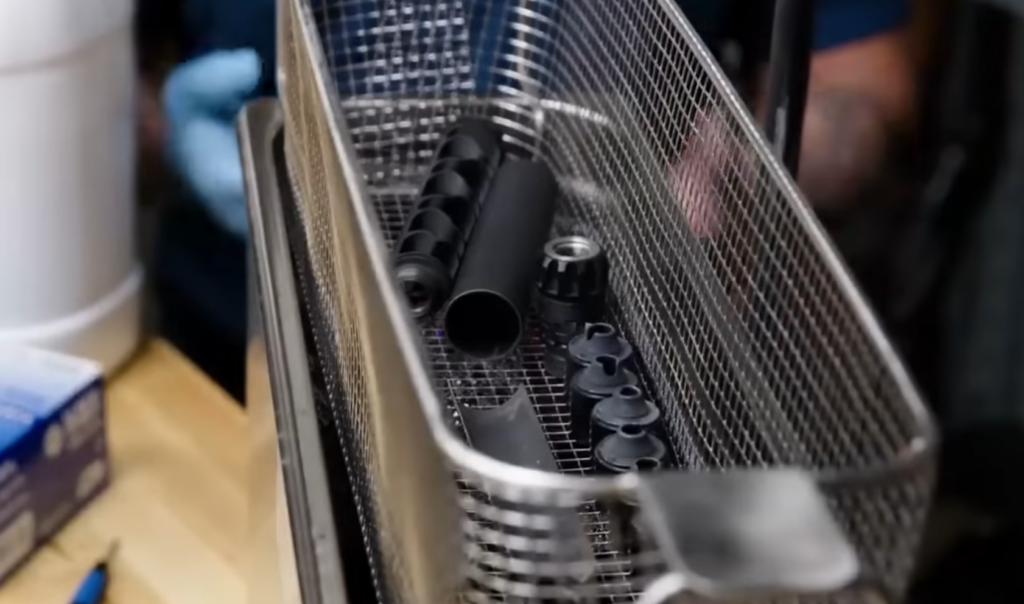
Ultrasonic cleaners also come with their own caveats as well; finishes like Duracoat, Cerakote, and Alumahyde II will all be damaged or completely stripped when run through an ultrasonic cleaner. Softer materials like aluminum can also develop microfractures that will degrade the structural integrity of your aluminum parts over time, and a decent machine of an appropriate size to clean an entire suppressor can cost anywhere from $120 to $250.
There’s still the proper disposal of the lead-laced ultrasonic cleaner solvent to worry about, but it’s much less dangerous than dealing with the Dip. You also have to be pretty careful about what solutions you put inside these machines for them to be fully effective.
Non-Toxic Solvents and Solutions
Professional-grade solutions are also available to us if you’re willing to put in a bit of your own elbow grease or soak your suppressor for a little while. Products like Breakthrough Clean Technologies Suppressor Cleaner and Bore Tech Decimator provide targeted chemical cleaning without the toxic results of the Dip.
Breakthrough Clean is a water-based, ammonia-free solution that dissolves heavy carbon and lead deposits while remaining safe for stainless steel, titanium, and aluminum. It typically retails for approximately $20 to $25 for a 16-oz bottle, or around $130 for a bulk one-gallon container.

Bore Tech Decimator offers a specialized binary chemical system to independently attack lead and copper fouling. Copper is a bit harder than lead, and these two chemical solutions do a great job when it comes to high-round-count cans. Bore Tech Decimator is generally priced around $30 to $40 for a 16-oz set of both solutions.
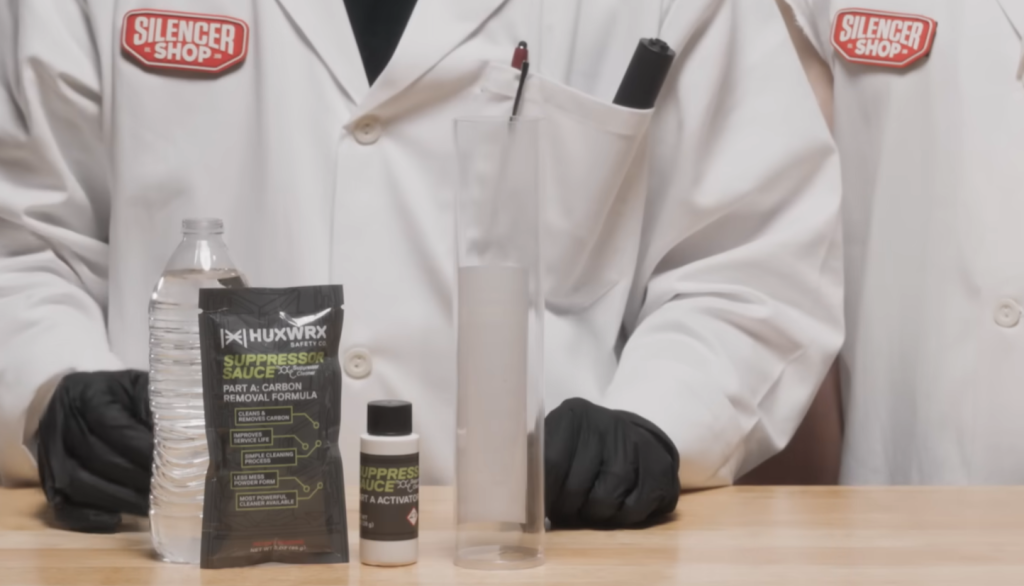
Low backpressure cans are also their own category of suppressor now, and highly popular. Naturally, that means that they have their own variety of cleaning agents like HUXWRX’s single-use powder-based Suppressor Sauce cleaning system, which costs about $65 for three “sets” of cleaning materials. This specific product claims to require no disassembly and is also non-toxic.
Finally, CAT 206, available on SilencerShop, is a premium synthetic safe acid (also called a “green acid”) designed for 3-to-12-hour submersion soaks to dissolve heavy carbon buildup in titanium and Inconel suppressors.
Priced at roughly $89.00 per quart, it is a specialized, single-use product that should never be used on other metals like aluminum or stainless steel due to its extremely aggressive nature – even more so than the dip. However, if you’re a high-round-count user of titanium or inconel cans, there isn’t quite anything else like CAT 206 currently on the market in terms of efficacy and overall health safety.
Read the full article here
