

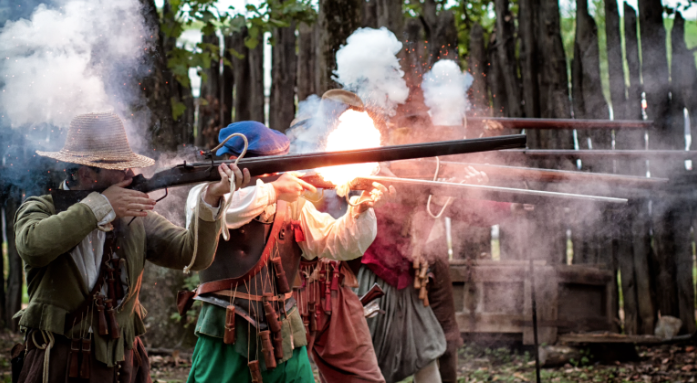

The story of the American Revolution is often simplified to April 19, 1775; Lexington and Concord, the “shot heard ’round the world,” and war between colonial militias and British regulars. But by the time musket fire echoed across Massachusetts, the conflict had been smoldering for years.
Long before independence was declared, the fight was already underway over a fundamental question: whether free people could remain armed.
Disarmament Came Before the Shooting
The British effort to control the colonies did not begin with battlefield engagements. It began with policies. By 1768, as resistance to taxation without representation, warrantless searches, and arbitrary rule grew, British officials identified armed colonists as a problem to be addressed.
Reports in Boston newspapers warned that the Crown intended to disarm the population, impose martial law, and arrest political leaders. Those rumors struck a nerve because they aligned with reality on the ground. British troops were moving into Boston, not as protectors, but as enforcers.
Colonial leaders responded quickly. Public meetings at Faneuil Hall invoked the English Declaration of Rights of 1689, which recognized the right of Protestants to have arms for their defense. Town resolutions reminded citizens that militia laws already required every able-bodied man to keep arms and ammunition.
A Standing Army Among the People
When British infantry landed in Boston in October 1768 and occupied key points throughout the city, resentment hardened into defiance. Troops were quartered among civilians. Armed sentries patrolled the streets. What colonists had long feared, a standing army used to intimidate the population, was now a reality.
British commanders quickly realized the scale of the problem. New England alone had tens of thousands of armed men, accustomed to firearms from childhood. Even exaggerated reports of colonial marksmanship underscored a critical point: these were not helpless subjects.
Rumors of impending gun confiscation circulated constantly. Whether true or not, they reflected a widespread belief that disarmament was a necessary step for the Crown to impose control. Daily friction between soldiers and civilians made that belief entirely plausible.
The Boston Massacre and Its Aftermath
Tensions exploded in March 1770 when British soldiers fired into a crowd, killing five civilians. The Boston Massacre became a rallying point for colonial resistance. While John Adams famously defended the soldiers in court, the proceedings reinforced a crucial principle: the people had a right to carry arms for personal defense.
That distinction mattered. Even as tempers cooled temporarily, distrust remained. Political writers and clergy openly warned that Americans would not submit to being disarmed, enslaved, or ruled by force.
The gun was no longer just a tool of survival; it was a symbol of liberty.
Arms, Powder, and the Road to Rebellion
By the early 1770s, colonists were arming themselves in earnest. When the Tea Party erupted in 1773, participants came prepared—not for violence, but for resistance. Contemporary accounts note that firearms and pistols were in short supply because they had already been purchased.
Parliament responded with the Intolerable Acts, closing Boston’s port, expanding military occupation, and replacing local governance with Crown appointees. Proposals to disarm the population surfaced again, narrowly avoided only because British officials understood the likely response: tens of thousands of armed citizens would mobilize immediately.
General Thomas Gage shifted tactics. Rather than attempt wholesale confiscation, British forces targeted gunpowder. Powder houses were seized. Arms shipments were intercepted. Export bans halted the flow of weapons and ammunition to the colonies. The intent was clear: reduce Americans’ ability to resist.
The reaction was immediate and fierce. Colonies urged citizens to stockpile powder and shot. Committees openly accused Britain of attempting to disarm the population in preparation for tyranny. Searches and seizures of private arms only accelerated militia organization and training.
Britain Understood the Risk
British leadership was not blind to the danger. Officials debated disarmament but repeatedly acknowledged the reality: it would require overwhelming force and control of the countryside. Without that, confiscation would spark open rebellion.
Military officers reported that colonists were acquiring arms at every opportunity and quietly moving them out of cities. Even individual components—like musket locks—were being smuggled to evade searches. The groundwork for resistance was nearly complete.
Gage himself predicted the nature of the coming conflict: decentralized, irregular warfare carried out by skilled marksmen operating independently. He knew that once fighting began, it would not resemble traditional European warfare.
Lexington, Concord, and the Inevitable Outcome
By April 1775, the situation was irreversible. British attempts to seize arms and powder at Lexington and Concord triggered the armed response they had long feared. Militia companies mobilized, not as rioters or criminals, but as citizens defending what they believed were their lawful rights.
The Revolution did not begin because Americans suddenly decided to fight. It began because sustained efforts to disarm them made conflict unavoidable.
Why This History Matters
Gun confiscation was not a side issue of the American Revolution. It was a catalyst.
Repeated attempts to seize arms, restrict ammunition, and intimidate an armed population convinced the colonies that liberty could not survive without the means to defend it.
That lesson was not lost on the Founders. The right to keep and bear arms was not created in a vacuum—it was preserved precisely because history had shown what happens when governments seek to disarm their people.
As America approaches its 250th anniversary, this history deserves careful reflection. The Second Amendment was not written out of paranoia. It was written from experience.
Read the full article here
