

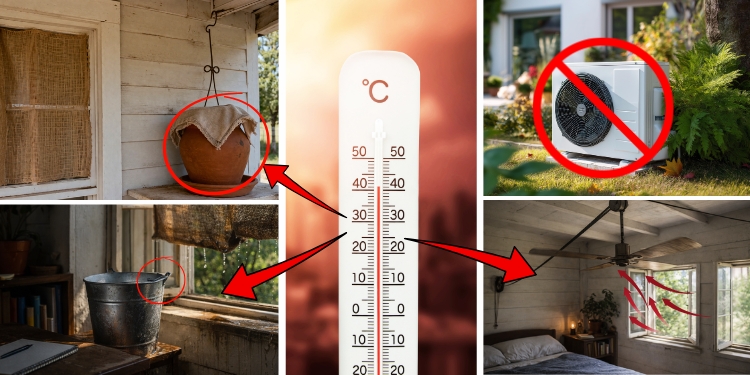

Three summers ago, a heat dome parked itself over my county for eleven days straight. Temperatures hit 104°F by noon and barely dropped below 85 at night. On day three, the grid buckled. No AC and no fans. Just dead, heavy air sitting inside the house like a wool blanket soaked in hot water.
My wife looked at me. I looked at her. And I realized that for all the beans and rice stacked in the basement, for all the solar panels on the roof and the water barrels in the garage, I had done almost nothing to prepare for heat.
That was a hard lesson to learn the easy way. But I spent those eleven days doing things I should have already known by heart. Things my grandfather would have laughed at me for not knowing.
Here’s what I learned, what I dug into afterward, and what I now have ready before the next one hits.
9. Cross-Ventilation and the Stack Effect
 Hot air rises and your house is a perfect trap for it if you let it be.
Every farmhouse built before 1950 was designed around this, but modern constructions ignores it almost completely.
The stack effect works like this: cooler, denser air sinks while warm air rises and pushes out through any opening it can find at the top.
You can either let that happen randomly or you can control it deliberately.
Here’s how to use it:
- Open windows low on the shaded side of your house – north or east side in the morning.
- Open windows or vents high on the opposite, warmer side.
- Keep interior doors open so air can move through the whole house, not just one room.
- At night, reverse the priority – open everything wide and pull the cooler night air through.
- Close everything up before the morning sun starts hitting the walls again.
That last part is what most people skip. You’re charging the house with cool air overnight and then sealing it in like a thermos before the day heats up. Done right, this can hold interior temperatures 10 to 15 degrees below outside air during the worst part of the afternoon.
8. Wet Cloth
Before refrigerants existed, evaporation did the same job. When water evaporates, it pulls heat from whatever surface it’s leaving. That’s why sweating works and it’s also why a wet cloth hung in a window actually does something measurable, not just psychological.
Air passing through wet cloth loses temperature on the other side as moisture evaporates out of the fabric. This is the exact principle behind swamp coolers, which were standard in dry-climate homes decades before central air became normal.
How to Make Your Own Wind Turbine (No Experience Needed!)
The one word that matters here is dry. Low humidity environments, such as the Southwest, high desert, inland areas, this works well. In Florida in August, wet cloth in a window adds misery. Know your climate before you count on this.
To do this, you should follow these steps:
- Hang wet sheets or burlap over open windows on the side the wind is coming from.
- Keep a bucket of water nearby and re-wet them every hour or two as they dry out.
- For personal cooling, wet a bandana and wrap it around your neck – the carotid arteries run close to the surface there and cooling the blood moving to your brain works faster than cooling your arms or legs.
7. Strategic Shading
 A single-pane window in direct sunlight lets in roughly the same heat as a small space heater running full blast.
Four or five sun-facing windows and your house is fighting itself – the walls trying to stay cool while the windows import heat as fast as they can.
Anyhow, external shading is far more effective than curtains or blinds on the inside. By the time sunlight gets through the glass, part of it has already converted to heat inside the room. An exterior awning, a porch roof, shade cloth, a well-placed tree – these stop the radiation before it enters.
Old farmhouses had deep roof overhangs for this reason. A 2-foot overhang on a south-facing wall blocks most of the high-angle summer sun while still letting lower-angle winter sun warm the house. People figured that out long before anyone named it passive solar design.
For immediate application, I recommend you these items:
- Exterior shade cloth over south and west-facing windows – these take the worst afternoon sun.
- Bamboo roll-up shades mounted outside the glass.
- Cardboard covered in aluminum foil, reflective side out, placed in windows from inside. Crude, but it works.
- Any exterior barrier that reflects radiation before it converts to heat inside the room beats anything you do after the heat is already in.
6. The Refrigerator With No Moving Parts
 Two clay pots, one inside the other, wet sand packed between them, a wet cloth over the top, set in a shaded and breezy spot.
That’s the zeer pot or the pot-in-pot refrigerator. As water evaporates through the porous outer pot, it pulls heat out of the inner chamber.
A Nigerian teacher developed the modern version of this in the late 1990s.
In dry conditions he kept tomatoes fresh for 27 days against 2 days in open air, which changed the entire game on food storage without power.
The Zeer pot can be used for many things, but some that work best are:
- Keeping vegetables, fruit, and cooked food from spoiling in dry heat.
- Storing medications that degrade in high temperatures.
- Cooling water for drinking.
- Keeping seeds viable during hot storage periods.
The materials cost close to nothing. Unglazed clay pots, sand, water, cloth. You can build one in an afternoon. Same limitation as evaporative cooling – humidity kills the effect. In dry climates, this thing earns its place in any serious setup.
5. Thermal Mass
Thick-walled homes (adobes) stayed cool in the American Southwest for centuries before electricity arrived. The walls were doing all the work.
Thermal mass is a material’s ability to absorb and store heat slowly. Stone, brick, adobe, concrete, rammed earth – all of these soak up heat during the day and release it at night.
The USA Gives Away Free Land. See the MAP Here!
The interior temperature lags behind the exterior by hours. A well-built adobe home can sit at 75°F inside while outside hits 100°F, and it gets there through mass, not insulation.
You probably can’t rebuild your walls. But you can still use the principle:
- Stone floors, brick interior walls, and ceramic tile all add thermal mass to existing spaces.
- Large water containers placed inside rooms act as heat sinks – water has one of the highest heat capacities of any common material.
- A 55-gallon drum of water absorbs a significant amount of heat before the room temperature around it rises noticeably.
- Shade your high-mass surfaces during the day so they don’t load up with heat – then let them radiate that coolness overnight.
The move is keeping the mass cool so it works for you and not against you.
4. Earth-Sheltered Spaces
Six feet underground, the temperature barely moves year-round. Across most of the continental U.S. that number sits somewhere between 50°F and 60°F regardless of what’s happening on the surface above it.
Every farm with a root cellar before the 20th century was using this for food. Most folks never think about using it for themselves during a heat emergency.
If you have a basement, you already have a version of this. A basement holding at 65°F while the upstairs climbs to 95°F is a survival room, not just a storage space. Sleeping down there during a heat event is the obvious move, and it costs nothing.
For those building or modifying structures, earth-sheltered construction takes this further. Soil banked against the north, east, and west walls uses the ground as a thermal buffer. The earth absorbs heat slowly and gives it back the same way. The interior stops tracking surface temperature swings.
If you don’t have a basement, consider building a small root cellar. Even a mini version tucked into your backyard taps is a life-saving idea; this way, your produce stays cool without electricity, and you get a space that holds steady around 55°F when it’s 110°F above.

It’s also a surprisingly satisfying build project, and once it’s done you’ve basically added a cool room you can step into when July in Phoenix, the Central Valley, Las Vegas, or anywhere across the country turns brutal. This amazing DIY cellar walks you through the whole build step by step if you want a clear blueprint to follow.
3. Night Radiative Cooling
On a clear night, surfaces lose heat by radiating it upward toward the sky. This is why frost forms on grass when air temperatures are still above freezing – the grass radiates heat away faster than the surrounding air replaces it.
In parts of ancient India, people left shallow pools of water in open courtyards overnight. By morning, a thin layer of ice had formed on the surface – in climates where daytime temperatures never dropped below freezing. They harvested it and stored it in insulated underground chambers for summer use.
Why Are the Amish Painting Their Barns Red?
A practical version of this works right now:
- Set water containers outside on clear nights – they will cool significantly by morning
- Bring them inside before the sun hits them and they act as thermal sinks, absorbing room heat before slowly warming back up
- Wet a flat or low-slope roof at night – the surface drops in temperature, the ceiling below drops, the room below the ceiling drops
- Clear nights work far better than overcast ones – clouds reflect radiated heat back down
2. Behavioral Cooling
 Before air conditioning made indoor comfort a given at all hours, people organized their entire lives around heat. They cooked in the early morning or outside entirely.
Heavy work happened before 10am and after 4pm. Rest during peak heat was a survival habit, not laziness. Siesta culture in hot-climate countries exists because working midday heat genuinely kills people.
They also dressed differently – loose, light-colored, breathable fabrics and full coverage.
This may sound backward, until you understand that fabric against skin wicks sweat and creates evaporative cooling across a larger surface area than bare skin sitting in direct sun. A loose linen shirt in desert heat outperforms no shirt. Bedouin people figured that out a long time ago.
Sleep was handled with damp sheets, elevated sleeping surfaces that allowed airflow underneath, and outdoor sleeping when conditions allowed. A screened sleeping porch was a standard feature of Southern homes before AC arrived. People slept outside and they slept better for it.
1. The Amish Ceiling Fan
You most probably grew up with a ceiling fan during the summer, or you still have one attached in the bedroom that you haven’t used in a while. But did you know there’s another version of it that works without even a watt of electricity?
It’s just a fan blade on the ceiling connected by a belt to a small wind turbine on the roof. Wind spins the turbine, the belt transfers that spin to the fan, and you get airflow inside without ever touching the grid. Some people use a hand crank or a water wheel instead of wind, depending on what they have available.
The Amish didn’t come up with this – factories and plantation homes were running belt-driven fans back in the 1800s. The Amish just never stopped because they never switched to electric in the first place.
These move real air too, not just a light breeze you can barely feel. Paired with open windows and a wet sheet they can make the room cool down fast. Hot days usually come with at least some wind, so it tends to work right when you need it.
If you want to see one get built from scratch, this video shows you how:

Old-School Keeps Your Home Cool
Heat kills faster than almost any other environmental threat, even faster than cold in many situations, because hypothermia gives you time to react and hyperthermia does not. And unlike cold, you cannot just add layers. You have to move heat out of your environment, and that requires understanding how heat actually moves.
Every method on this list works through the same basic physics – convection, evaporation, conduction, or radiation. All of them require either preparation, knowledge, or both.
Your stockpile is only as useful as the people operating it. A wet sheet, a cross breeze, and a hole in the ground will outperform a generator you can’t fuel. Keep yourself cool enough to think straight when SHTF (and even this summer).
Are you already using any of these? What did we miss? Drop it in the comments below.
 You may also like:
10 Ways to Light Your Home Without Electricity
The Complete DIY Medical Kit from The Dollar Store (VIDEO)
How To Cool Your Home When The Power Goes Out
19 Survival Skills to Teach your Children This Summer
Read the full article here
