

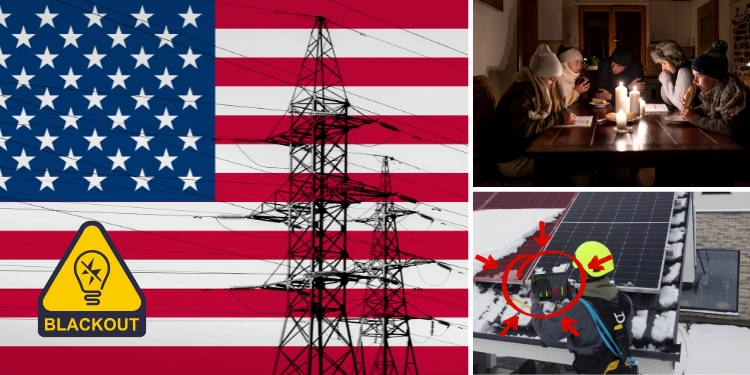

Just days ago, a historic blizzard hammered the Northeastern U.S., dumping up to three feet of snow across major population centers and knocking out power for hundreds of thousands of people. Cities from Massachusetts to New Jersey saw utility lines collapse under heavy snow and hurricane-force winds.
At the peak, more than half a million customers were left without electricity, and restoration crews warned that some households could remain in the dark for several days as temperatures stayed dangerously low.
That event was a powerful reminder of how quickly daily life shifts when electricity disappears. Most people assume outages are temporary and localized, but what if the lights never came back on across the country?
Federal assessments warn that a full-scale, long-lasting nationwide blackout would be unlike anything American folks have experienced in recent memory. Grocery supply lines, water systems, fuel supplies, medical infrastructure, and communications all hinge on steady power.
Once those systems collapse, society would be pushed into survival mode and the majority of households are nowhere near ready.
Notable Blackouts in U.S. History
Before we explore the nightmare scenario that officials fear most, it helps to look at how past outages unfolded. These events were serious, and some lasted days, yet none approached the nationwide, months-long blackout that many experts say would be catastrophic:
- Northeast Blackout of 1965 – A power failure hit parts of the Northeast and Canada, leaving millions without power for up to 13 hours. The event was traced to a cascade of failures that overwhelmed protective systems in the grid.
- Northeast Blackout of 2003 – One of the most disruptive outages in U.S. history, this event affected about 50 million people across the Northeast and Midwest. Some areas were dark for up to two days.
- 2008 Ice Storm Outages – A severe ice storm in the Northeast left as many as 1.7 million people without power. Weeks passed in some regions before all service was restored.
- Manhattan Blackout of 2019 – A transformer failure caused an outage on the West Side of New York City, leaving tens of thousands of people without power for several hours.
- Recent 2026 Blizzard Outages – The storm this week knocked out power to hundreds of thousands across multiple states, with crews warning of multi-day restoration timelines.
These episodes show how fragile the system can be when weather or equipment issues strike. Yet even the worst of these were regional and temporary. The blackout scenario officials worry about would be far more severe.
Where the U.S. Power Grid Is Most Vulnerable
The U.S. power grid looks vast, yet it depends on a surprisingly small number of critical components. High-voltage transformers connect major generating stations to long-distance transmission lines.
These transformers weigh hundreds of tons and are custom-built for specific locations. The fact is, there are only a few thousand of these units nationwide and many are decades old. A significant portion are manufactured overseas, and production times can stretch from 12 to 24 months under normal conditions.
Stop Throwing This Away! It Could Save Your Life During a Blackout
If dozens were destroyed or permanently damaged at once, replacing them would not be simple. Transporting them requires specialized railcars or heavy-haul trucks, but also stable weather conditions.
Grid planners have acknowledged that certain substations act as choke points. Losing a small number of these key nodes could trigger cascading failures across entire regions. When the system falls out of balance, power plants automatically disconnect to protect themselves, which spreads the outage even further.
The EMP Scenario Congress Quietly Studied
 We said this before and we will keep saying until you are absolutely prepared: the EMP is the worst thing that could happen to America and the world.
If it happens, it can change our world to the core and we can’t even begging to imagine what it could mean for humanity as a whole.
And the EMP Commission knows this. An EMP can be triggered by a nuclear device detonated high above the atmosphere. It does not destroy buildings with blast waves. It sends out a massive pulse of energy that fries electronics across a wide area.
A single high-altitude detonation over the central United States could damage power systems from coast to coast. The pulse would overload transformers, destroy control systems, and cripple anything connected to long transmission lines.
The Commission found that large transformers are especially vulnerable. These units weigh hundreds of tons and are custom-built. Many are produced overseas, and replacement times can stretch beyond a year under normal conditions. If dozens were destroyed at once, there would be no quick recovery.
The report warned that water systems, food distribution, banking, fuel pipelines, and emergency services all depend on electricity. Once the grid fails nationwide, those systems begin to collapse in a chain reaction.
The 90 percent mortality estimate came from looking at how long society could function without electricity and how many people rely on daily deliveries of food and medicine. That’s why experts have created a step-by-step survival playbook for an EMP attack, outlining exactly what to do before, during, and after the event.
You can find the full life-saving protocol here.
A Solar Storm Could Do the Same Thing
An EMP is not the only threat. The sun has already shown what it can do.
In 1859, a massive solar storm known as the Carrington Event struck Earth. Telegraph systems sparked, caught fire, and failed across continents. At that time, the grid did not exist, and society was not wired together the way it is today.
In 1989, a smaller solar storm hit Quebec and knocked out power for six million people within minutes. The blackout lasted nine hours, and that was from an event far weaker than the Carrington storm.
In 2013, Lloyd’s of London released a report estimating that a severe solar storm hitting the United States today could leave tens of millions without power for months. Economic losses were projected in the trillions. Some regions could face outages lasting one to two years due to transformer damage.
3 Things You Need to Protect Before an Electromagnetic Pulse (#1 Will Surprise You!)
Solar storms create geomagnetic currents that overload high-voltage transformers. These transformers form the backbone of long-distance transmission. When they burn out, entire regions go dark.
Even though NASA and federal agencies track solar activity constantly, there is no guaranteed shield against a direct hit from an extreme storm. If a Carrington-level event struck today, recovery would depend on how many transformers survive and how quickly replacements can be produced.
These scenarios are closer than most people think, because the grid was never built to withstand that kind of strain.
 In April 2013, attackers opened fire on the Metcalf transmission substation in California. They damaged 17 large transformers and caused significant disruption. The attack required knowledge of the facility and careful planning.
Officials later admitted that if more substations had been hit at the same time, the consequences could have been severe. The grid relies on key nodes. Removing several at once could destabilize large sections of the country.
Security around substations has improved in some areas, yet thousands remain lightly protected. Many sit in remote locations with minimal barriers. A coordinated assault on multiple high-value targets could create cascading failures.
The North American Electric Reliability Corporation has warned about this risk for years. Grid planners understand that certain transformers are so critical that losing them would cause prolonged regional blackouts. Repairing those units takes time, heavy equipment, and specialized crews. During a national crisis, those resources would be stretched thin.
Cyber Warfare Is No Longer Theory
In 2021, the Colonial Pipeline was shut down after a ransomware attack. Fuel shortages spread across several states within days. Long lines formed at gas stations. and panic buying began almost immediately.That incident targeted a private pipeline, not the power grid itself. Even so, it showed how quickly fear spreads when energy supply is threatened.
Officials have repeatedly confirmed that foreign hackers have probed U.S. infrastructure. In recent years, reports surfaced that adversaries had gained access to control systems within utilities. The goal in some cases appeared to be pre-positioning malware for future use.
This #1 Generator Mistake Can Kill You in 5 Minutes. The Only Way to Prevent It…
What does this mean for the grid? A coordinated cyberattack on multiple utilities could shut down generation plants, open breakers, and disable monitoring systems. If attackers also corrupted backup systems, restoration would become far more complex.
This is a dangerous threat because modern substations rely on digital controls. Many were built before cybersecurity was a serious concern. Updating every facility across the country is an enormous task, and progress moves slowly.
The Real Danger Begins After Day Three
 In the event of a powerful solar storm or an EMP attack, the grid could suffer damage so severe that power would not return for months.
The first day would feel confusing. The second day would feel tense. By the 72-hour mark, the situation would begin to unravel.
After three days without electricity:
-
Grocery stores are stripped bare as panic buying collides with collapsed supply chains.
-
Refrigerated warehouses fail, and food spoilage accelerates nationwide.
-
Fuel pumps stop working, halting trucking, emergency transport, and resupply efforts.
-
Water systems begin shutting down as generator fuel runs out.
-
Wastewater treatment plants fail, creating immediate sanitation risks in cities.
-
Hospitals face critical shortages of generator fuel, putting vulnerable patients in danger.
-
Pharmacies cannot replace essential medications, including insulin and antibiotics.
-
Cell towers go dark, and communication networks weaken or disappear.
-
Police and emergency services are stretched beyond capacity as panic and disorder rise.
The first 72 hours mark the tipping point. After that, the crisis shifts from inconvenience to survival.
What’s the Government’s Plan?
The federal government has continuity plans designed to protect itself. For example, bunkers, secure facilities, backup generators, and protected communications ensure leadership and defense operations continue without interruption.
But those plans are built to preserve command and control, not your refrigerator, your local grocery store, or the pharmacy down the street. They are not designed to restore power to your neighborhood in a matter of days.
 Strategic military systems have received electromagnetic hardening for decades. Civilian infrastructure has not been given the same priority. Most of the national grid remains exposed and vulnerable to large-scale disruption.
Grid protection has been debated in Washington for years, yet funding stalls and long-term safeguards are delayed with each election cycle. Nationwide installation of protective systems has never fully materialized.
In a prolonged blackout, leadership would operate from secure sites while ordinary communities face empty shelves, fuel shortages, and failing supply chains. The distance between what the government can shield and what your household can survive is wider than you realize.
Why You Might Be Caught Off Guard
In a prolonged nationwide blackout triggered by a solar storm or EMP attack, survival would depend entirely on preparation and self-sufficiency. The reality is that most people rely completely on systems that function only when electricity flows.
When those systems collapse, so does their ability to meet basic needs:
- Most U.S. households have only a few days of supplies. Surveys repeatedly show that many families lack even a week’s worth of food and water.
- Cities depend on powered infrastructure. High-rise buildings require electric pumps for water, elevators for access, and climate control for safe living conditions. If you live in the city, you need to read the Urban Survival Code – this knowledge could save your life during a total blackout!
- Medical dependence is widespread. Millions rely on powered medical devices, refrigerated medications, and routine hospital care that can disappear fast during a prolonged outage. You may feel prepared, but without these 10 critical medicines in your stockpile, your situation could turn serious very quickly.
- Food production and distribution are centralized. Without fuel, refrigeration, and digital coordination, restocking stops nationwide.
- Water access disappears fast. Municipal systems cannot operate long without power or diesel for backup generators. Specialists recommend you have backup devices, such as the Smart Water Box or the Water Freedom System.
- Social stability weakens under scarcity. History shows that even short-term shortages trigger unrest, looting, and violence in some areas. For example, these Great Depression stories are the cautionary tales you need to learn from before it’s too late.
 If a nationwide blackout ever stretches beyond a few days, preparation alone will not be enough. You can store food, learn skills, and reinforce your home, yet without a steady source of electricity your daily life becomes a constant struggle.
The only real way to step outside that vulnerability is to stop depending entirely on the grid and create your own power.
That is the idea behind The Ultimate OFF-GRID Generator.
Instead of trusting aging transformers, fragile substations, or political promises about infrastructure upgrades, this blueprint shows you how to build a compact generator using affordable components that are widely available.
For about what many families spend on a single monthly electric bill, you can assemble a system designed to produce unlimited power without relying on utility companies.
And in a prolonged blackout? That shift changes your position completely.
You are no longer relying on the grid, because you have taken a practical step toward energy independence. If you understand how serious a months-long grid failure would be, then it makes sense to prepare for it in a way that addresses the root problem.
Learn how to reduce your dependence on centralized power and see what The Ultimate OFF-GRID Generator can offer (while it is still available).
Final Thoughts
Read the full article here
