

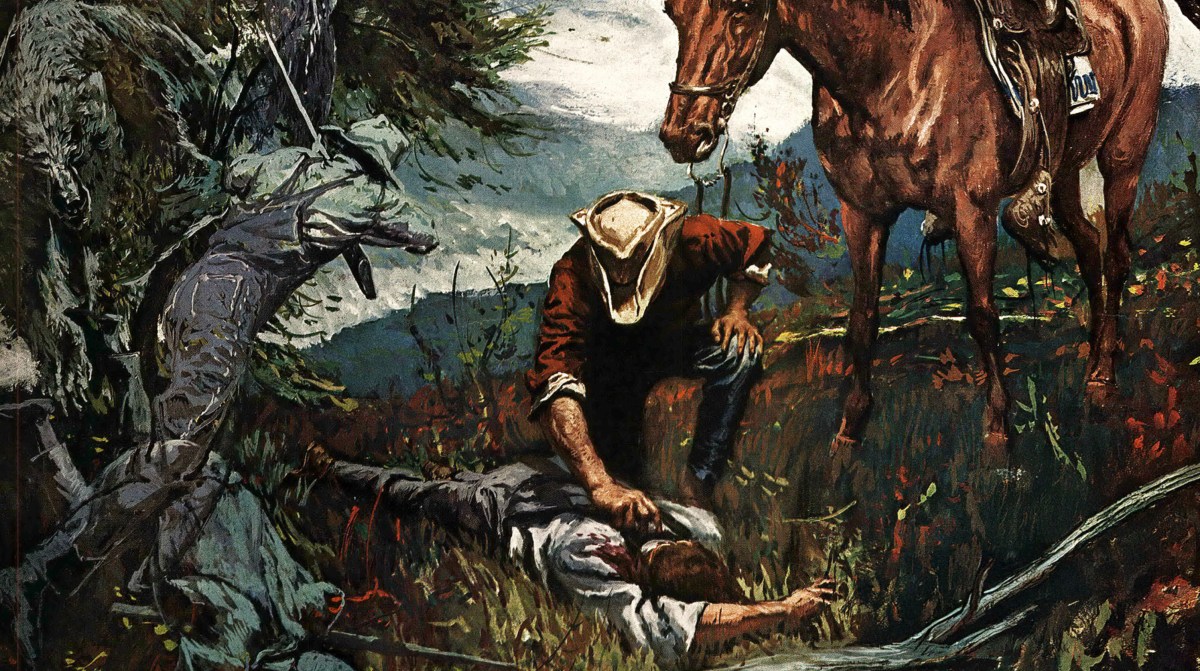

This story, “Dark Tragedy,” appeared in the February 1963 issue of Outdoor Life.
Henry Heydweiller, a rancher living near me on the North Fork of the Dearborn River south of Augusta, Montana, spent the last Saturday in September of 1947 in the hills above his ranch hunting a sheep-killing bear. For Josif Chincisian, a wiry little Rumanian [sic] who had herded sheep for my family for 24 years, that apparently was a lucky circumstance, though in the end it didn’t make much difference to him.
I run 500 head of cattle and about 1,000 sheep on 6,400 acres lying against the foot of the Rockies on the eastern slope, a ranch my father took up in 1877. The Heydweiller place is just south of ours. At the time, I had 2,000 sheep, grazing on high land above the ranch, being cared for by Chincisian. He was 65 years old but still tough as rawhide.
Heydweiller had come to this country from Germany as a young man and a trained engineer. He had worked for a time in a Chicago hotel, had moved on to a railroad survey job in Canada, and finally settled on the Montana ranch. He and the little Rumanian were good friends. Henry had a smaller herd of sheep on his own place, and when a bear started giving Chincisian a bad time that fall he undertook to help get rid of it, both as a neighborly gesture and to protect his own stock.
Trouble with bears, both blacks and grizzlies, was nothing new to my herder. He had fought an implacable war with them all the years he had tended sheep, and had accounted for his share. But this time, for reasons of his own that I didn’t quite understand, things were a little different.
When the bear first began his raids, we moved the sheep down from the mountains to a safer location closer to the ranch. But a couple of nights later the marauder found them again. Hearing the disturbance, Josif took his flashlight and rifle, a battered old .30/40 Krag that had seen much service, and went out to investigate. He saw something black moving among the white sheep, touched off a shot, and killed his own dog, one of the best he’d ever had. That was a hard piece of luck, but it was only the beginning.
Chincisian was a sober, industrious herder, not the kind that works for six months and then blows his wages on one big binge. He had saved his money and acquired a farm in Minnesota, though he continued working for me. A week after he shot the dog, I had to take word up to him at the sheep camp that lightning had burned the barn on the Minnesota farm.
He acted sorry, but not as if it mattered a great deal. He had felt very bad about the dog, but the barn didn’t bother him as much as I expected. And if somebody had told him what was going to happen next I doubt if it would have surprised him. I believe now that he was convinced he was fated to die within a short time, even though he was in excellent health. For a year he had been giving substantial gifts of money and other things to friends, and each time I remonstrated he had smiled quietly and said, “That’s all right. I won’t need it.”
The bear struck again, and we moved the sheep once more, this time to a pasture still farther out of the hills. Heydweiller and Chincisian trapped a black bear nearby and loaded it in the back of Henry’s pickup. He drove to my place to show it to me, but none of us believed it was the bear we were after.
A few days after that, on the morning of Saturday, September 27, Henry climbed on a horse, rode into the hills, and spent the rest of the day looking for sign of the sheep killer.
Riding back to the ranch about 5 o’clock in the afternoon, he saw a man sprawled face down in the grass at the head of a small timbered coulee half a mile from his house. It was Chincisian, lying half conscious on the ground, torn and bloody from a severe bear mauling.
Though the herder had only a few wounds, he was not a pretty sight. The bear had torn away most of his scalp and one ear, and they hung now in a dried, bloody flap over his face. He also had a deep cut at the corner of one eye. His body and legs were untouched, and there were no claw marks on his arms. High on the right arm near the shoulder, however, were four deep tooth punctures, as if the bear had picked him up to drag him. We learned the next day that that was exactly what had happened.
Those four tooth marks and his head wounds were all the hurts he had suffered, but they were enough. When Heydweiller bent over the herder, he saw that a piece of skull about the size of a silver dollar had been smashed out and torn away. He was looking at exposed brain.
Josif seemed to recognize his friend and began to babble incoherently. How he had reached the place where he was found, a full mile from his sheep wagon, we still can only conjecture.
Heydweiller raced for the house, turned his horse into the corral, and drove back in his pickup. A slight man with a bad leg and hand from an earlier accident with a horse, he was unable to lift the half-conscious herder into the bed of the truck. But he got Josif up with his elbows propped on the tail gate, urged him to help, and managed to boost him in. Then he came hell-for-leather to our place.
It was suppertime, and we were all at the house. One of my men saw Henry drive up with something lying in the back of the pickup and called to me that Heydweiller had caught another bear. The bear turned out to be the injured herder.
His torn scalp was too stiffened to be put back in place, but we laid damp bandages on his head, transferred him to the back seat of a car, and made him as comfortable as we could.
It was clear he was in terrible pain. He kept moaning softly and running a hand over his bare, bloody skull. When we were ready for the trip to Deaconess Hospital in Great Falls, 65 miles away, with a man to hold him on the seat, I said to him, “Say your prayers, Joe. We’re going to take you to the doctor.” He made no reply, but he did lie back and fold his arms as if the pain had been eased. He was out cold when we reached the hospital.
On Tuesday, October 7, despite brain surgery, oxygen, and everything the doctors could do, Joe died without ever regaining consciousness or speaking a word.
The next act in the drama sounds almost too far-fetched to believe, but I’ll take oath it happened. I won’t try to explain it. I’ll simply tell it as it occurred.
Before I started to the hospital with Josif, I instructed my ranch hands to get up to the sheep pasture before dark and move the herd down to a corral and open shed a mile farther out of the mountains where I had a small shack for shelter. I also sent a man to Augusta to get Theodore Olsen, an experienced herder, to go up and take charge of the animals. But I left flat orders that Olsen was not to open the door of the shack or step outside during the night, no matter what happened or what noises he heard.
It didn’t take the bear long to find the sheep in their new location. He came in around midnight, climbed a four-foot board fence to get into the corral, and killed a ewe, making a sloppy job of it. Olsen heard the commotion but obeyed orders and sat tight inside the shack.
The bear carried the sheep back over the fence, dragged the carcass around the corral within a few yards of the shack (we found the bloody trail the next morning), took it into a grove of quaking aspen behind the shed, put it down at the base of a tree, covered it with a few leaves, and left it there. Next, he made himself a bed against one corner of the shed, 30 feet away, and lay down as if waiting for something. He left sometime before daybreak without touching the sheep.
Bruce Neal, a now-retired Montana state game warden who had been a government trapper and had lived in the mountains and dealt with bears for almost 50 years, and who investigated the whole affair carefully, is convinced to this day that the bear was aware of Olsen in the cabin and dragged the sheep past in a deliberate attempt to bait him out. We were sure by that time we were dealing with a grizzly. He had attacked a man successfully the night before and he had a chip on his shoulder, Neal believes, and when he got scent of the herder he set up an ambush near the sheep carcass in the hope the man would take the dare.
I realize this is giving the bear credit for a great deal of devilish cunning, and I don’t pretend to know whether he set the trap intentionally, but Neal believes firmly that that was the case. At any rate, for one reason or another, he did lie in wait near his kill for hours, as the signs showed, and left without feeding.
We went up to Josif’s camp right after breakfast the next morning to try to piece together the details of what had happened there. It wasn’t difficult.
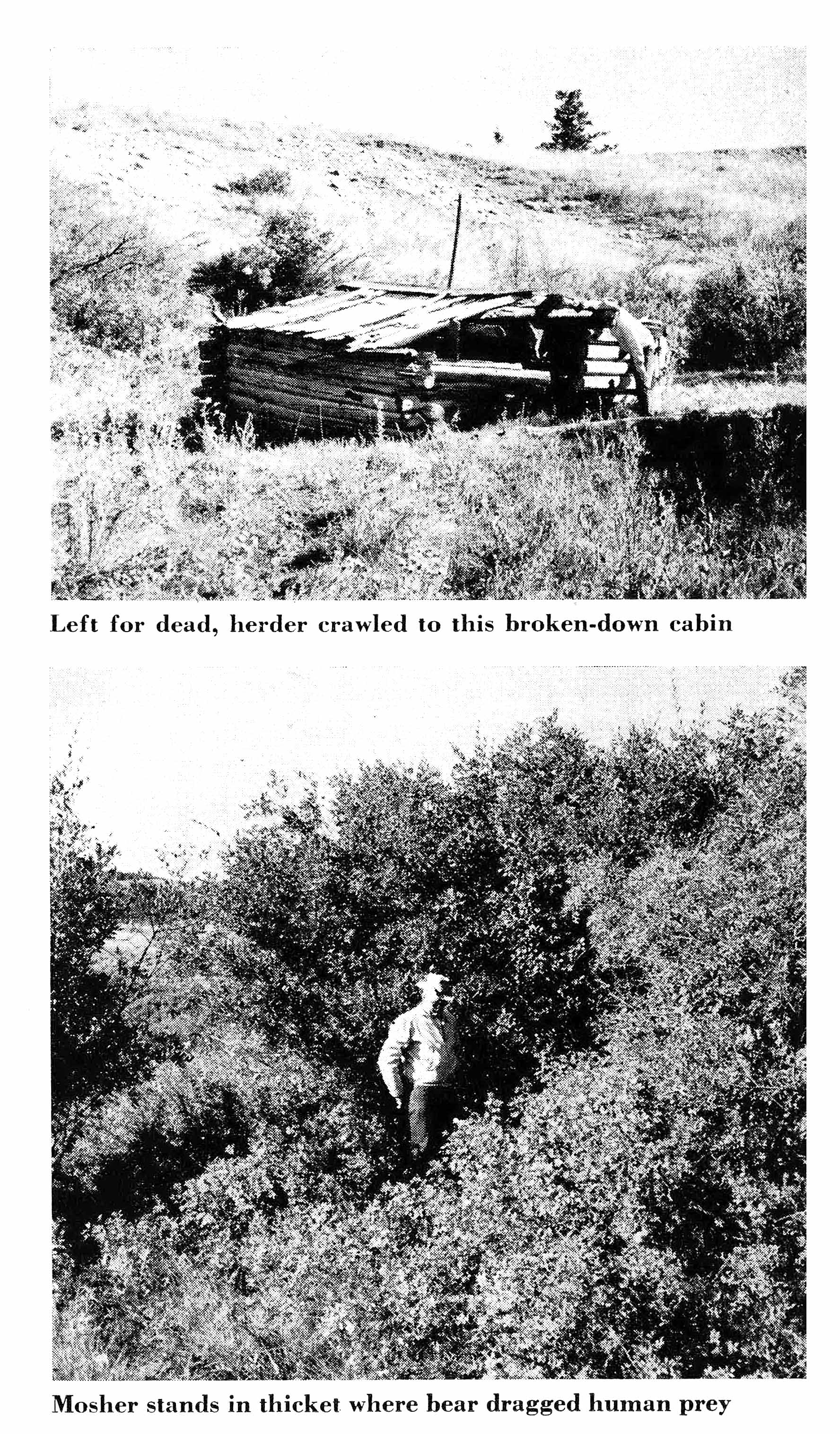
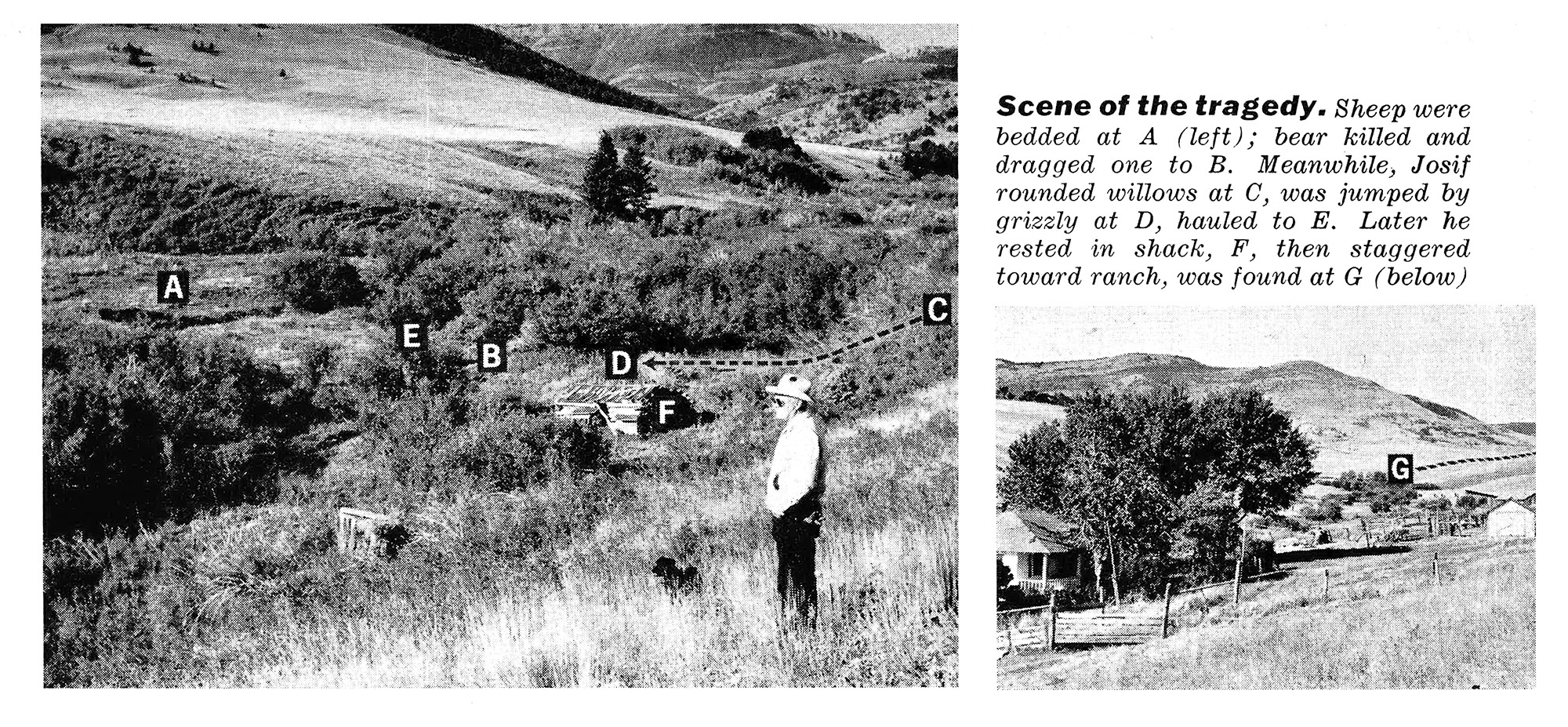
The sheep wagon was parked on a long, grassy ridge, with a small coulee on one side and Cunniff Creek on the other. The creek wound down from the hills through level, grassy bottoms grown up with dense thickets of willow 10 to 15 feet high. At the foot of the ridge below Chincisian’s campsite, a homesteader’s tumble-down, one-room log cabin was still standing.
The sheep had bedded down on Friday night on an open flat across the creek from the herder’s wagon. The bear had made his raid sometime during the night; we can never be sure just when. We found two sheep he had killed, one a little distance up the creek, the second directly below Josif’s camp.
Chincisian had heard the commotion and gone after the bear with a flashlight, his herder’s cane, and his rifle. I had taken a couple of dogs from the ranch to replace the one he had lost, but he had left them in the wagon as he usually did when there was a bear to be killed.
Walking out to look for a sheep-killing grizzly in the black of night in that fashion is a spooky business, but Josif had no fear of bears, and I’m sure it didn’t faze him. We found his tracks where he had run down off the ridge, following a trail to the bottom.
The bear had killed on the far side of the creek, carried the sheep across, closer to the wagon, and laid it on a gravel bar. He was feeding on it the way a grizzly does, tearing, and chomping, and slurping, about as fastidious as a hog, when Josif rounded a willow clump and walked into him at 20 feet. The bear must have come roaring for the man like forked lightning.
He was feeding on it the way a grizzly does, tearing, and chomping, and slurping, about as fastidious as a hog, when Josif rounded a willow clump and walked into him. The bear must have come roaring for the man like forked lightning.
Josif had fired one shot from the Krag and missed. We found where the bullet had plowed into the gravel, apparently high and a little to the left of the target. There was no bear blood and no other evidence of a hit, and that shot was all the herder had time The bolt of the Krag was open and ejected shell Jay nearby. He had left to attempt the trek down to the Heydweiller place, 1 1/2 miles away, nor will we ever know the details of that terrible journey. My own theory is that he stayed in the wagon until sometime around midday, hoping help might come, and was finally goaded by pain and desperation into making a try for the ranch.
He had covered a mile when he fell at the head of the coulee where Henry found him. How did he make that mile? Did he stagger or crawl? No one can say, but I believe he managed to stay on his feet most of the way, staggering and falling, getting up and tottering on, for his pants legs were not torn and dirty as they would have been had he crawled.
The agony of that slow, awful trip can only be guessed at, for Josif did not speak a coherent word after he was found. It is easy to imagine him, however, weak from loss of blood, half conscious and in blinding· pain, with the dried flap of scalp hanging down over his eyes, forcing himself along, yard by yard, foot after foot. He had two fences to cross, one of woven wire, the other four strands of barbed wire.
We’ll never know how he got over them. There are questions about his ordeal that I’d still give a great deal to have answered. How long did he lie unconscious in the thicket where the bear left him? How long did he stay in the homesteader’s shack and in his wagon? Just when did he start down the valley to the Heydweiller ranch, and how long did it take him to cover that long mile?
We’ll never know.
The hunt for the bear got under way that same day. It was intense and lasted all through the fall, and just about everybody in the community who knew anything about bears — and some who didn’t — joined in. There is still disagreement around Augusta as to the outcome, but there is no doubt in my mind about what happened.
Two government trappers tried to trail the bear with dogs. They followed it into the hills for almost six miles from the sheep wagon, but the track was too old by that time, and the dogs finally lost it on bare ground and gave up.
Some believed the herder had wounded the grizzly with his one shot and that it had crawled off into the willows and died, but I’m sure that was not true. To begin with, the dogs would have found the bear had it been hurt. Every shred of evidence at the scene indicated Josif had missed, and a wounded bear would not have dragged him off into the brush and covered him, as this one did. Finally, I’m sure it was the same grizzly that returned and killed a sheep in the corral the following night, and that one certainly was not wounded.
Trappers took a couple of bears, small blacks, not far from the sheep camp, but nothing that matched the one we were looking for. Claude Tannehill, a trapper now living at Missoula, reported that he caught a female black in the area later in the fall that was thin and in poor condition from a festering bullet wound in one hip, and he believed he had liquidated the right bear. But the one that had left its tracks in the mud at the scene of the attack was definitely not a black.
About two weeks after Josif was mauled, Dick Bean, a neighboring rancher, shot a big grizzly while up in the hills moving cattle, and many thought it was the killer. But Bean’s bear had two middle toes missing — on a front foot from an encounter with a trap. The stubs had healed, which meant the foot had been pinched some time earlier, not after the herder was attacked, and the tracks we had seen along Cunniff Creek had shown no sign of mutilation. Again the evidence didn’t jibe.
I can reach only one conclusion. The grizzly that struck Chincisian down in the darkness of that September night was never killed, unless some hunter shot him later, not knowing what he had bagged, back in the mountains miles from the scene of the attack.
Related: I Was Trapped on a Cliff Edge, Staring Down a Charging Grizzly
The commotion of the hunt drove the bear up into the hills, I am sure, for he did not come back to feed on any of his three sheep kills, nor did he molest our herd again. Olsen stayed on as my herder, and we wintered the sheep at the corral where the bear had made his last raid, but we saw no more of him. And when we moved the herd back into the hills the following spring, we had no more bear trouble.
We did our best to avenge Josif, but I am convinced we did not succeed.
Read the full article here
