

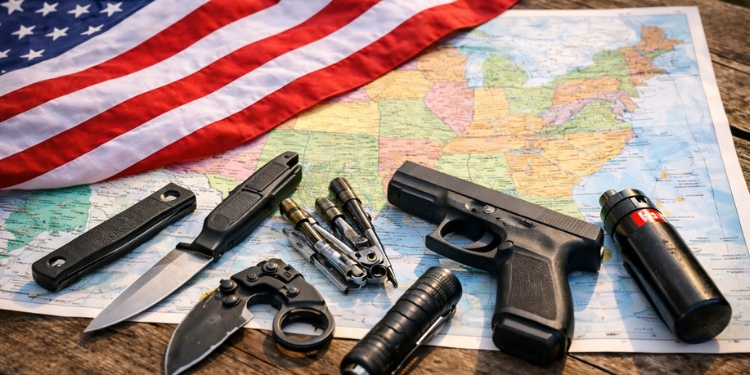

LEGAL NOTICE: This article is for general informational purposes only and does not constitute legal advice. Laws change frequently and vary by municipality as well as state. Always verify current laws in your specific jurisdiction before carrying any item, and consult a licensed attorney for guidance specific to your situation.
Most people have no idea what they are legally allowed to carry every day until they get stopped and find out the hard way. EDC, or everyday carry, is not just philosophy. It is a legal responsibility. The tools you carry for self-defense and preparedness are governed by a patchwork of state laws, local ordinances, and federal regulations that can shift dramatically the moment you cross a state line.
This guide breaks down what you need to know across all 50 states for the five core EDC categories: firearms, knives, less-lethal tools, medical gear, and the legal mindset that ties everything together. Knowledge is the first piece of gear you should always carry.
The EDC Legal Mindset
 Before getting into specific state laws, there is a foundational principle every prepared carrier needs to internalize: being legally right and being legally safe are two different things.
You can be within the letter of your state’s law and still face arrest, confiscation, or civil liability if you cross into a different jurisdiction, enter a prohibited location, or encounter a law enforcement officer who interprets the law differently than you do.
The practical standard for a prepared EDC carrier is not “what can I technically get away with” but “what can I carry and defend in any situation I might realistically encounter.” That means knowing not just your home state’s rules but the rules of any state you drive through, fly into, or work near.
The Giffords Law Center maintains a continuously updated database of state firearms and weapons laws that is one of the most reliable publicly available legal references for EDC research.
Firearms: Concealed Carry and Open Carry Laws by State
Firearm carry law is the most regulated and most consequential area of EDC law. Getting it wrong is a felony in many states. The landscape has shifted significantly in recent years, particularly following the Supreme Court’s 2022 ruling in New York State Rifle and Pistol Association v. Bruen, which established that states must justify firearm restrictions against historical tradition, fundamentally reshaping how courts evaluate carry restrictions going forward.
Constitutional Carry States (No Permit Required)
As of 2024, 29 states have adopted constitutional carry, meaning that law-abiding residents who can legally own a firearm may carry it concealed without a permit. These states include:
- Alabama
- Alaska
- Arizona
- Arkansas
- Florida
- Georgia
- Idaho
- Indiana
- Iowa
- Kansas
- Kentucky
- Louisiana
- Maine
- Mississippi
- Missouri
- Montana
- Nebraska
- New Hampshire
- North Dakota
- Ohio
- Oklahoma
- South Dakota
- Tennessee
- Texas
- Utah
- Vermont
- West Virginia
- Wyoming
- North Carolina
Constitutional carry does not mean carry anywhere. Even in these states, firearms are prohibited in schools, government buildings, polling places, courthouses, bars, and other designated locations. Many constitutional carry states still offer optional permits, which are worth obtaining for reciprocity purposes when traveling.
Shall-Issue Permit States
Shall-issue states require a permit but must issue one to any applicant who meets objective criteria such as passing a background check, completing a safety course, and paying the required fee. The issuing authority has no discretion to deny based on subjective factors. Most remaining non-constitutional-carry states fall into this category, including:
- Colorado
- Michigan
- Minnesota
- Nevada
- Oregon
- Pennsylvania
- Virginia
- Washington
- Wisconsin
May-Issue and Restrictive States
 A small number of states retain significant discretion in issuing carry permits.
California, Hawaii, Maryland, Massachusetts, New Jersey, and New York historically operated as may-issue states, though court rulings post-Bruen have forced reforms in several of these.
These states often require demonstration of “good cause” or “justifiable need,” and the practical reality is that permits remain difficult to obtain in densely populated areas even where legally required to be issued more broadly.
Illinois requires a Firearm Owner’s Identification card as well as a Concealed Carry License, making it one of the more administratively complex states for EDC carriers. The application and training requirements are clearly defined at the Illinois State Police website.
Open Carry
Open carry laws do not follow the same pattern as concealed carry laws. Some states that restrict concealed carry permit open carry without a license. Others that allow constitutional carry for concealed firearms restrict open carry in urban areas.
How to Build a Tripwire Alarm (Even If You Are a Beginner)
For example Texas, despite being a constitutional carry state, only legalized open carry of handguns in 2016 and the landscape continues to evolve. California prohibits open carry of both loaded and unloaded handguns in most public settings. Florida also prohibits open carry with narrow exceptions.
So, it’s best to always verify open carry status separately from concealed carry status in any jurisdiction.
Interstate Travel With a Firearm
The federal Firearm Owners Protection Act of 1986 provides a safe harbor for interstate transport: a person may transport a firearm through a state where they could not otherwise carry it, provided the firearm is unloaded, locked in a hard-sided case, and stored separately from ammunition, typically in the trunk or a locked container inaccessible from the passenger compartment.
This protection applies to transport, not carry, and does not authorize you to carry in states where your permit is not recognized. It is a legal minimum floor, not a carry authorization.
Knives and Bladed Tools
Knife laws are arguably the most inconsistently enforced area of EDC law in the United States. A folding knife that is perfectly legal in rural Texas may result in arrest in New York City. The same blade carried clipped to a pocket in one municipality can be a prohibited “gravity knife” in the next. Understanding the key legal distinctions is essential.
Blade Length Restrictions
Many states and municipalities restrict knife carry based on blade length. Common thresholds are 2.5 inches, 3 inches, and 4 inches, though the specific measurement and what it triggers varies. New York City historically prohibited carry of knives with blades over 4 inches, but enforcement centered on the “gravity knife” designation caused widespread issues for workers carrying standard folding knives.
3 Signs Your Guns and Weapons Are on FEMA’s Radar
California generally allows folding knives of any blade length if carried folded, but restricts fixed-blade carry in many contexts. Massachusetts prohibits carrying any knife with a blade over 1.5 inches with intent to use it unlawfully, which is a context-dependent rather than length-based standard.
Prohibited Knife Types by State
Switchblades (automatic knives) are regulated federally under the Federal Switchblade Act and prohibited from interstate commerce, but state laws vary significantly on possession. Many states prohibit switchblades outright. Others, including Arizona, Alaska, and Texas, have repealed switchblade bans entirely.
The Only Knife You Need in Your Stockpile
Ballistic knives, which project a blade by spring or gas mechanism, are federally prohibited. Dirks, daggers, and double-edged blades face specific restrictions in California, Washington, and several other states even when the overall blade length would otherwise be legal.
The Knife Rights Foundation maintains a state-by-state knife law guide that is one of the most detailed and regularly updated references available for this category.
Practical Carry Standard for Knives
For an EDC carrier who travels frequently or moves between jurisdictions, a conservative standard is a single-edge folding knife with a blade under 3 inches, carried clipped to the pocket in plain view where clip carry is permitted.
This configuration is legal in virtually every US jurisdiction for most adult carriers. A work knife used in a professional context (trades, farming, hunting) often has broader legal protection under state law than the same knife carried with no obvious work purpose.
Tasers, Stun Guns, Batons, and Tactical Pens – State-by-State Overview
Less-lethal tools occupy a legal gray zone in many states, often treated inconsistently because legislators drafted weapons laws focused on firearms and blades without anticipating the full range of modern EDC tools.
Tasers and Stun Guns
 Following the Supreme Court’s 2019 ruling in Caetano v. Massachusetts, which struck down a state ban on stun gun possession, most outright state bans on stun guns and tasers have been overturned or revised. However, significant restrictions remain.
Hawaii prohibits stun guns entirely. Rhode Island prohibits civilian carry of tasers. Several other states require a permit to carry a taser outside the home.
New York significantly restricted taser carry for many years though court rulings have forced reforms.
In states where tasers are legal to carry, they are almost universally prohibited in the same locations as firearms: schools, government buildings, courthouses, and other sensitive locations. The rules that apply to your firearm in terms of prohibited locations almost always apply to your taser as well.
Batons, Collapsible Clubs, and Impact Weapons
Expandable batons (ASP-style) and fixed batons are heavily restricted in most states. California prohibits carry of batons by civilians entirely. New York, Illinois, and Massachusetts have similar broad prohibitions. Even in states where baton carry is technically legal, local ordinances often restrict them further.
This is a category where the gap between what is technically legal statewide and what is practically safe to carry is very wide. Unless you have a specific professional need and documented authorization, batons are not a practical EDC item in most US jurisdictions.
Tactical Pens
A tactical pen is a writing instrument with a reinforced body and often a pointed glass-breaker tip. As a tool, it is legal to carry in virtually every US jurisdiction because it is, first and foremost, a pen. The legal risk arises if you use or display it as a weapon, at which point it may be classified as an impact weapon in jurisdictions with broad weapon definitions.
7 Homemade Weapons You Need to Add to Your Stockpile in 2026
Carry it as a tool, use it as a writing instrument, and do not advertise its defensive capabilities. In TSA screening, tactical pens are generally allowed through airport security as they meet the definition of a pen, though individual screener discretion applies.
Medical and Trauma Gear
 Good news: medical and trauma gear faces almost no legal restriction anywhere in the United States.
A tourniquet, chest seal, hemostatic gauze, emergency mylar blanket, CPR mask, or trauma shears can be carried in all 50 states without any permit, license, or legal concern in virtually any setting including government buildings and airports.
The Stop the Bleed campaign, developed in partnership with the American College of Surgeons and supported by federal agencies including FEMA and DHS, actively encourages civilians to carry and know how to use basic hemorrhage control tools. This is one area where the federal government’s position and the prepared individual’s position are in complete alignment.
Trauma shears are the one item occasionally flagged at TSA checkpoints due to their blade, though they are listed as permitted in checked baggage and are generally allowed in carry-on baggage when the blade is under 4 inches. Verify current TSA guidance before flying with any cutting tool.
Key Federal Prohibitions Every EDC Carrier Must Know
Beyond state law, several federal statutes create carry restrictions that supersede any state permission you may have.
- Gun-Free School Zones Act (GFSZA): Prohibits firearm carry within 1,000 feet of a school zone with very limited exceptions. This applies regardless of your state’s carry laws and regardless of whether you have a permit. Many states have carve-outs for permit holders, but the federal law remains and its interaction with state law is complex enough to require careful attention in any populated area.
- Federal Buildings and Courthouses: Firearms and many weapons are prohibited in all federal facilities, including post offices, federal courthouses, VA facilities, and military installations open to the public. No state permit overrides this prohibition.
- TSA and Air Travel: Firearms must be declared, unloaded, and transported in a hard-sided locked container in checked baggage only. No firearms are permitted in carry-on baggage under any circumstances. TSA maintains a current list of prohibited and permitted items at their website.
- Prohibited Persons: Federal law prohibits firearm possession by anyone with a felony conviction, domestic violence misdemeanor conviction, active restraining order, adjudication as mentally defective, unlawful drug user status, or several other disqualifying conditions. These prohibitions apply regardless of state law and regardless of whether a state issues a carry permit.
Building a Legally Defensible EDC Kit: The Practical Framework
 Every year, millions of routine police interactions happen in the U.S., and in those moments, what you’re carrying gets judged fast.
If something looks off or you can’t clearly explain why you have it, things can escalate quickly. It’s rarely one item that causes problems.
It’s the mix of gear, how it’s carried, and whether it makes sense to anyone looking at it from the outside. A legally defensible EDC kit starts with the law, not the gear.
Most issues preppers run into come from simple mistakes like carrying in the wrong place or not knowing the rules when crossing state lines. To avoid these common mistakes, I recommend you the perfect EDC blueprint. After years of experience, ex-Navy Seal Joel Lambert created this amazing plan – totally legal and adapted to any SHTF situations.
The goal is simple: everything you carry should be legal, easy to explain, and have a clear purpose. If you ever get asked about it, your answer should be obvious and make sense immediately.
The following framework applies across all EDC categories.
- Know your home state’s laws cold. This is the baseline. If you do not know exactly what you can and cannot carry in your own state, start there before thinking about anything else. State attorney general websites, state police websites, and organizations like the Giffords Law Center and the NRA-ILA maintain state law summaries that are reasonably current and accessible.
- Research any state you travel through or to. A multi-state road trip means your EDC configuration may need to change at the border. Firearms reciprocity maps, knife law databases, and taser law summaries are all available from the organizations referenced throughout this article. The NRA-ILA maintains a carry law reciprocity tool that is one of the most practical references for multi-state travel.
- Carry documentation. If you have a carry permit, keep it on your person with your identification at all times when carrying. In states with duty-to-inform laws, you are legally required to disclose to law enforcement that you are carrying a firearm when contacted. These states include Alaska, Illinois, Louisiana, Michigan, Nebraska, North Carolina, Ohio, Oklahoma, and Texas, among others. Know whether your state requires disclosure proactively or only upon request.
- Avoid prohibited locations without exception. No preparedness benefit from having a tool on your person is worth the criminal liability of carrying in a prohibited location. Know the list for your jurisdiction and leave restricted items in your vehicle or at home when entering those locations.
- Prioritize the legal carry items first. Medical gear is universally legal. A 3-inch folding knife is legal nearly everywhere. A flashlight, a tactical pen, and a phone are legal everywhere. Build your kit from the legal foundation up, not from the most restricted items down.
So, if America’s history with guns has taught us anything, it’s that your safety is your responsibility. That’s why I recommend you to take an online self-defense course and learn everything you need to know about protecting yourself, your home, and your stockpile.
CLICK HERE and enroll today – only 18 spots left!

Final Thoughts
Everyday carry is not just about what you have on you when something goes wrong. It is about carrying smart enough that you never have to explain yourself to a prosecutor. The best EDC kit in the world is useless if you lose your freedom over it.
Laws change. The constitutional carry expansion of recent years would have seemed politically impossible a decade ago. The post-Bruen litigation reshaping may-issue states is still working through the courts. Stay current, stay legal, and carry with the confidence that comes from knowing exactly what your rights are in every jurisdiction you set foot in.
You may also like:
 What No One Told You About Your Guns
U.S. Nuclear Bunker Map (VIDEO)
5 Native American Weapons You Should Have
Taser vs. Stun Gun: What They’re Not Telling You
What a Green Beret Would Say about Your Guns
Read the full article here
