


A dull knife is more dangerous than a sharp one. That statement surprises a lot of people until they use a blade that slips instead of cuts and realize how quickly a loss of control turns into a serious injury. Whether you are deep in the backcountry, dealing with a grid-down situation, or simply nowhere near your whetstone, knowing how to sharpen a knife without a sharpener is a skill every prepper needs locked in.
The good news is that nature and everyday household items are full of abrasive surfaces capable of restoring a working edge. This guide covers seven reliable methods, explains the science behind each one, and gives you the technique details you need to actually get results instead of just scratching up your blade.
Why Keeping Your Knife Sharp Is a Survival Priority
A sharp edge does not just make cutting easier. In a preparedness context, blade performance affects food processing speed, cordage work, shelter building, first aid, and self-defense. Every extra minute you spend forcing a dull blade through a task is energy and time you cannot afford to waste. According to the American College of Emergency Physicians, dull knife injuries are common because users apply excessive force and lose control of the blade. In a survival scenario with no medical support nearby, that risk multiplies dramatically.
Research published in the Journal of Materials Processing Technology confirms that edge geometry and surface micro-serration directly determine cutting performance. Everything in this guide works on that principle: creating controlled abrasion that restores or refines the edge bevel.
Understanding What Knife Sharpening Actually Does
Sharpening works by removing metal from both sides of the blade to create or restore a thin, consistent edge. When you drag a knife across an abrasive surface at a consistent angle, you are grinding away the rolled or dulled metal until a fresh, keen edge emerges. The angle matters. Most western kitchen and utility knives are sharpened at 20 to 25 degrees per side. Japanese-style and hunting blades often run 15 to 17 degrees. You do not need to memorize those numbers, but you do need to maintain a consistent angle throughout each method below.
A useful rule of thumb is to imagine a matchbook spine placed under the blade spine while the edge rests on the surface. That gap approximates a usable working angle for most field knives. Hold it steady and be consistent.
7 Ways to Sharpen a Knife Without a Sharpener
1. The Unglazed Ceramic Mug Bottom
This is arguably the best no-tool sharpening method available because most people have a ceramic mug in their kit, bug-out bag, or camp kitchen. Flip the mug over and examine the bottom. The rough, unglazed ring of bisque ceramic is a legitimate abrasive surface that works nearly as well as a ceramic sharpening rod.
Place the mug on a stable surface with the unglazed bottom facing up. Hold your knife at a consistent angle against the ceramic ring. Draw the blade toward you in smooth, even strokes from heel to tip, as if you were trying to slice a thin layer off the ceramic. Apply light to moderate pressure. Do 10 strokes on one side, then flip and repeat on the other. Alternate sides until the edge feels noticeably improved. Finish with a few lighter strokes to remove the wire edge that forms during sharpening.
The University of Sheffield’s advanced manufacturing research has documented how alumina-based ceramics provide consistent micro-abrasion ideal for edge refinement. Your coffee mug is doing real metallurgical work.
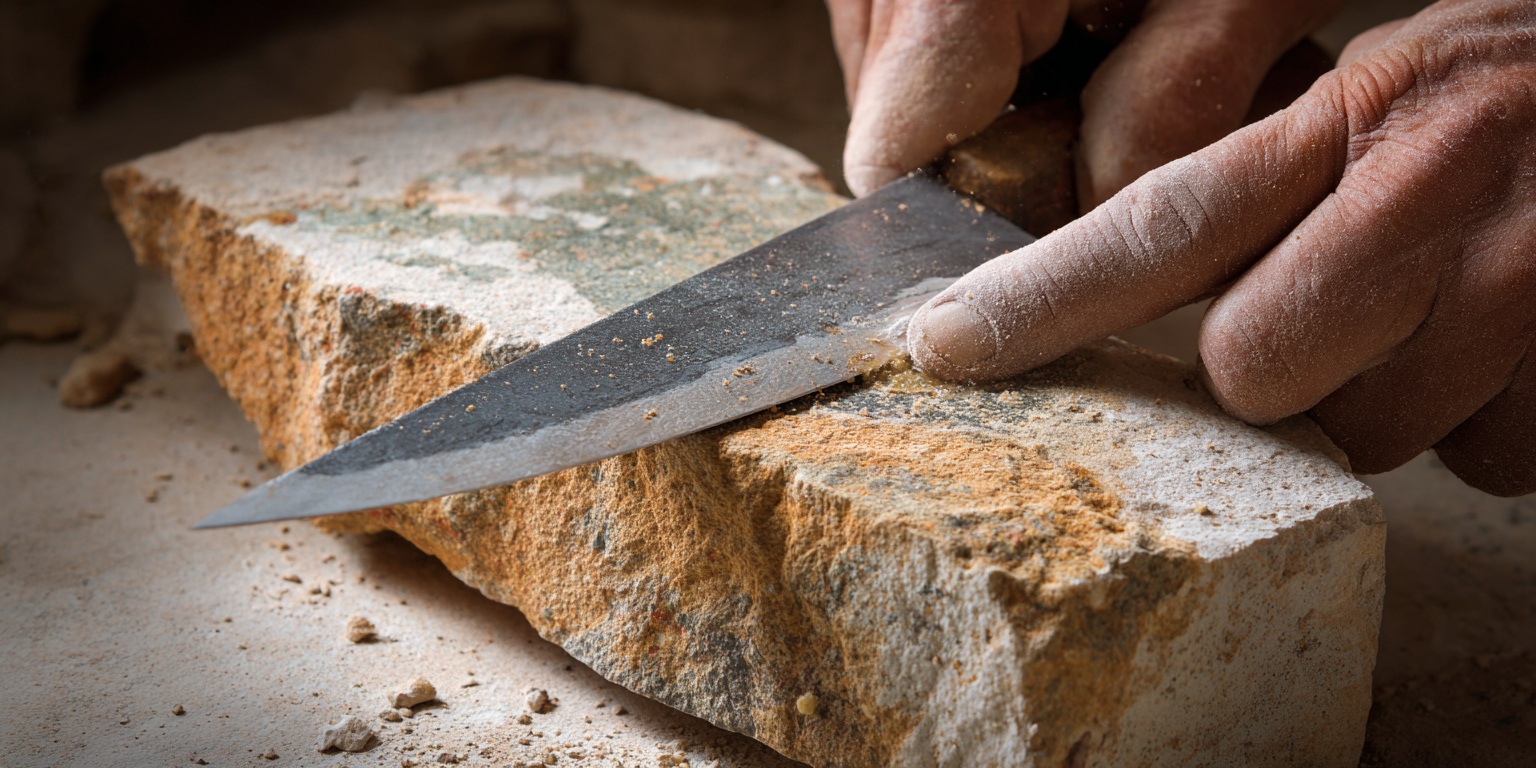
2. A River Stone or Fieldstone
Humans have been sharpening blades on natural stone for tens of thousands of years. It still works. Smooth river stones are generally too fine for a badly dulled knife but excellent for touching up a blade that just needs refreshing. Sandstone, quartzite, and granite offer more aggressive cutting action.
Wet the stone surface with water or spit to act as a lubricant and carry away metal particles. Hold the stone flat on the ground or against a log. Work the blade across it just as you would a bench stone, maintaining consistent angle and using the full surface of the stone in even strokes. Rotate the stone periodically to expose fresh abrasive surface. Coarser stones do the heavy removal work; finish on a smoother stone if you have one available.
The National Park Service’s lithic technology documentation notes that quartzite and chert were the preferred sharpening materials of prehistoric tool makers, a track record that speaks for itself.
3. A Leather Belt or Leather Strop
A leather belt is more finishing tool than sharpening tool, but in the field it is invaluable for maintaining an edge that has not degraded too far. Stropping does not remove metal the way a whetstone does. Instead, it realigns the microscopic teeth of the edge and polishes the bevel to a keener finish.
Thread your belt through a door handle or secure it to a tree branch so it lies flat and taut. Drag the blade spine-first away from the cutting edge in smooth strokes, the opposite direction from sharpening. You are pulling the edge, not pushing it into the leather. Alternate sides evenly. Twenty strokes per side will noticeably improve a knife that has lost its bite through regular use.
For deeper sharpening on a leather strop, you can embed a mild abrasive compound into the surface. Field options include fine ash from a campfire or even toothpaste, which contains mild abrasive silica. Apply a thin coat, let it work into the surface, and strop as normal.
4. A Car Window or Glass Edge
Glass is harder than most knife steel. The unfinished edge of a car window, the spine of a glass bottle, or the edge of a glass sheet all provide a usable abrasive surface. This method is best treated as a last resort when no other option is available, but it does work.
Roll a car window down slightly to expose the top edge of the glass. Hold the knife at a consistent angle and draw it across that edge just as you would a sharpening rod. Use light pressure and controlled strokes. Do not use the flat surface of a pane of glass as it provides no edge geometry advantage and can be unpredictable. Scratched or roughed-up glass works better than perfectly smooth glass because the surface micro-texture does the abrading.
This method will not produce a razor edge but will restore functional sharpness to a working blade in a pinch.
5. A Concrete Block, Cinder Block, or Sidewalk Edge
Concrete is essentially compressed aggregate stone. Its abrasive properties are real and usable. The smooth face of a cinder block or the curb of a sidewalk can sharpen a blade surprisingly well, particularly if you work a progression from a coarser surface to a smoother one.
Wet the surface with water. Hold your knife at a consistent angle and work the blade across the concrete in smooth, controlled strokes. The face of a cinder block tends to be moderately aggressive. The smooth top surface of a finished concrete step is finer and better for polishing the edge after the initial work. This is a solid urban survival method when natural materials are not available.
The Portland Cement Association notes that standard concrete aggregate includes quartz, granite, and basalt, which are all harder than tool steel on the Mohs scale.
6. Another Knife (Spine-to-Edge Steel)
If you have two knives, you have a sharpening setup. The spine of one knife can act as a makeshift honing rod for the other. This is not ideal for a seriously dulled blade but works well for refreshing an edge that has lost its bite.
Hold one knife steady with the spine facing up. Draw the second knife’s edge across that spine at a consistent angle, just as you would use a honing rod. The steel-on-steel contact creates a scraping abrasion that realigns and refines the edge. Switch sides evenly. This is a technique that many experienced field hands use routinely between full sharpenings.
Be precise with your angle control. The technique requires a steady hand but delivers real results when executed correctly.
7. Sandpaper on a Flat Surface
Sandpaper is essentially a portable whetstone and is one of the most effective improvised sharpening tools you can carry in a kit. 120 to 220 grit does the heavy reprofiling work on a dull blade. 400 to 600 grit refines and polishes. If you have both, use them in sequence.
Lay the sandpaper flat on a hard, stable surface. Hold the blade at a consistent angle and draw it across the sandpaper heel to tip, edge-leading. Work in even strokes with moderate pressure. Check your progress by feeling for a wire edge forming on the opposite side of the blade, a slight burr you can feel with your fingertip running perpendicular to the edge. Once you feel it, flip and work the other side. Alternate until the wire edge is gone and the blade cuts cleanly.
Sandpaper is cheap, lightweight, and packs flat. Every prepper’s kit should include several grits wrapped in a waterproof sleeve.
Pro Tips for Better Results with Any Method
Angle consistency is the single most important variable in improvised sharpening. A slightly inconsistent angle will round the edge instead of sharpening it. If you struggle to hold a consistent angle freehand, use a coin or folded piece of cardboard as a guide to set your bevel.
Always use lubrication when possible. Water, saliva, or a drop of oil reduces heat from friction and carries away metal swarf that would otherwise clog the abrasive surface and reduce effectiveness.
Test your progress on paper. A sharp knife slices cleanly through a sheet of paper with no tearing. If your blade catches or tears, keep working. Test on an arm hair if paper is not available. A sharp edge will shave cleanly without pressure.
According to the blade-sharpening research compiled at BladeForums and validated by metallurgists in peer-reviewed cutlery studies, edge angle consistency matters more than the abrasive material used. The best stone in the world cannot produce a good edge if your angle wanders.
Maintaining Your Edge in the Field
The best strategy is preventing serious dulling in the first place. A few habits protect your edge and reduce how often you need to sharpen.
- Never cut on metal, stone, or glass surfaces if a wooden or plastic cutting surface is available.
- Avoid twisting the knife in a cut. Lateral pressure rolls the edge faster than cutting motion.
- Strop your blade on leather before putting it away after each heavy use session.
- Keep your blade dry and clean. Rust pitting destroys edge geometry and requires aggressive metal removal to repair.
- Store your knife in a sheath or blade guard. Loose in a pack, blades contact other gear and dull faster than they ever would in use.
The University of Georgia Cooperative Extension notes in their food preservation guides that proper knife maintenance significantly reduces processing time and improves safety during high-volume tasks, a principle that applies equally in a survival food preparation context.
Build a No-Cost Improvised Sharpening Stash Now
You do not need to wait for a disaster to gather sharpening materials. Right now, you have access to all seven methods listed in this guide. Keep a dedicated coffee mug with an unglazed bottom in your camp kit. Store two or three sheets of sandpaper in multiple grits with your knife roll. Identify the concrete and stone surfaces in your immediate area that you could use if needed.
If you ever build a bug-out bag, include a small strip of leather and a folded sheet of 400-grit wet-dry sandpaper. That addition weighs less than two ounces and eliminates the need for a dedicated sharpening tool in most field scenarios.
The prepper mindset is not about stockpiling gear. It is about building skills and systems that work when gear fails, runs out, or simply was never there. Knowing how to sharpen a knife without a sharpener is one of those foundational skills that pays dividends every single time you use a blade in the field.
Frequently Asked Questions
Can you really sharpen a knife with a rock?
Yes, and humans have been doing it for thousands of years. The key is finding a rock with a hardness greater than your knife steel, which most natural quartzite, sandstone, and granite stones easily satisfy. A smooth river stone works best for touching up an edge, while rougher stones with visible grit can do heavier reprofiling work.
How many strokes does it take to sharpen a knife on a mug?
For a knife that is moderately dull, 10 to 20 strokes per side on an unglazed ceramic mug bottom is typically enough to restore a working edge. A badly dulled or chipped blade will require significantly more work and may need a more aggressive surface like sandstone or coarse concrete first.
What angle should I use when sharpening without a sharpener?
Most utility and survival knives work well at 20 degrees per side. A practical way to visualize this angle is to hold the blade so the spine is roughly the height of two stacked quarters above the sharpening surface. The most important thing is maintaining a consistent angle throughout the sharpening process, not hitting a precise number.
Does stropping on leather actually sharpen a knife?
Stropping is more finishing and maintenance than sharpening in the metal-removal sense. It realigns the microscopic teeth of the edge that fold over during use and removes the wire burr left after abrasive sharpening. A well-stropped edge will feel noticeably sharper after light use without the blade actually needing any metal removed.
What is the best emergency sharpening method if I am in the wilderness with nothing?
The unglazed bottom of a ceramic container and flat natural stone are your best wilderness options. River stones, sandstone outcroppings, and granite slabs are available in most outdoor environments. In a true emergency with no gear at all, look for stones near waterways where natural tumbling action has created relatively flat, smooth surfaces that are still rough enough to abrade metal effectively.
Final Thoughts
If a simple coffee mug can sharpen a knife, imagine what other practical skills have been forgotten over time. Our grandparents knew how to improvise tools, preserve food without electricity, purify water, build shelter from raw materials, and stay self-reliant without depending on modern supply chains. Those skills did not disappear because they stopped working. They disappeared because convenience replaced necessity.
The Lost Skills II is a collection of time-tested survival knowledge that once made everyday people resilient in uncertain times. Inside, you will discover practical techniques for food preservation, natural medicine, water sourcing, off-grid cooking, tool improvisation, and dozens of other forgotten abilities that can make the difference between struggling and adapting when systems fail.
Just like learning to sharpen a knife without a sharpener, mastering these old-world skills gives you independence that cannot be disrupted by shortages, outages, or emergencies. The more skills you possess, the fewer tools you depend on, and the more confident you become in your ability to handle whatever comes your way.
Thousands of readers have already added The Lost Skills II to their preparedness library because it focuses on practical knowledge that works in real conditions, not theory. These are skills developed through generations of trial and error, refined long before modern convenience existed.
If you are serious about becoming more capable, more prepared, and less dependent on fragile systems, this resource belongs in your collection.
👉 Discover the forgotten techniques that helped previous generations thrive without modern infrastructure: The Lost Skills II
You may also like:
 The Knife In Rambo – Good For Survival Or Not?
9 Tools The Pioneers Carried With Them At All Times (VIDEO)
Best OTF Knife Under $100
Common Tactical Knife Myths that Can get You Killed
How To Correctly Choose Your Survival Knife
Read the full article here
