

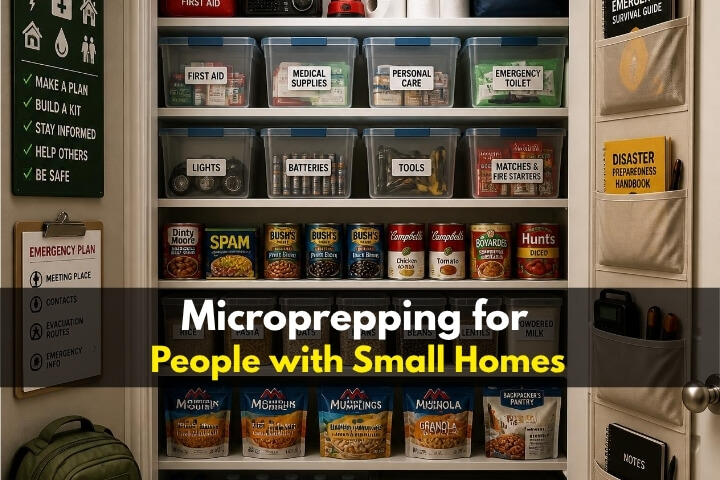


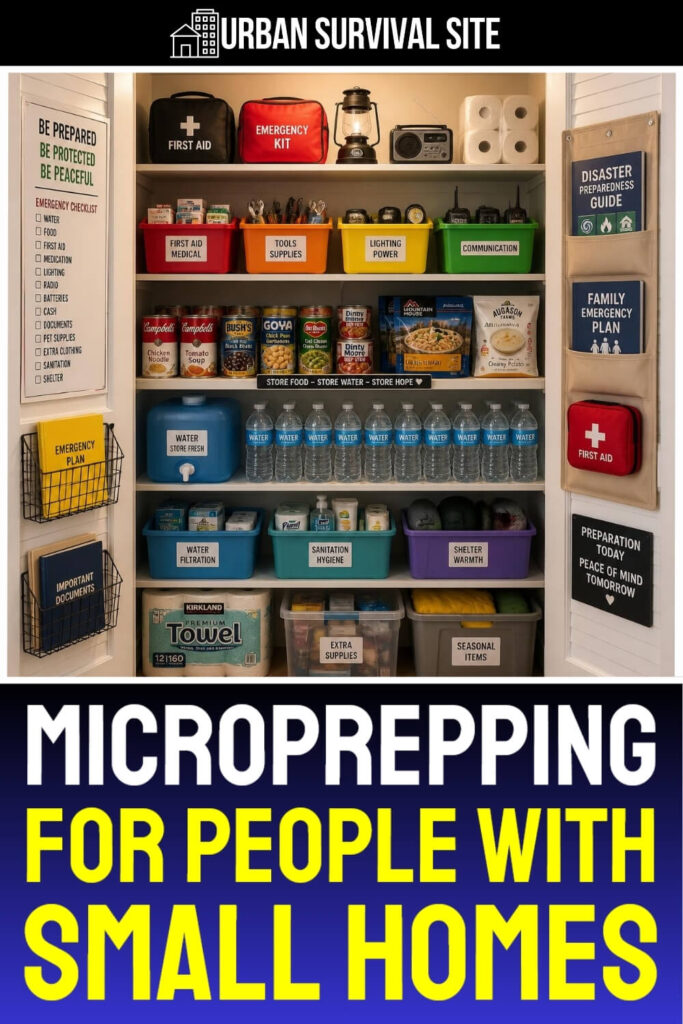
When most people picture an emergency stockpile, they imagine a basement lined with shelves, a spare bedroom packed floor to ceiling, or a garage full of five-gallon buckets. And if you’ve got that kind of room, great. But a lot of us don’t. If you live in a small house or apartment, you might have nothing more than a single closet to work with.
Here’s the good news: it absolutely is. This is where microprepping comes in. Microprepping is all about squeezing a bunch of survival supplies into a tiny space by being organized, intentional, and clever about what you choose to store. Emergency supplies can take up a ton of room if you’re careless, but if you plan well, you’d be surprised how much you can fit in one closet.
In fact, you can put together a full 60 days of supplies for two adults in a single linen closet. We’re talking food, water, health items, self defense, all of it. It just takes a bit of thought about what earns a spot on the shelf.
We found this microprepping demonstration on the YouTube channel, Wandering Prepping, where the host empties out a bathroom linen closet and rebuilds it as a 60-day survival kit for two adults. Below is his video and a step-by-step breakdown of how he does it.
Step 1: Define Your Scenario and Your Goals
Before you buy a single can of beans, get clear on what you’re actually prepping for. The whole demonstration runs under a specific scenario, and yours should too, because it shapes every decision you make.
The scenario here is a situation similar to the COVID-19 pandemic. You’re bugging in, sheltering at home under lockdown and unable to leave, and on top of that, the grid is down. There’s a total power failure for whatever reason, and you need to keep yourself and one other adult alive for at least 60 days.
From there, set a calorie target so you know how much food you actually need. The goal in this build is about 1,500 calories per day per person. For two adults over 60 days, that works out to roughly 180,000 total calories. That number is your north star for the food section. Everything you stock should be moving you toward it.
Step 2: Solve the Water-Heating Problem First
This one’s easy to overlook, but it’s non-negotiable. Every food item in this stockpile is chosen so it can either be eaten as-is or prepared with nothing more than hot water. That’s a deliberate strategy. It keeps prep simple and predictable. But it only works if you actually have a way to heat water when the power’s out.
If you’ve got a gas stove, you may be able to use that. If you don’t, you need a backup. Here are four options to consider, all of which can boil water quickly:
- Jet Boil system — A canister-fuel stove that boils water incredibly fast. Just note that these aren’t really meant for indoor use, so you’d want to run it outside on a patio or similar.
- MSR Pocket Rocket — A compact backpacking stove that also runs on canister fuel. It holds a smaller pot, but it heats water fast and takes up almost no space.
- Coleman two-burner camp stove — Runs on one-pound propane canisters. Great for actually cooking or heating food, and big enough to boil large pots of water.
- Single-burner butane stove — Uses butane canisters and burns fast and hot. A simple, reliable way to get water ready.
Whichever you choose, remember you’ll want to heat water for two reasons: cooking your meals, and boiling water to disinfect it for drinking if it comes to that. Keep that in mind as you plan.
Step 3: Stock the Top Shelf with Basic Necessities
With a four-shelf closet plus floor storage, the top shelf is a natural home for the bulky-but-light basics you’ll reach for constantly: toilet paper, tissues, and paper towels. You don’t necessarily need to cram the shelf full. Just put up enough to comfortably cover the full 60 days.
Step 4: Build Your Food Base
This is the heart of the stockpile, and the strategy is to lean on hearty, shelf-stable staples that stack up calories fast. Here’s the food lineup from the demonstration:
- Beans — Roughly 20 cans, for about 7,700 calories. Mix up the types, including seasoned varieties and refried beans, so you don’t burn out on one flavor. They can be eaten cold from the can or heated and added to rice.
- Jasmine rice — One big 25-pound bag. That’s over 200 servings and more than 40,000 calories from a single item. Rice is the backbone here.
- Canned chili and soup — About 20 cans, around 6,800 calories total. Eat it straight or heat it over a camp stove. Go for the hearty ones with beans, plant-based meats, and vegetables, and diversify so you’re not eating the same can every day.
- Oatmeal — Individual packets are the pick here. It only takes a little hot water, it’s filling, and it’s a solid source of fiber and protein. Packets are better than a big bulk container because if one gets compromised, you haven’t lost the whole supply.
- Pancake mix — About five boxes. Just add hot water and a hot skillet. Hearty, easy, and a good source of protein and fiber. Granola or other sturdy grains fit this category too.
- Granola bars and crackers — Tasty, hearty, and easy. Protein bars, peanut butter crackers, and saltines all work. Crackers take up a bit more room but pair nicely with your soups, chili, and rice and beans.
- Pasta — A big one, around 80 servings. Store a variety of pasta shapes and sauces to keep meals interesting. Family-size mac and cheese counts here too, and adds flavor variety.
- Protein powder — About 44 servings. A compact way to add protein to the stockpile.
- Peanut butter — Around 68 servings. Eat it by the spoonful or pair it with crackers. Versatile and calorie-dense.
- Jam — A couple of jars. It makes bland food more palatable and can be eaten on its own if needed.
- Plant-based meat crumbles — Shelf-stable, no refrigeration required, and they taste good. They’re ultra-processed, so they’re a sometimes item, but as a meat substitute to mix into other dishes they’re a great fit — especially with no working fridge.
- Nuts and trail mix — A batch of almonds and a small can of peanuts. Great fats, works as a snack or part of a meal.
- Quinoa and brown rice packets — The organic hot-water-only kind. A bit niche, but healthy and easy.
- Coffee — Three packs. Self-explanatory, but you’ll want it.
- Hard candy — A couple of bags. No prep, super shelf-stable, and a nice feel-good treat.
- Biscoff cookies — A personal pick. Dip them in peanut butter or have them with your coffee. Somewhere between a cracker and a cookie.
- Electrolyte tablets — They flavor your water and give you something other than plain water to drink all day.
- Freeze-dried smoothie packets — Each packet is about a pound of fruit and only needs water. A great way to get fruit into your diet when fresh produce is off the table.
- Quinoa — Tricolor quinoa, water-only prep, healthy, and adds variety.
- Jerky — Great protein and a solid snack. Plant-based jerky works if you’re vegetarian.
- Freeze-dried meals — Long shelf life and versatile, needing only hot water. The main downside is high sodium, so treat them as one option among many rather than your whole plan.
Step 5: Don’t Forget Seasonings and Flavor
Here’s a detail that separates a survivable stockpile from a miserable one. Sixty days of rice and beans gets old fast, and bland food wears you down. So build in ways to make your meals taste like something.
Stock soy sauce, salt and pepper, and whatever seasonings and sauces you actually enjoy. This is also the logic behind the mac and cheese, by the way. It’s not really about the pasta, it’s about that big packet of cheese powder, which you can sprinkle over rice, beans, or a taco salad to rescue a meal that’s gone bland. Little flavor boosters like that go a long way over two months.
Step 6: Cover Health and Wellness
This category is more important than people expect, and it doesn’t take up much room. Make space for:
- Medications — Both any prescription meds you take regularly and general first-aid items like pain relievers, band-aids, and tampons. Put together a full set of whatever you’d need.
- An organized first aid kit — Keep it tidy and easy to grab.
- Multivitamins — Critical here, because fresh fruit and produce will be basically unavailable. Vitamins help fill that gap.
- Hand sanitizer and cleanliness supplies — Keeping yourself and your space clean matters a lot in an emergency, and these take up almost no space.
Step 7: Plan for Water and Water Safety
Here’s the biggest caveat of the whole build: you can’t realistically stockpile enough water to last two adults 60 days. This closet holds about 10 gallons of fresh water, and that simply won’t stretch that far. So your water plan has to include a way to make found water safe to drink, whether you’re collecting it from an outside source or your tap is running but under a boil order.
Start with your stored water, then add treatment tools:
- Fresh water storage — Two full 5-gallon jugs, plus two 5-gallon collapsible jugs you can fill later.
- Potable Aqua (iodine tablets) — Cheap, tiny, and perfect for microprepping. They treat dirty water and make it safe to drink, and they store just about anywhere.
- LifeStraw — A personal filter straw you can drink through directly from a creek, pond, or puddle. It filters out contaminants and makes questionable water mostly safe. They run around $17 apiece now, but they work great and weigh almost nothing.
- SteriPen — Uses UV light (and four AA batteries) to kill bacteria in water. Pair it with a pre-filter on a wide-mouth bottle to knock out the heavy particulate first, then hit it with the UV light. A little more involved, but effective.
Because water safety is so important in a grid-down lockdown, it’s worth actually buying these products ahead of time and trying them out so you know how they work before you need them.
Step 8: Round It Out with Other Supplies
Once the essentials are in, use any leftover space for the things that make two months of confinement livable and keep you running:
- Personal care — Lotion, deodorant, and a 90-day supply of contact lenses if you wear them.
- Entertainment — Small games and books. With the grid down, no TV, and your phone likely useless, you’ll need something to keep yourself occupied and sane.
- A couple bottles of booze — If that’s your thing and you’ve got the room, it’s a nice comfort to have on hand.
- Basic supplies and lighting — Extra batteries, candles, and headlamps for a grid-down situation.
- Handy extras — Binoculars and a small repair kit with a needle and thread.
Step 9: Cover Personal Protection
Finally, think through personal safety. Hopefully you never need any of it, but it belongs in the plan. There are a few compact options that fit into a stockpile like this:
- Bear spray — A good deterrent to have, though keep in mind it’s genuinely dangerous to use indoors.
- Knives and machetes — An assortment gives you options.
- Baseball bats — Simple, and easy to stash in a few spots around your home.
For the host of the channel, firearms are the first line of defense for himself and his family, with everything above serving as backups. That’s a personal choice, and it’s not for everyone.
If you want to go that route, there are plenty of dedicated experts out there who cover handguns and personal safety in depth. The main point is to think it through ahead of time and have something on hand so you can protect yourself and your family if it ever comes to that.
You May Also Like:

Read the full article here
