


You never forget the really bad things that happen to you — it’s like they’re branded in your mind.
Two years after his friend was almost ripped apart by a crazed sow grizzly, Alaskan hunter Gary Corle can still shut his eyes and hear Johnny McCoy’s agonized screams and the crunch of breaking bones.
Time has healed the horrendous wounds in McCoy’s head and arms. The casts that immobilized his broken and crushed bones are long gone, too. But that terrible morning is still just a flash of memory away. The hunting buddies thank God and good friends that McCoy, a Baptist preacher, survived the attack at all. And McCoy’s survival also bears witness to the power of friendship and the determination of a community to keep him alive.
Until the huge sow grizzly and her two cubs showed up that day in September 2000, the moose hunt that McCoy and Corle had embarked on promised to be just another adventure in the Alaskan outback. McCoy, 53, is a former mayor of North Pole, Alaska—a small community 15 miles south of Fairbanks—and for 22 years was pastor of First Baptist Church of North Pole. Corle, 59, is one of the church deacons and works at nearby Eielson Air Force Base. Hunting buddies for almost 20 years, they had been flown to their base camp by pilot Art Ward for a moose hunt they expected to resemble many others that came before.
A Hunt Like No Other
After landing on the Little Delta River about 40 miles west of Delta Junction, they spent the first day setting up camp and preparing for their hunting adventure. The next morning after breakfast, they packed their backpacks with food and equipment, headed upriver and began scouting for moose and marking trails. They followed the stream for a couple of miles, then turned inland. The pair saw bear scat and tracks but paid little attention. Such sign was as common to the landscape as the distant mountains. The men hiked along quietly until McCoy told Corle he had to stop to relieve himself. Corle continued flagging and minutes later McCoy was back on the trail, hurrying to catch up. Almost at the same instant that he saw Corle again, McCoy spotted a sow grizzly with two cubs in tow suddenly rush out of the bushes that fringed the river and charge at his friend. McCoy raised his rifle to shoot but the bear was on Corle so quickly that he feared hitting his friend.
“I saw that bear and didn’t even have time to alert Gary,” McCoy remembers. “I thought she was going to kill him.” Corle, taken completely by surprise, was sideswiped by the massive bear and sent tumbling face first into a thick clump of brush.
“I heard something behind me and the first thing that came to my mind was that it was Johnny,” Corle recalls. “I turned my head toward the sound and looked and it was the darnedest thing I ever saw—a huge grizzly bear and that sucker was coming full bore toward me.”
The backpack Corle was wearing became tangled in the vegetation and it helped save his life. The frenzied bear pummeled him repeatedly but couldn’t roll him because the pack was caught in the bushes.
Corle managed to get partly turned and jammed the rifle into the sow’s thick brown fur. He pulled the trigger and, at the report, the bear suddenly let him go and wheeled away. When he looked back Corle half-expected to see her lying dead nearby, but the sow had only shifted the focus of her fury.
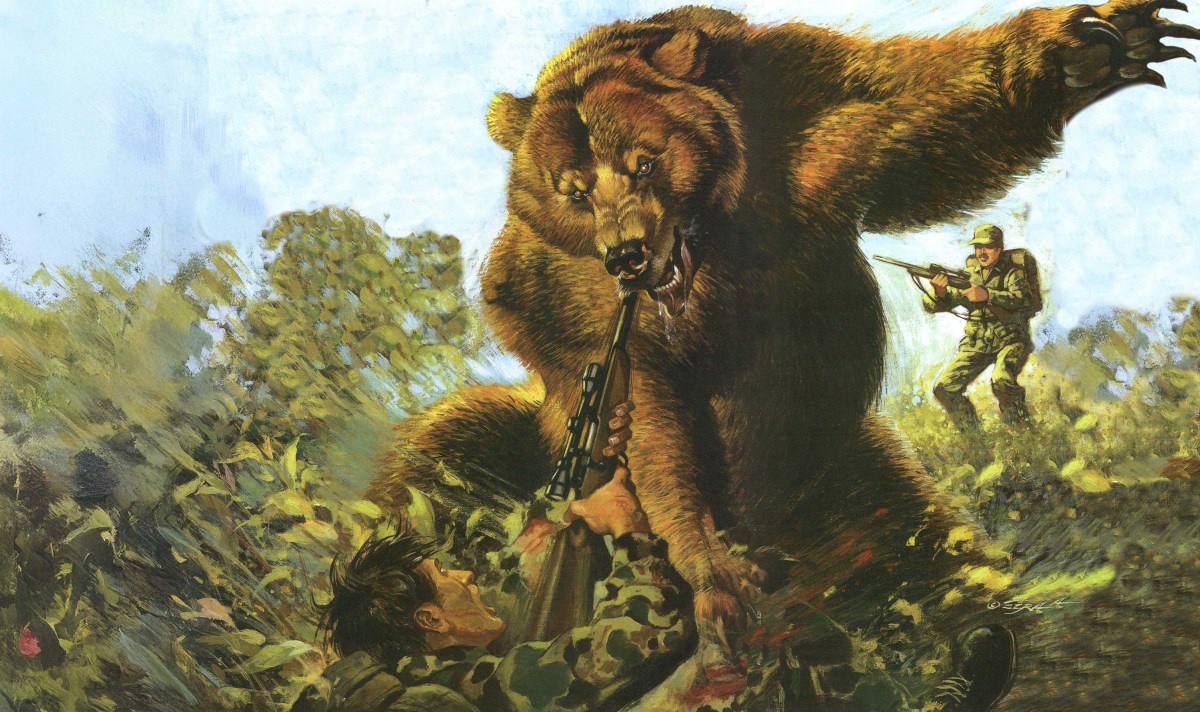
“As I was trying to get up I heard the most agonizing scream I have ever heard,” says Corle. “Then I saw Johnny was literally being torn to pieces by the grizzly. They were 10 yards away and the bear was slashing away at him. I could hear the sound of her tearing the flesh off his bones.”
Grabbing his rifle and chambering a round, Corle followed the blurred frenzy with his .30/06. Moments before, McCoy had been the one afraid of shooting at the bear and hitting Corle. Now it was Corle’s turn to feel powerless to help.
The entire attack lasted less than a minute, but the bear’s savagery resulted in horrible wounds to McCoy. The bear bit through his arms and shoulder and the preacher could feel and hear his bones crushing. Hanging onto McCoy’s damaged arm, the sow swung him around like a rag doll.
Even in his terror, McCoy tried to fend off the sow with his .300 Winchester Magnum. He shoved the rifle barrel into her mouth and the bear ground her teeth into the metal. He pulled the trigger repeatedly but the rifle wouldn’t fire. Then the bear quit worrying about the rifle barrel and directed her attention to McCoy’s head. “I could feel her trying to grab hold of my whole skull. I kept thinking, ‘This isn’t happening to me. This isn’t happening to me,’” he says.
Inexplicably, the bear’s fury ebbed and she released her grip. McCoy remained still, playing dead, thinking that “if I moved one foot she’d finish me off.” The sow bounded away a few feet and then glanced back at him. Then the bear tossed a quick glance at Corle and fled into the underbrush.
For a moment, Corle thought about shooting the grizzly as she left but he had a more important task at hand. One look at his friend convinced him that he needed to focus on saving the preacher’s life.
“Johnny was in bad shape,” recalls Corle. “His ear was attached to a flap of skin under his chin and his eyeball had been swatted from its socket and was dangling on his cheek. Blood was everywhere. One arm looked like it had gone through a meat grinder.”
Realizing his friend was losing blood at an alarming rate, Corle quickly attempted to stanch the flow. He pulled off his and McCoy’s backpacks and started reassuring his injured companion, who was in agonizing pain. Then he checked both rifles to make sure that they were ready in case the grizzly returned for a second attack.
A Prayer for Strength
Undaunted by McCoy’s terrible wounds, Corle immediately went to work. First he pushed the preacher’s ripped ear and scalp back in place and wound game bags from his backpack under McCoy’s chin and around his head. He replaced the eyeball as best he could, wound the makeshift bandage over the socket a few turns and then tied it off.
Because of the excruciating pain, McCoy wouldn’t let Corle check his bleeding arms, both of which had multiple compound fractures. The man’s muscles and skin were lacerated by the bear’s claws and teeth.
“Johnny had a hole in his hand as big as a nickel and the blood was spurting out,” says Corle. “I bandaged it, too, but I thought he might still bleed to death because there were so many other wounds.”
Realizing they needed to move toward help quickly, Corle put on his backpack and slung the rifles. The lean, 5-foot, 11-inch hunter struggled to get his heftier companion to his feet.
“He was so weak,” says Corle. “I told him, ‘You have got to get up. I can’t do it alone. We have to get you out of here. Ask God to give you the strength to make those legs work.’”
Nauseated and in horrific pain, McCoy managed to gain his feet and stood there tottering as Corle tried to figure out how to help him move. Since McCoy’s arms and hand were in such pain he couldn’t bear being touched. He was blinded from injuries, blood and layers of bandaging.
In the end McCoy solved the problem himself by feebly grabbing onto Corle’s backpack with two severely injured arms and saying he’d stumble along behind.
“I told him he was going to have to do more than just hang on,” Corle recalls. “I told him, ‘You need to pray for strength. You need to do your share and be brave.’ And everything I asked him to do, he did.”
The journey back to the river camp was an arduous three-mile hike over rough terrain. The trip took a couple of hours. As the two trudged along, Corle warned McCoy of every patch of mud, every hill and every creek they had to cross—all the time praying his friend wouldn’t fall.
“I knew if he went down he’d go unconscious and I’d never get him up again,” Corle says. “He was bleeding bad and making funny noises in his throat. When we came to a place where I thought we’d probably never get across, we’d stop and pray. When we’d get across, we’d stop and offer thanks. We prayed the whole way.”
In between prayers, Corle wondered what he needed to do to keep McCoy alive if they made it back to camp. The men weren’t due to be picked up for another 11 days and there was no way McCoy would survive without immediate medical attention.
The pair eventually reached the river. It was there, while they took a break to catch their breath, that McCoy revealed to Corle that he had a cell phone with his gear at their base camp—another mile or so away.
The men finally struggled into their camp several hours after the bear attack. Corle got McCoy into a camp chair and checked the bandages. He added more game bags over those now soaked and dripping with blood but was pleased to see the back of the severely injured hand had stopped bleeding and a huge blood clot covered most of it. He warned McCoy to keep the hand still, knowing it would start gushing again if the clot was jarred loose.
Calling 911
When he retrieved McCoy’s cell phone, he tried to call Art Ward, the pilot who had flown them out the morning before. The line was busy. Corle tried the church, but that line was busy, too.
“So I called 911,” says Corle. “I thought they might not be so busy.”
The phone was answered by a dispatcher at the North Pole Police Department, which handles calls for Delta Junction, the nearest town. Within 45 minutes of Corle’s 911 call, a team of rescuers from Fort Wainwright’s 68th Medical Company Air Ambulance was airborne on a UH-60 Blackhawk helicopter and headed south.
Corle saw the helicopter in the distance but realized it was hugging a ridgeline more than five miles away, instead of following the river. There was little time to make course corrections. McCoy had grown quiet. He was suffering. If he didn’t have help soon, the copter might be carrying him home in a body bag. Then despair was replaced with hope as Corle spotted Art Ward’s Super Cub flying down the river. News about McCoy had spread.
Corle already had cleared a small patch of ground he thought would be big enough for the rescue helicopter and was astounded when Ward set the Super Cub down on the tiny bit of land. Once he stopped the plane, the pilot leapt from the cockpit, took McCoy’s phone, punched in the numbers and explained to the 911 dispatcher exactly where the helicopter was in relation to the injured hunter.
When another Super Cub, whose pilot was also searching for the pair, flew overhead, the two pilots used radios to vector in the Blackhawk.
Twenty minutes later, medics on the chopper had McCoy’s wounds redressed, except for the ear, which they realized would fall off if they removed Corle’s field bandage. A trail of blood trickled from the gurney as medics loaded McCoy into the chopper and whisked him to Fairbanks Memorial Hospital’s emergency room.
After he watched the helicopter disappear in the distance, Corle gathered up the pair’s rifles and other equipment and climbed into Ward’s Cub. Within minutes he was on his way back home, worried about his friend.
Doctors spent six hours putting back together what took the grizzly a moment to rip apart. Dr. William Wennen, a renowned plastic surgeon who has pieced together several bear attack victims in his career, was in the hospital and took over repairing McCoy’s head wounds. Another doctor, Jim Tamai, pinned and repaired the fractured arms and tended the preacher’s badly damaged hand.
McCoy’s left eye, miraculously undamaged, was properly refitted into its socket. His left ear, which had been left dangling around his chin, was sewn back into place.
A Major Patch Job
The doctors made more than 1,000 stitches—some 35 inches of them—in treating McCoy’s injuries. For weeks both of his arms and hands were swathed in casts and bandages, and his head and body were covered with massive bruises.
Recovery took months, but McCoy healed well. Today, his face and head are crisscrossed with fading scars. His injured arms and hand took many weeks to heal and he still suffers from a weakened grip.
Corle escaped the incident relatively unscathed except for a few bruises and a bite wound on his arm. His clawed and chewed backpack revealed that he, too, could have been critically injured. Both men realize what the eventual outcome would have been had Corle been more seriously hurt.
Good friends before the hunt, McCoy and Corle are even closer now and still hunt together. They agree that the ordeal with the grizzly was the result of an accident. It was just an unlucky coincidence that their paths crossed that of a grizzly sow who assumed her cubs were in danger.
The bear paid a price, too, as Corle discovered when he returned to the scene weeks later to retrieve McCoy’s backpack. When the sow plowed into Corle and knocked him to the ground, he shoved the muzzle of his .30/06 into her thick hide and fired. At that point the bear turned on McCoy. Until he returned to the site, Corle was unsure whether the bullet had hit its mark. It had. Corle found the rotting carcass of the grizzly in the dense bushes, several yards away from where she had almost taken McCoy’s life.
Read Next: I’ve Killed Dozens of Bears. Here’s What Actually Makes a Great Bear Gun
Life Goes On
After he had fully recovered from the bear attack, Johnny McCoy, the much-loved, 20-year pastor of First Baptist Church of North Pole, Alaska, stood at the pulpit of his packed church and told the congregation about the incident that changed his life.
McCoy has transformed his ordeal into a testimonial on faith and the power of prayer. He has spoken in many churches throughout Alaska, to the Alaska Baptist Convention and to local civic organizations about the episode. He also is writing a book that will include reflections about how God saved him and the miracles of survival and recovery that surrounded the event.
As for Gary Corle, life hasn’t changed much. His rifle and backpack, which he carries frequently, serve as reminders of a dangerous encounter when he almost lost a close friend. Beyond the bad memories, Corle finds solace in the wilderness. To him, Alaska is much more than a place to live, and hunting represents much more than an occasional jaunt into the outdoors.
“I feel so close to God out there,” he says. “That’s my prayer room. I don’t ever want to lose it or give it up.”
This story was originally published in the September 2002 issue of Outdoor Life.
Read the full article here
