

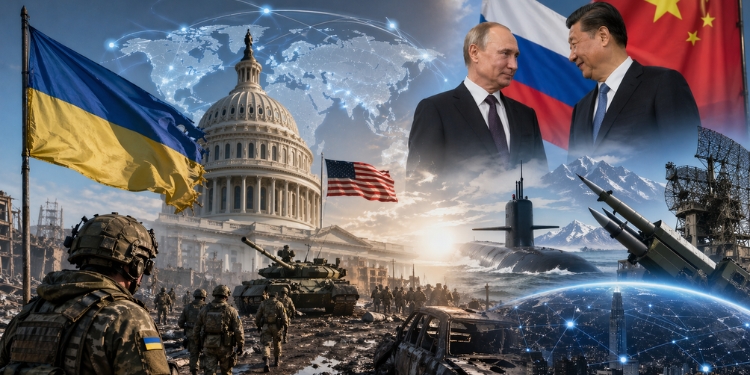

More than four years have passed since Russian tanks crossed the Ukrainian border, and the war shows no real sign of ending. Peace talks have stalled, ceasefires last a day and fall apart, and the diplomatic ground keeps shifting under everyone’s feet. But while the world watches the front lines, Russia is making moves that go far beyond Ukraine. Moscow has a bigger game in play, and the United States sits right in the middle of it.
So what is Russia actually trying to do? And how does all of this affect America? Let’s walk through it.
The War in Ukraine
The battlefield in Ukraine has reached something close to a stalemate. Russia occupies roughly twenty percent of Ukrainian territory, including Crimea, most of the Luhansk region, and parts of Donetsk, Kherson, and Zaporizhzhia.
Moscow’s forces have been making small gains, but the cost in soldiers and equipment has been enormous. Russian advances have been slowing since late 2025, and in early 2026, Ukraine actually managed to push back in the southeast, reclaiming hundreds of square kilometers for the first time in over a year.
👉 Trump’s Best-Kept Secret Just Leaked – And It Could Save Your Life
But that doesn’t mean Russia is losing. Actually, Putin is grinding forward at a pace that is painful for both sides and the Kremlin’s strategy here is not complicated. Moscow believes that time is on its side. If the war drags on long enough, the thinking goes, Western support for Ukraine will weaken, European unity will crack, and eventually Kyiv will have no choice but to accept whatever terms Russia puts on the table.
And those terms have not changed. Here’s what Russia actually wants:
- Full control of four Ukrainian regions – Donetsk, Luhansk, Kherson, and Zaporizhzhia. including the parts its forces have not even conquered yet.
- A permanent end to Ukraine’s NATO ambitions – a binding guarantee that Ukraine will never join the alliance.
- Western acceptance of these demands as the starting point for negotiations – meaning the West should come to the table already agreeing to Russia’s baseline, and anything else gets discussed from there.
Kremlin spokesman Dmitry Peskov said it in April 2026: the special military operation will continue until Zelenskyy accepts Russia’s conditions.
Peace Talks That Go Nowhere
 The Trump administration has been pushing hard for a deal. Several rounds of talks were held in the UAE and Switzerland in early 2026, with U.S. envoys Steve Witkoff and Jared Kushner representing Washington.
President Zelenskyy said at one point that ninety percent of a potential peace deal had been agreed upon with Trump.
But the remaining ten percent, the question of territory, is the part that matters most. Russia refuses to budge on territorial demands. Ukraine refuses to hand over land that Russian forces haven’t even taken.
The gap between these two positions is enormous, and no amount of shuttle diplomacy has been able to close it.
An Orthodox Easter ceasefire in April 2026 was supposed to offer a glimpse of what peace could look like. It lasted thirty-two hours on paper. In practice, both sides accused each other of thousands of violations before it was even over. Ukraine recorded over two thousand breaches. Russia claimed nearly the same number from the Ukrainian side. The whole thing was a reminder of how deep the distrust runs.
Meanwhile, Washington’s attention has shifted. The conflict in the Middle East involving Iran pulled American focus away from Ukraine in recent months, and the momentum behind peace talks slowed considerably. For Russia, this is not a problem. It is an opportunity. Every day the world looks somewhere else is a day Moscow can keep pressing its advantage without serious diplomatic pressure.
The China Factor
Perhaps the most important part of Russia’s broader strategy has nothing to do with the battlefield at all. It has everything to do with Beijing.
Russia and China have been building their partnership for years, and in 2026, the relationship is deeper than ever. Putin is set to visit China twice this year, including a trip to the APEC summit in Shenzhen in November. The two countries are coordinating through the UN Security Council, the Shanghai Cooperation Organization, and BRICS.
China’s foreign minister Wang Yi and Russia’s security council secretary Sergei Shoigu met in Beijing in early 2026 to talk about strengthening their cooperation in what they called an increasingly turbulent international environment.
Why is this partnership important? China has become Russia’s dominant supplier of dual-use goods, meaning products that can be used for both civilian and military purposes. By 2023, China accounted for around two thirds of Russia’s dual-use imports. That includes critical microelectronics and drone components that go straight into the Russian war machine. Europe has imposed sanctions, but the flow of goods continues. Read more about China’s next move.
In return, Russia backs China on Taiwan. Putin has reaffirmed support for the one-China principle, and Russian officials have publicly criticized any moves they see as threatening stability in the Taiwan Strait. This is not just diplomatic courtesy. It is a strategic exchange. China keeps Russia’s economy and military supplied. Russia gives China political cover on the issue that matters most to Beijing.
3 Alarming Signs the USA Is in Serious Danger of an EMP Attack
For the U.S., this partnership creates a serious problem. Washington is now dealing with two major powers that coordinate their foreign policy, support each other economically, and share a common interest in reducing American influence around the world.
The old hope that the U.S. could peel Russia away from China, or the other way around, looks increasingly unrealistic. Analysts have pointed out that even a change in Russian leadership after Putin would not automatically reverse the tilt toward Beijing. Russian society has shifted, and the suspicion toward the West runs deep.
The Nuclear Problem
 There is another dimension to Russia’s strategy that doesn’t get enough attention. The New START treaty, the last remaining nuclear arms control agreement between the United States and Russia, expired in February 2026. There was no replacement deal. There were no serious negotiations to extend it.
This means, for the first time in decades, there is no formal limit on the number of nuclear weapons the U.S. and Russia can deploy. Together, the two countries hold about eighty-seven percent of the world’s nuclear warheads.
Without the verification measures that New START provided, including on-site inspections and data exchanges, neither side can be fully confident about what the other is doing.
Russia proposed a voluntary, non-binding agreement to stay within the old treaty’s limits for another year. Washington never gave a formal response. The Trump administration has not shown much interest in traditional arms control, and Moscow, despite its public statements about strategic stability, has been modernizing its nuclear forces aggressively.
It’s important to note that the actual risk is not that someone launches a nuclear strike tomorrow. Without any guardrails, both sides start creeping toward higher deployed numbers, and other nuclear states like China follow suit. The global arms control architecture that kept the world relatively stable for half a century is falling apart, and nobody seems to be in a hurry to replace it.
Challenging American Influence Everywhere
Russia’s moves are not limited to Ukraine and nuclear politics. Moscow is actively working to challenge American influence in multiple regions at once, and it is doing so on fronts that most people are not paying close attention to.
Here’s where things are heating up:
- The Western Hemisphere. Tensions between the U.S. and Russia flared when the U.S. Coast Guard seized a Russian-flagged tanker near Venezuela that was allegedly violating sanctions. Russian naval assets, including a submarine, were operating nearby at the time. Moscow called it piracy. It was one of the most direct confrontations between U.S. and Russian forces in years.
- The Arctic. Russia is leveraging its control over the Northern Sea Route to boost its geopolitical importance. As ice recedes and the route becomes more navigable, Moscow has positioned itself as the gatekeeper of a potentially major trade corridor between Asia and Europe. China’s interest in what it calls the Polar Silk Road only adds to Russia’s leverage.
- The Middle East. Russia has tried to maintain its position as a power broker, though the recent conflict involving Iran has exposed the limits of what Moscow can actually do in the region. Russia condemned the operations against Iran, but it did not take any military action. The war in Ukraine has consumed too many resources for Russia to project real force elsewhere.
Through all of this, Russia pushes the same message in international forums. Moscow wants a multipolar world, meaning a world where American dominance is replaced by a system where several major powers, including Russia and China, have equal say.
👉 The Shocking Facts That Are Keeping Top Right-Wing Politicians Up at Night
Every summit, every BRICS meeting, every SCO gathering reinforces this theme. Russia’s foreign policy is built around the idea that the American-led international order is both unfair and unsustainable, and that the future belongs to countries willing to stand up to it.
What This Means for US…
Multiple national security studies have concluded that after natural disasters, the single greatest threat to modern civilization is a sustained, deliberate blackout. And Russia has already proven it can do it. In 2015 and 2016, Russian-linked hackers took down parts of Ukraine’s power grid, leaving hundreds of thousands in the dark. Since then, U.S. intelligence agencies have warned that Russian cyber operatives have been probing American energy infrastructure.
This is the new warfare. You don’t need to send tanks or launch missiles – you just target a country’s grid and watch everything collapse. The fuel stops pumping, the heat shuts off, and communication dies overnight. And the hard truth? Alternative energy isn’t accessible enough to save most families when that happens.
Will Russia use this strategy against the U.S.? We don’t know. But the capability is there, the motive is there, and the window is growing.
So, will you be ready? No matter your answer, you need to start training yourself now – before the chaos unleashes.
In this case, I personally vouch for Dark Reset as one of the best resources for learning how to survive and thrive in a blackout. It’s practical, actionable, and built for real people, not doomsday preppers. If you read one thing after this article, make it Dark Reset.
But knowledge without power is only half the battle. The Off-Grid Generator is the backup every home needs – portable, silent, and completely fuel-free. It charges from the sun or a wall outlet, and when the grid drops, it keeps your fridge, phones, lights, and medical devices running while you stay in control.
And if you are looking for true energy independence, the 3D Solar Innovator captures sunlight from every angle, outperforming traditional panels even in bad conditions. It’s the kind of setup that keeps your house running while everyone else goes dark.
You may also like:
 6 Signs to Watch for Before a Russian Nuclear Strike
This Upcoming Conflict Will Change Our Lives in Ways We’re Not Ready For (VIDEO)
The Secret Chinese Farms on US Soil
Safest Places to Hide in Nuclear War
EMP Myths You Need To Stop Believing Before It’s Too Late
Read the full article here
