
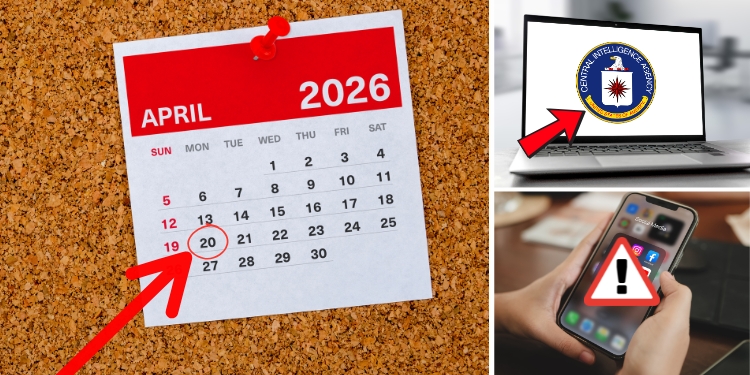

At first glance, the date itself might not mean anything to you. It blends into the calendar like any other spring day. You are most probably thinking about work, bills, plans for the weekend, maybe even summer coming closer. And that is exactly why you should care about this date.
There is no public event related to it, even though it sits at the intersection of human rights and technology.
April 20, 2026, could reshape society as we know it, and that alone is a damn good reason to mark it on your calendar.
How Fast Everything Can Shift
Before telling you what happens on April 20, you need to understand this.
The idea that a country like the U.S. can change overnight feels unrealistic to a lot of people. There is a deep assumption that stability is a major part of the system, that rights are respected, and that any major crisis will be solved in a matter of days.
This illusion is shattered when you realize that… things have never worked that way.
Estimates suggest there are somewhere between 20 and 25 million preppers in the United States today. That number has grown steadily, especially over the past few years. These are people who have looked at the direction things are moving and decided they do not want to rely entirely on a system that can change without warning.
👉 The Amish Have Been Warning Us of TEOTWAWKI. Here’s What You’ve Been Missing This Whole Time!
Even with that growth, most folks remain exposed. The average household depends heavily on the grid. Digital infrastructure controls access to money, while information is widely available through social media. Now, our Government has access to tools that can map and monitor activity at a massive scale, something that was impossible not so long ago.
Freedom, as most people experience it, depends on these systems staying within certain boundaries. That’s why April 20th is a big deal.
The Day Your Privacy Could Be at Risk
 FISA Section 702 is a U.S. law that allows FBI, CIA and other agencies to monitor communications of certain non-citizens located outside the United States.
In practice, it allows these agencies to gather data from emails, messages, and internet traffic, without getting a warrant. Their justification is national security.
The government says this helps track external threats such as terrorism, cyberattacks, and espionage. The controversial part is how this affects Americans.
Even though the law is aimed at foreigners, Americans’ communications can get picked up if they are talking to or interacting with those foreign targets. That data can then be stored and later searched by agencies like the FBI. Critics argue that this creates a “backdoor” way to access Americans’ data without a warrant, while supporters say there are safeguards and oversight in place.
Another issue is that modern systems can process huge amounts of data, and with AI tools becoming more advanced, analysis of that data is faster and more detailed than before. That raises concerns about how much visibility the government can have into digital life, even if indirectly.
So, if this bill expires, is it good or bad for you? It depends from what angle you are looking at it.
- If it expires, you get more privacy, and the government has less access to data, but they also lose an important tool used to track threats inside our country.
- If it gets renewed, the government keeps that surveillance power, which helps with security, though concerns about privacy and misuse stay in place.
What Happens When Surveillance Meets AI
Surveillance has always been a sensitive issue. But once artificial intelligence enters the picture, the scale will change in ways we have never imagined.
AI doesn’t just collect data – it studies it, connects patterns, and slowly builds a clearer understanding of human behavior. And even worse, much of our daily life already exists in digital form. Messages, emails, payments, location, browsing, even the way people interact online all leave small traces behind. On their own, those traces don’t seem important, but together, they can put your life in danger.
China is a very good example of this. The government there runs one of the most advanced surveillance systems in the world. Cameras with face recognition are everywhere, so payments, social media, travel, and even small daily actions can be tracked and analyzed. All of this feeds into a system that can restrict access or put pressure on those who are trying to fight the system
THIS Is How the End of U.S. Will Look Like (According to Experts)
The U.S. is not operating in the exact same way, but the direction is not as far apart as you’d think. The main difference is in how it is done. In China, control is direct and visible. In the U.S., it is more subtle. Surveillance and data collection are built into laws, and through companies and social platforms. These are things we all accept without blinking twice.
It’s also a moment to pay closer attention to your privacy and how the government can break it again and again under laws that allow it. So, if you truly want to protect your privacy, there’s one method you must try. Even if it’s controversial, it is completely legal.
Find the answer in the video below:

What Happens If It Gets Renewed
If FISA Section 702 gets renewed, the biggest change will be not what the government can do, but how easily and how often it can do it.
Over time, that creates a different kind of environment:
- It becomes easier to spy on you. Agencies can dig through massive amounts of stored data with less friction, connecting dots between people and their behavior.
- Your data gets used for things you never agreed to. Information collected for one reason can end up being used for something completely different.
- Nothing gets deleted. Old messages, searches, and activity logs become more useful over time as AI gets better at finding patterns in them.
- Machines start making decisions about you. Automated systems flag people before any human even looks at the case and you’d never know it happened.
- The line between “foreign” and “American” data disappears. The moment your communication crosses a border, which happens constantly online, it’s fair game.
- Nobody explains what’s going on. The more complex the system gets, the less anyone outside of it can understand or challenge what’s happening.
You can’t opt out of the system, but you can reduce what you leave behind. Switch to encrypted messaging. Use a VPN. Be selective about what lives in the cloud. Also, make sure you pay cash when it matters and, last but not least, assume that anything you put online today could be analyzed years from now with tools that don’t exist yet.
What matters is how prepared you are to operate within whatever comes next. This is why you need The Bug-in Guide in your home at all times. It teaches you how to protect your privacy and your family, while still using the internet (it’s a great tool, you can’t deny that). Also, you will learn some hand-on strategies to live off-grid, to have full privacy and also to be connected in a safe way. 👉 I want to see a preview of the book!
What Happens If It Doesn’t Get Renewed
 On the surface, it sounds like a win. Less surveillance, more privacy, fewer agencies digging through your data without a warrant. And in some ways, it is.
But here’s what most people miss: the threat doesn’t disappear when the law expires. It just changes shape. Without Section 702, intelligence agencies lose one of their most used tools for tracking foreign threats before they reach U.S. soil.
Cyberattacks, espionage, terrorism – these don’t pause, they adapt. And so will the agencies trying to stop them. That means pressure builds fast to find workarounds: emergency orders, new legislation rushed through, or expanded use of tools that already exist outside of 702’s framework.
Moreover, the surveillance doesn’t stop either; it just becomes less transparent and harder to track. There’s also the data that’s already been collected, years of it. Expiration doesn’t erase what’s already stored, and it doesn’t limit how that data gets used going forward.
So, if you were expecting expiration to feel like a clean break, it won’t. What it actually creates is a window of uncertainty. A gap between old rules and whatever replaces them, and gaps like that rarely favor the average person.
The bottom line? Whether it’s renewed or not, if you don’t have a plan that works independently of it, you’re still exposed. So, you need to go even a little bit further with your prepping game and learn how to be more self-sufficient.
Not only what you are stockpiling and how often you are rotating, but also learning skills that have great value now and when SHTF. So, for any HOW TOs you want to know – from building a bicycle generator, to making a faraday cage or even how to make toilet paper, we’ve got you covered. Click here to find out more.
Why You Need a New Plan by April 20th
Once your property shows up in a database or satellite record, it never truly disappears again. With tools like FISA Section 702 allowing agencies to store data indefinitely, and AI growing more capable of pattern recognition every year, what gets captured today can be analyzed years from now. Distance alone no longer protects you. What protects you is how little you depend on the systems doing the watching.
That dependency shows up most clearly in how you feed yourself.
In an emergency, the fastest way to become exposed is having to leave home for food and supplies. Every trip to a store is a transaction. Every transaction is a data point. Every data point builds a clearer picture of who you are, where you are, and what you need.
Whether Section 702 gets renewed on April 20th or lapses, the truth is your privacy is no longer safe. The infrastructure is already in place. The data already collected doesn’t disappear. Anyone who still depends on outside supply chains remains visible, trackable, and vulnerable in ways that no VPN can fully fix.
Autopilot Homestead is an excellent course built around the simplest way to remove that dependency, by showing you how to grow your own groceries, preserve what you produce, and build a long-term stockpile that doesn’t rely on stores or supply chains. Even if you think you already have a sturdy stockpile, THIS COURSE will prove you wrong.

Therefore, if you want a food system that keeps you steady when everything else becomes uncertain, you can start here. Enroll now and enjoy this exclusive course – only for Ask a Prepper’s Readers!
 We Have a New WhatsApp Channel – Click Here to Join Our Community!
How to Make Your Home Invisible (VIDEO)
The Pentagon Will Remove Your Off-Grid Location. Here’s Why
Digital Security 101: How to Protect Your Privacy Online
How to Hide Your Phone From 3-Letter Agencies
Read the full article here
