

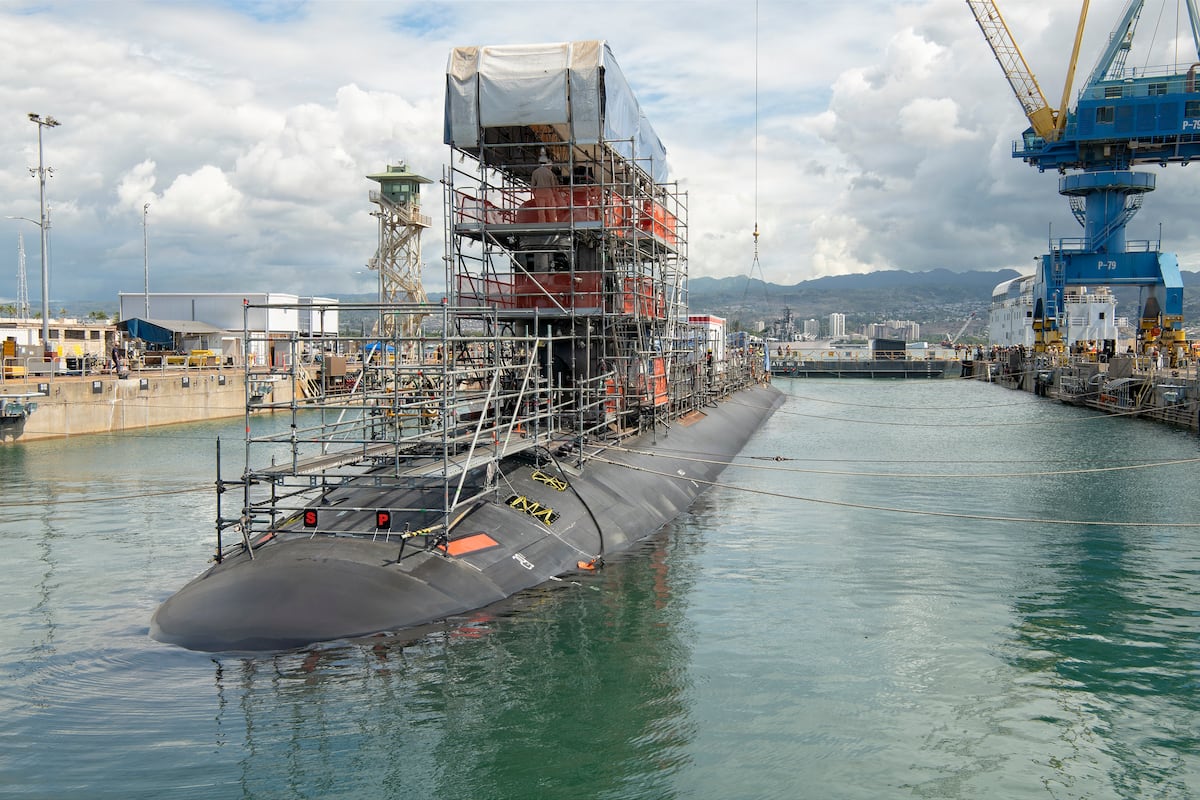

Maintenance delays for U.S. Navy attack subs have resulted in boats that are frequently idle in port when they should be at sea.
Over the last decade, “these delays resulted in an estimated $3.4 billion in costs to sustain crews and submarines that provided no operational capability,” according to the Government Accountability Office study.
Perhaps even worse for a Navy already overstretched and exhausted, maintenance backlogs for attack subs between 2016-25 resulted in 15,000 lost operational days. This includes “active idle time,” when submarines and their crews “must remain pier-side because they are no longer certified to conduct normal operations and cannot be inducted into a maintenance period,” the GAO report found.
In other words, the Navy is stuck paying for a fully-crewed submarine that cannot be deployed.
For Los Angeles-class subs, active idle time is costing almost $220,000 per day for the entire group. For the Virginia-class, that figure is more than $237,000 per day.
“Active idle time increases the strain on the heavily used sub fleet,” Diana Maurer, a director of GAO’s Defense Capabilities and Management team, told Defense News. “It’s essentially a traffic jam — subs waiting to get into dry dock for depot maintenance.”
Compounding the problem are shipyard delays in decommissioning nuclear submarines that have cost $722 million from 2016 to 2025. Such “inactive idle time” means boats must “remain pier-side until a shipyard has the capacity in a dry dock to defuel their nuclear reactor.”
For example, the Los Angeles-class submarine USS Pasadena became inactive in January 2025, but is not expected to enter Norfolk Naval Shipyard for almost four years, until November 2028.
“During this time, the attack submarine is unable to be operational since its dive certification is expired, but is still fully crewed with sailors,” GAO noted.
While the Navy will use the boat as a training platform, GAO estimates the delay will cost more than $300 million.
While GAO credits the Navy with making progress in reducing active idle time, “inactive idle time for submarines has grown and is projected to worsen,” GAO warned.
Given current trends, the Navy will be stuck with 15 subs and 14,000 days of inactive idle time between 2026 and 2030, at an estimated cost of $3.1 billion.
Maintenance for nuclear subs is performed at four public shipyards: Portsmouth Naval Shipyard, Norfolk Naval Shipyard, Puget Sound Naval Shipyard and Pearl Harbor Naval Shipyard. Certain maintenance can also be done at two private shipyards: General Dynamics Electric Boat in Groton, Connecticut, and Huntington Ingalls Industries Newport News Shipbuilding in Newport News, Virginia.
While one solution would be to expand the capacity of shipyards already suffering from aging infrastructure and shortages of labor and materials, revitalizing shipyards will take years.
In the meantime, Navy officials told GAO that one alternative is to allow nuclear reactors to be defueled while the subs are pier-side, rather than waiting for a slot at a shipyard.
“However, officials were unable to provide documentation of detailed analyses conducted on the feasibility and cost-effectiveness of this option,” the report noted.
Using floating dry docks for defueling is another option, though this “would require additional analysis to determine technical viability.”
For inactive subs awaiting decommissioning, the Navy is looking at transferring crews to active boats over months or years until a shipyard slot opens. Nonetheless, Navy officials believe this option is still limited by lack of shipyard capacity.
As for extending the service life of submarines to avoid decommissioning backlogs, “these service life extensions are still pending approval,” the report noted.
Issues identified by GAO are another chapter in the Navy’s long-running maintenance saga.
“The problems we reported for attack subs are similar to what we’ve seen over the years in other parts of the fleet,” Maurer said.
Michael Peck is a correspondent for Defense News and a columnist for the Center for European Policy Analysis. He holds an M.A. in political science from Rutgers University. Find him at theuncommondefense.com. His email is [email protected].
Read the full article here
