

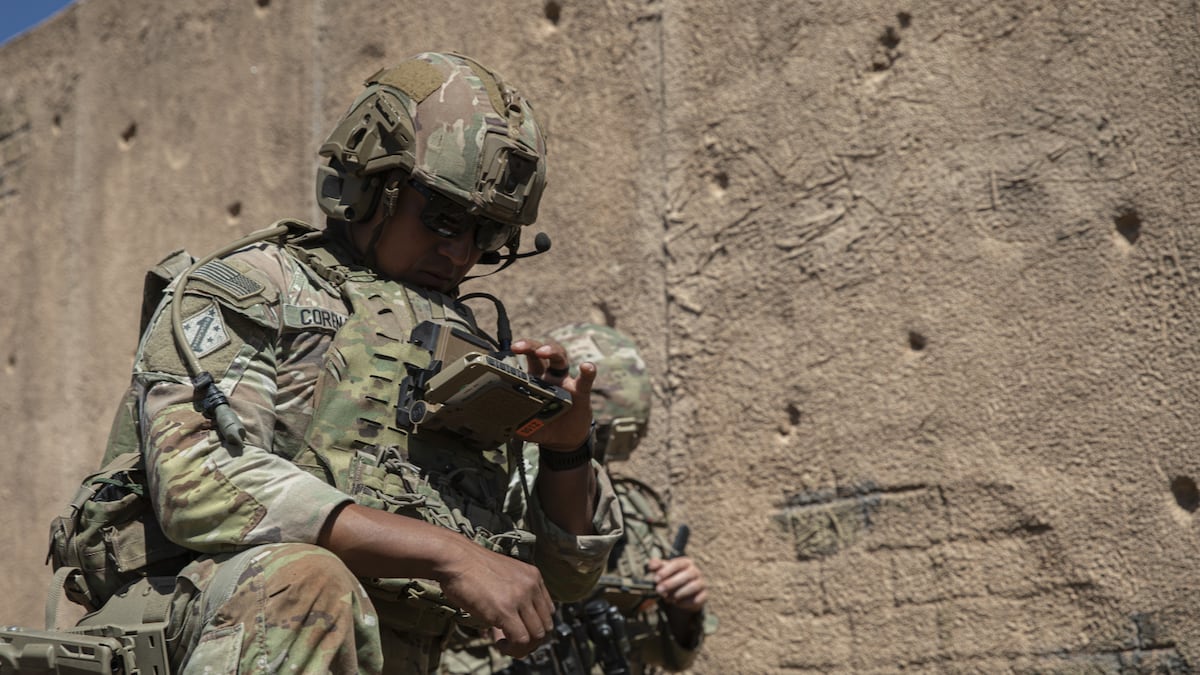

The U.S. Army launched a new data center earlier this month to support the flow of information from the military’s vast troves to commanders and soldiers on the battlefield.
The Army Data Operations Center’s April 3 debut is part of an enormous push to further integrate data and machine learning into military operations, according to a Pentagon release.
The armed forces have used data from military, intelligence and business sources for the past several years.
Historically, that has been a somewhat cumbersome process, as different datasets are often separated from one another, necessitating different security clearances, or housed on different systems. The ADOC is meant to mitigate those issues, functioning as a kind of information hub.
“We don’t have a data problem. We have a data management problem, and data becomes the ammunition that we need to provide to our senior leaders in order for them to make quick and informed decisions and gain decision dominance,” Lt. Gen. Jeth Rey, deputy chief of staff for the Army G-6, said in the release.
The office will be housed under Army Cyber Command, the release states. It is scheduled to run as a pilot for six months, with the Pentagon potentially adopting it as a model, DefenseScoop reported.
Although data could have many military uses, the Army is emphasizing its use in battlefield decision-making, such as targeting.
That’s not new, but there should be a broader focus on artificial intelligence integration into other areas, experts told Military Times.
“Most of the AI development had all been toward enemy-centric targeting, looking for and refining that enemy target and helping us basically build out target sets and hit more faster, essentially target more faster in one way or another,” Wes Bryant, a former U.S. Air Force joint terminal attack controller and Pentagon whistleblower, told Military Times.
“But you didn’t really have much of anything to the civilian environment,” Bryant continued. “That was one thing we were working on at the [Pentagon’s Civilian Protection] Center of Excellence — looking at ideas for AI integration in civilian environment mapping, in updating no strike lists in given areas.”
Jon Lindsay, associate professor at the School of Cybersecurity and Privacy and the Sam Nunn School of International Affairs at the Georgia Institute of Technology, said that AI is best suited to more mundane organizational tasks, such as “planning, intelligence, logistics administration.”
The Department of Defense has also put out contracting opportunities for commercial data centers on four U.S. military bases.
Two bases, Dugway Proving Ground, Utah, and Fort Bliss, Texas, have entered into agreements already, according to a March 2026 release.
Fort Hood, Texas, and Fort Bragg, North Carolina, are also listed as potential sites for the data centers, which provide the computing power and hardware for AI models and cloud services.
Under the agreements, the data centers would be operated by civilian firms but would provide computing power for the military’s use, according to Task & Purpose.
Those data centers are part of a government-wide effort to pursue “a golden age for American manufacturing and technological dominance,” per a July 2025 executive order.
The effort to achieve artificial general intelligence is a “race that has a very short-term horizon,” Ismael Arciniegas Rueda, a senior economist at the RAND Corporation, told Military Times.
Housing the data centers on Army bases could provide an extra level of security for the centers, which are vulnerable to cyber and kinetic attacks.
But they also present potential downsides to the communities where they are built, like tremendous energy consumption.
That, combined with an aging power grid, is likely to drive up energy costs in the surrounding areas.
Read the full article here
