

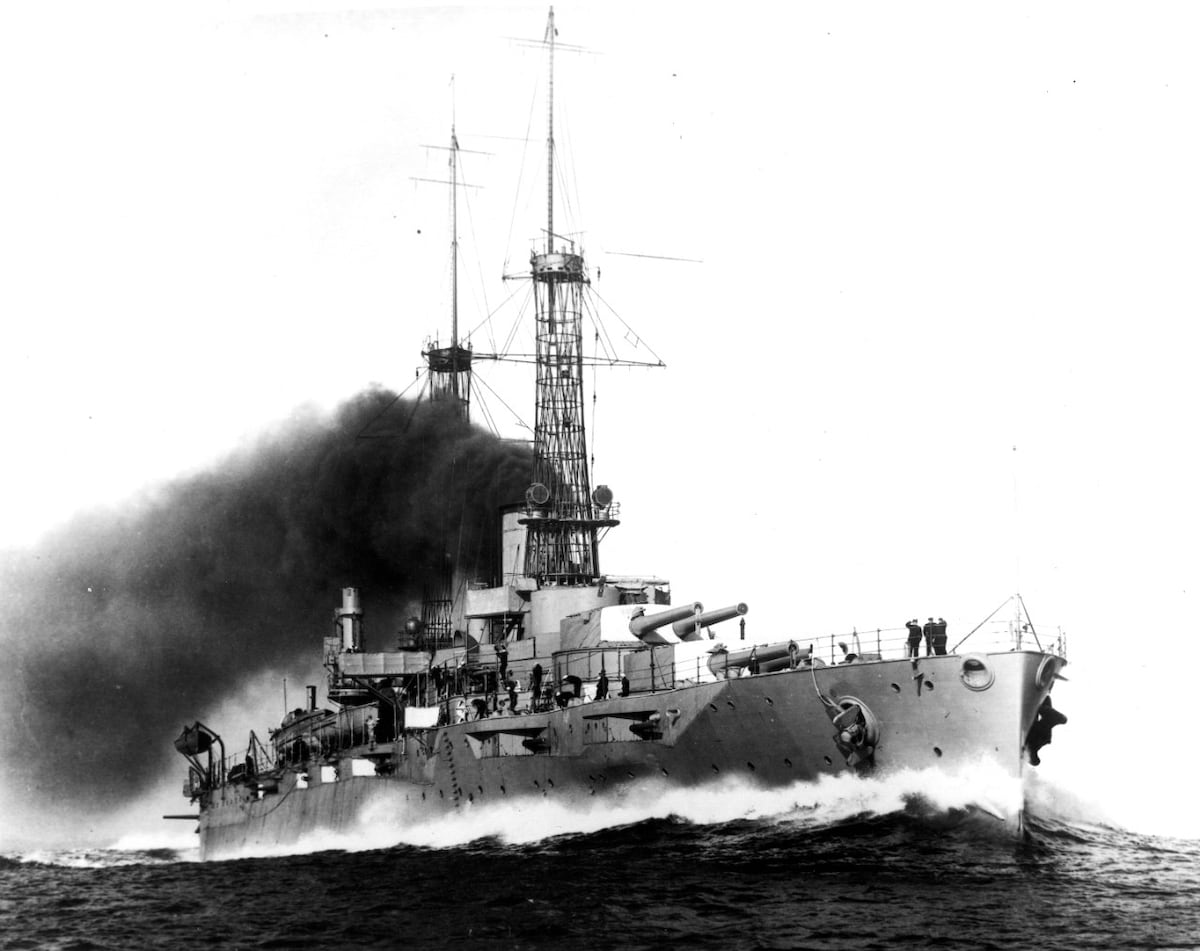

Little is known of Wilhelm Smith’s background, save that he was born on April 10, 1870, in a German Empire that would formally unite in the following year. Since then, he emigrated to the United States and enlisted in the U.S. Navy. By January 1916, he was serving as a gunner’s mate third class aboard the battleship New York (BB-34), one of the most up-to-date and powerful warships of its kind. For all that, though, New York was served by a variety of seamen and engineers in an often claustrophobic labyrinth of chambers and passageways. On Jan. 24, 1916, one of New York’s crews within a crew were reminded of how dangerous even a routine procedure could be.
The Great War in Europe was raging at that time, but the United States was still neutral, with the New York helping to maintain that neutrality. Amid all the maintenance activity, Coxswain W.L. Campbell, in charge of the 1st Division, ordered the sanitary tank in section A12 opened for cleaning by three crewmen.
Of them, P. J. Walsh, J. Paone, and L. L. Nerling thought the tank sufficiently ventilated, but plumber R.M. Traynor, upon examining the train and suction valves, judged the air still too foul. At the same time, Smith led another sailor, Peter G. Walsh into the handling room. They also thought their room sufficiently aired out — until Smith discovered that Walsh was unresponsive and jammed in the cramped quarters below, overcome by the fumes.
Besides the difficulty that presented itself dislodging Walsh from the handling room, Smith himself faced extraordinary difficulty going down there, being of stocky build and 192 pounds. Regardless, he procured a rope, which he tied around Walsh and passed his limp body out of the room — only to be himself overcome by the fumes. Fortunately, his fellow crewmen retrieved him and rushed him and Walsh to the sick bay, where they were resuscitated.
Word of Smith’s rescue of Walsh spread throughout the ship, leading to a citation from the 1st Division officer: Navy General Order — New York:
“Peter J. Walsh, ordinary seaman, undoubtedly owes his life to the prompt and heroic action of Wilhelm Smith, gunner’s mate, first class, who unhesitatingly risked his own in order save that of his shipmate. Such action is a shining example of fearlessness, unselfishness, and heroism, and merits the highest commendation and praise. It is recommended that the department award Smith a medal of honor…”
Smith was awarded the Medal of Honor on April 6, 1916 — a somewhat ironic date, since exactly one year later his adopted country declared war on the nation he’d left behind. For the next year and a half after that, New York patrolled the Atlantic Ocean against German submarines, disguised raiders and other enemy warships.
During that time, more medals would be earned of greater magnitude, but that lay in the uncertain future when Smith got his, judged by the peacetime standard of the time.
Smith was a chief gunner’s mate when he died on Oct. 30, 1925, aged 55, and was buried in Cypress Hills National Cemetery on Brooklyn, New York. He would not be around to see his ageing battlewagon participate in a second world war, contributing its 14-inch guns to supporting American landings at Normandy on D-Day, June 6, 1944, or at Iwo Jima and Okinawa in 1945.
There was, however, at least one shipmate who owed his longevity aboard USS New York to Wilhelm Smith.
Read the full article here
