

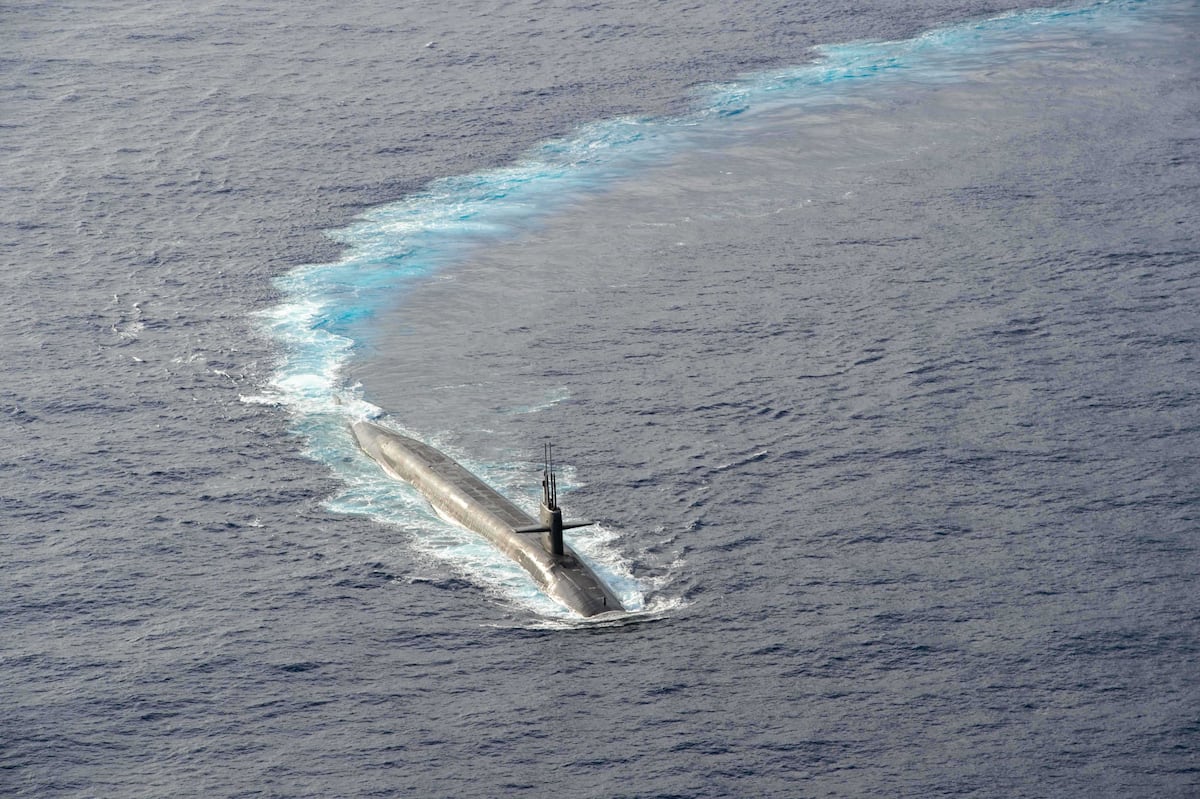

At about 5 p.m. Eastern Standard Time on June 21, a U.S. Navy nuclear-powered submarine launched over two dozen Tomahawk land attack cruise missiles into Iran, striking targeted infrastructure sites in Isfahan.
Shortly after the Tomahawks were fired, fighter aircraft and B-2 Spirit stealth bombers swept over Iran, culminating in the destruction of Iranian nuclear facilities with the force of 14 GBU-57 Massive Ordnance Penetrators, known as “bunker busters.”
While the B-2 bombers and bunker-buster bombs are so far dominating discussions of the mission, titled Operation Midnight Hammer, the Ohio-class submarine performed a critical role in it, too.
The specific vessel that fired the missiles has not yet been identified, but Secretary of the Navy John Phelan confirmed to lawmakers in a Senate Appropriations subcommittee hearing Tuesday that it was an Ohio-class guided-missile submarine that had “performed exceptionally, causing significant damage to Iran’s nuclear capacity.”
Stealth and surprise
The Ohio class was originally designed as one of the Navy’s ballistic-missile submarines. Powered by a nuclear reactor, it was also designed to carry and launch ballistic missiles armed with multiple nuclear warheads.
At 560 feet long, the Ohio class can dive to over 800 feet below and maneuver at over 25 knots per hour. It has the capacity to carry 15 officers and around 144 enlisted personnel.
Four Ohio-class submarines were modified into guided-missile submarines, enabling them to launch conventional land attacks and support Special Forces operations. These included the submarines Ohio, Florida, Georgia and the Michigan.
It was a guided-missile submarine that delivered the strikes on Iran.
As a guided-missile submarine, each Ohio-class has a modified interior that allows it to transport over 66 SOF operators and underwater vehicles. It is also designed to launch up to 154 Tomahawk land attack cruise missiles and has about 22 missile tubes on average.
It is stealth, rather than sheer firepower, that makes an Ohio-class submarine — whether carrying nuclear warheads or guided missiles for land attacks — truly formidable. Designed as a nuclear deterrent and part of the U.S. strategic nuclear triad, the Ohio-class was built for longevity and to evade detection, requiring minimal maintenance stops.
The Tomahawk lends itself to flexibility, and so the choice to use an Ohio submarine to launch this type of missile in Operation Midnight Hammer was not a foregone conclusion.
The precision cruise missile can penetrate air defenses to strike targets with nearly hairpin precision from over 1,000 miles away, and can be commanded to change course in flight instantly.
Tomahawks were recently fielded in Operation Rough Rider against Houthi rebels and were launched continuously from the aircraft carrier Harry Truman during over 50 days of combat.
While other types of Navy vessels could have successfully delivered the strikes, the choice of an Ohio-class submarine guaranteed a destructive array of firepower and a complete surprise. Use of the vessel also demonstrated the efficacy of the U.S. seaborne nuclear deterrent.
Despite its participation in the strike, the Ohio is due for replacement. The first of Navy’s 14 Ohio-class submarines will reach the end of its lifecycle by 2027 — making the launch of its intended replacement, the Columbia-class submarine, an urgent national priority.
The manufacture of the Columbia-class has stalled. Adm. James Kilby, acting chief of naval operations, told lawmakers Tuesday that the Columbia is currently forecasted to be delivered about two years late, in March 2029.
Zita Ballinger Fletcher previously served as editor of Military History Quarterly and Vietnam magazines and as the historian of the U.S. Drug Enforcement Administration. She holds an M.A. with distinction in military history.
Read the full article here
