

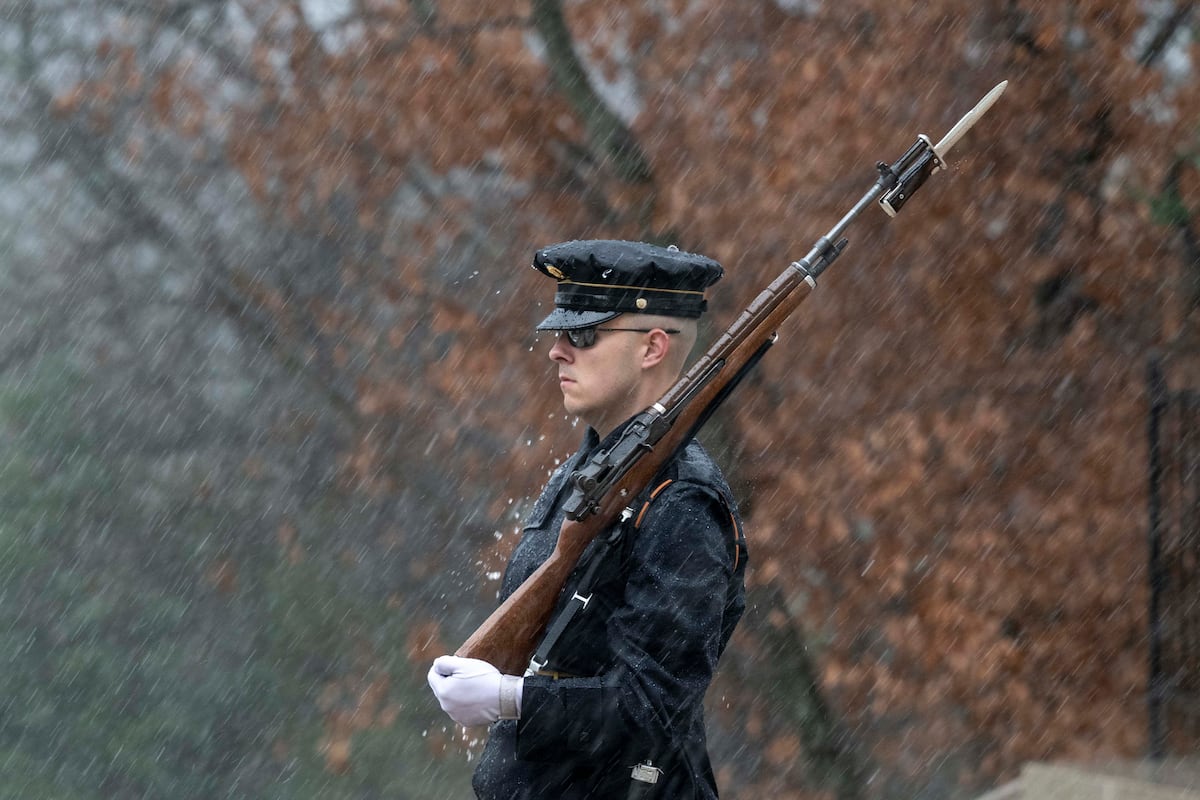

For over 100 years, Arlington National Cemetery has been the site of the Tomb of the Unknown Soldier, but it hasn’t always been guarded — or revered.
Following the soldier’s 1921 internment, the burial site was unguarded and often treated as a tourist attraction by visitors.
That is, until 1925, when “concern over the lack of respect led Army Maj. Gen. Fox Conner, the Army’s deputy chief of staff, to order an armed military guard on March 24, 1926,” according to the Department of Defense.
The first sentinel was posted the very next morning, with soldiers from the 3rd Infantry Regiment (the DOD erroneously identifies the 3rd Cavalry Regiment as the “Old Guard”) beginning what would become an unbroken vigil.
World War I
The English and French had honored and laid to rest their unknown soldiers in 1920 — in Westminster Abbey and at the Arc de Triomphe, respectively. Then, in October 1921, it was the United States’ turn.
The task of selecting a body to represent the thousands of unknown dead from the Great War was daunting. The United States still had not identified 1,237 dead soldiers, and, according to the U.S. Naval Institute, extraordinary care had to be taken to select a body that would not be identified later.
Four bodies were exhumed from the U.S. cemeteries of Aisne-Marne, Meuse-Argonne, Somme and St. Mihiel. Arriving at the city hall of Chalons-sur-Marne, France, on Oct. 23, French and American soldiers then rearranged the caskets to further obfuscate their origins.
The following day, Army Sgt. Edward Younger, an enlisted man, walked slowly toward the four flag-draped caskets. He had been given the honor of choosing the United States’ Unknown Soldier.
According to Arlington National Cemetery, Younger recalled that he thought of himself and his comrades as just “good, average soldiers” and believed that “none of the men had been decorated, nor had performed signal feats.” Speaking to a Washington Post reporter in 1930, he recalled that the process seemed arbitrary — simply being told, ‘I guess you’re the one, Younger. … You select the Unknown.’”
Younger approached the caskets, carrying white roses in his hand given to him by a former member of the Chalons City Council who had lost two sons in the war.
Younger circled the caskets three times, awed by the honor and responsibility he was tasked with. He later recalled in a first-person account:
“I began a slow march around the caskets. Which should it be? Thoughts poured like torrents through my mind. Maybe these buddies had once been my pals. Perhaps one of them had fought with me, had befriended me, had possibly shielded me from a bullet that might have put me in his place. Who would even know?”
Transported aboard a special funeral train, the Unknown Soldier was carried to Paris, and then on to the port town of Le Havre the following day. Marine Capt. Graves Erskine and his 38 hand-picked Marines readied the steel gray casket for its sea voyage by placing it in a rough wooden box wrapped in waterproof canvas.
The casket, too large to be carried through the hatch of the USS Olympia and to relative safety below, had to be lashed to the bow of the ship.
However, the ship almost didn’t make it. Two storms were roiling the ocean prior to the Olympia’s departure causing the Olympia to repeatedly roll to the point of capsizing.
Whether divine intervention or a fleeting weather pattern, the Olympia and its crew battled through, arriving on time and to much fanfare as the ship and its crew made its way up the Potomac River.
Ultimately laid to rest in Arlington National Cemetery in a ceremony attended by President Warren Harding, Vice President Calvin Coolidge, senior government representatives, Medal of Honor recipients and other military groups, the Unknown Soldier was finally home.
World War II and Korean War unknowns
Following the end of the Second World War, Congress authorized that two “unknown” candidates — one from the Pacific and one from the Western theater — be included in the selection, with the original date set for interment on Memorial Day, May 30, 1951.
However, with the outbreak of the Korean War, President Harry S. Truman postponed the internment.
According to the Society of the Honor Guard, by 1958, Congress directed the selection of a Korean War Unknown Soldier to lie in state at the U.S. Capitol Rotunda and be buried at Arlington National Cemetery alongside the World War II Unknown Soldier.
Col. Glenn T. Eagleston, a combat pilot in both WWII and the Korean War, was designated to select the unknown candidate to represent the Pacific Theater, while U.S. Army Maj. Gen. Edward Joseph O’Neil, was designated to make the selection of the European Theater unknown candidate.
Hospital Corpsman First Class William R. Charette, the U.S. Navy’s only active-duty recipient of the Medal of Honor, ultimately made the final selection of the WWII unknown.
President Dwight D. Eisenhower awarded the Medal of Honor to both.
Vietnam War controversy
A decade following the Vietnam War, there were calls from the American public to designate another unknown.
Known only as X-26, the remains of an American service member was being held in the U.S. Central Identification Laboratory in Hawaii. Found near a stream in An Loc in 1972, X-26 had remained unidentified for over a decade when the remains were selected to represent the nation’s missing from that war and buried at Arlington on Memorial Day, 1984.
During the ceremony, President Ronald Reagan awarded the Medal of Honor to the unknown.
However, in 1994, in the face of mounting evidence that their son, Capt. Michael J. Blassie, was the Vietnam War unknown, the family of the Air Force pilot submitted a formal request to the DOD to exhume X-26’s body and submit it for DNA testing.
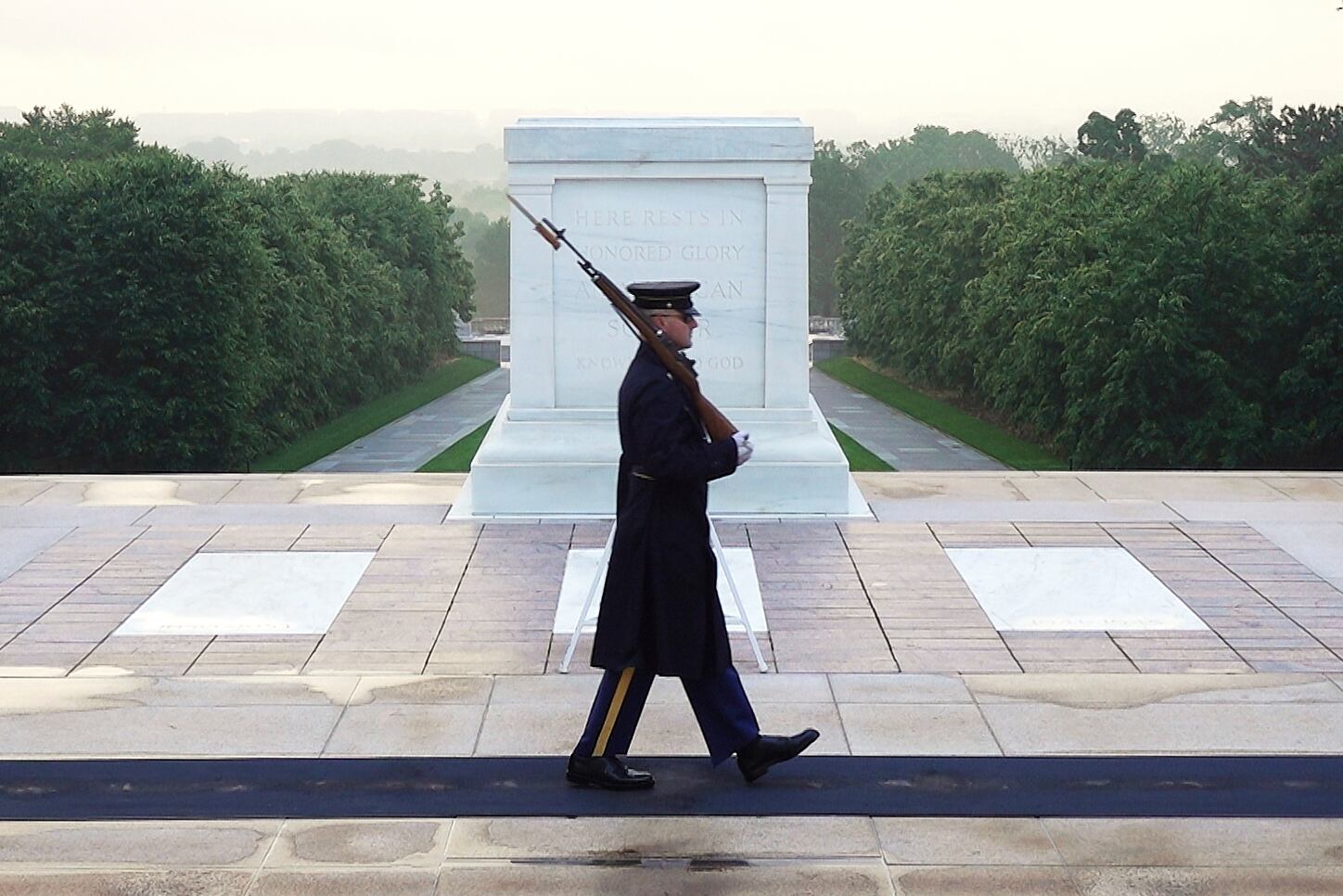
Of the exhumation, then-Secretary of Defense William Cohen remarked that, “we disturb this hallowed ground with profound reluctance. And we take this step only because of our abiding commitment to account for every warrior who fought and died to preserve the freedoms that we cherish.”
The remains were taken to the Armed Forces Institute of Pathology at Walter Reed Army Medical Center, and the test result confirmed on June 28, 1998, that the Unknown Soldier was indeed Blassie.
Several weeks later, an MC-130E aircraft from his former unit, the 8th Special Operations Squadron, flew his remains back to his home state of Missouri. He was then re-interred at Jefferson Barracks National Cemetery in Saint Louis County, Missouri, according to the Society of the Honor Guard.
The marble crypt that once honored him was ultimately changed to read: Honoring and Keeping Faith with America’s Missing Servicemen, 1958–1975.
Claire Barrett is an editor and military history correspondent for Military Times. She is also a World War II researcher with an unparalleled affinity for Sir Winston Churchill and Michigan football.
Read the full article here
