

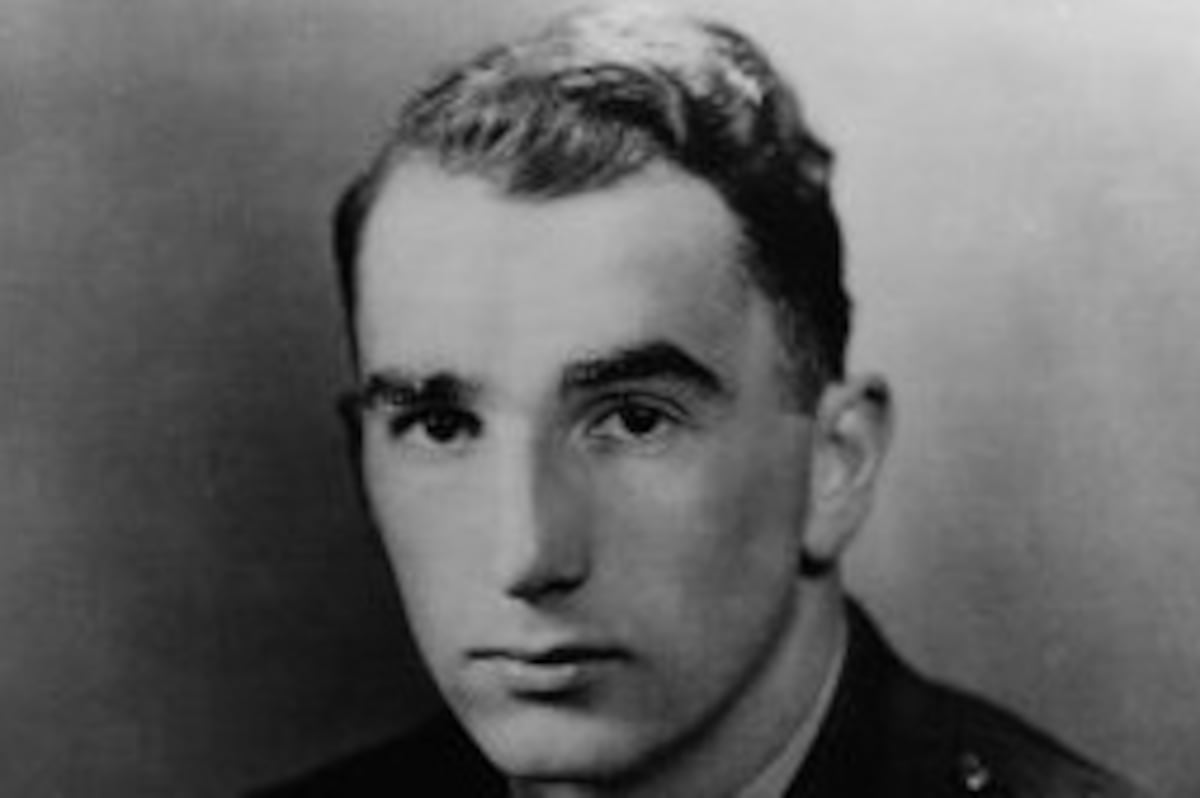

First used by the 1st Air Commando in World War II, the Sikorsky R-4 often fell short of its role in rescuing airmen downed in the mountains and rainforests of the China-Burma-India front but as the first helicopter designed to perform such tasks it set the precedent for a new generation of rotary aircraft. A vastly improved design, the Sikorsky S-61 first took off in February 1946 and got its baptism of fire just four years later when North Korea invaded the South. Among the pioneers who demonstrated what it could do was John Koelsch.
Born on Dec. 22, 1923, in London, England, to American parents, Koelsch and his family returned to the U.S. just one year later, settling in Briarcliff Manor, New York. Koelsch enrolled in Princeton University on Sept. 1, 1941, but when the United States entered World War II, he postponed his collegiate studies to enlist in the United States Naval Reserve on Sept. 14, 1942, and took up aviation.
He received his ensign’s commission on Oct. 23, 1944, and served in the Pacific, flying TBM Avengers. Koelsch returned to Princeton after the war, completing his education in 1949.
Koelsch had planned a career in law, but when news arrived of war in Korea on June 25, 1950, he applied for transfer from reserve to active duty, ditching the plane for a helicopter.
According to the Department of Defense, Koelsch made a name for himself while stationed aboard the USS Princeton, rescuing at least two crew members, designing devices to help with operations during Korea’s harsh winter, and developing a floating sling hoist that he used during the mission that saw him receive him the Medal of Honor.
On July 3, 1951, while piloting a Navy helicopter, Koelsch received word that Marine Capt. James V. Wilkins’ Vought F4U Corsair had been struck by North Korean anti-aircraft artillery.
Unarmed and with no fighter escort, Koelsch and crewmate, Petty Officer 3rd Class George Neal, set off towards the North Korean-held territory.
It was late in the day, overcast was thick and so was enemy ground fire, but without hesitation, Koelsch and Neal hastened out and managed to find him in what Wilkins later called “the greatest display of guts I’ve ever seen.”
Wilkins had suffered burned and injured legs, so Neal rode the rescue device down, exposed to enemy fire, but just as contact was made and Koelsch tried to lift off, his helicopter was hit and crashed on a mountaintop.
Neither Koelsch nor Neal were seriously hurt and over the next nine days Koelsch cared for Wilkins as best his limited resources allowed until the trio was finally found and taken prisoner.
By then, North Koreans had a well-established reputation as unpredictable captors, often prone to murder, but Koelsch found one with whom he could communicate and convinced him to treat Wilkins’ injuries separately.
He and Neal, on the other hand, underwent standard North Korean interrogation by torture, though neither gave up any information. After the signing of the armistice at Panmunjom on July 27, 1953, Neal and Wilkins were on the list of the surviving UN prisoners of war to be released.
Koelsch was not.
Records indicate that the pilot had died of malnutrition and dysentery on Oct. 16, 1951. Belated though it was, though, Koelsch had carried out his mission: the men he’d set out to rescue ultimately made it home.
On Aug. 3, 1955, Koelsch was posthumously awarded the first Medal of Honor issued to a helicopter pilot. He also received the Purple Heart and POW Medal, and on June 8, 1965, his name was given to the destroyer escort Koelsch (DE-1049), redesignated in 1975 as a missile frigate (FF-1049).
His partner Neal, who also happened to be among the first Black helicopter crewmen in the Navy, received the Navy Cross. Neal died on Dec. 1, 2016, aged 86, and both he and Koelsch are buried at Arlington National Cemetery.
Read the full article here
