

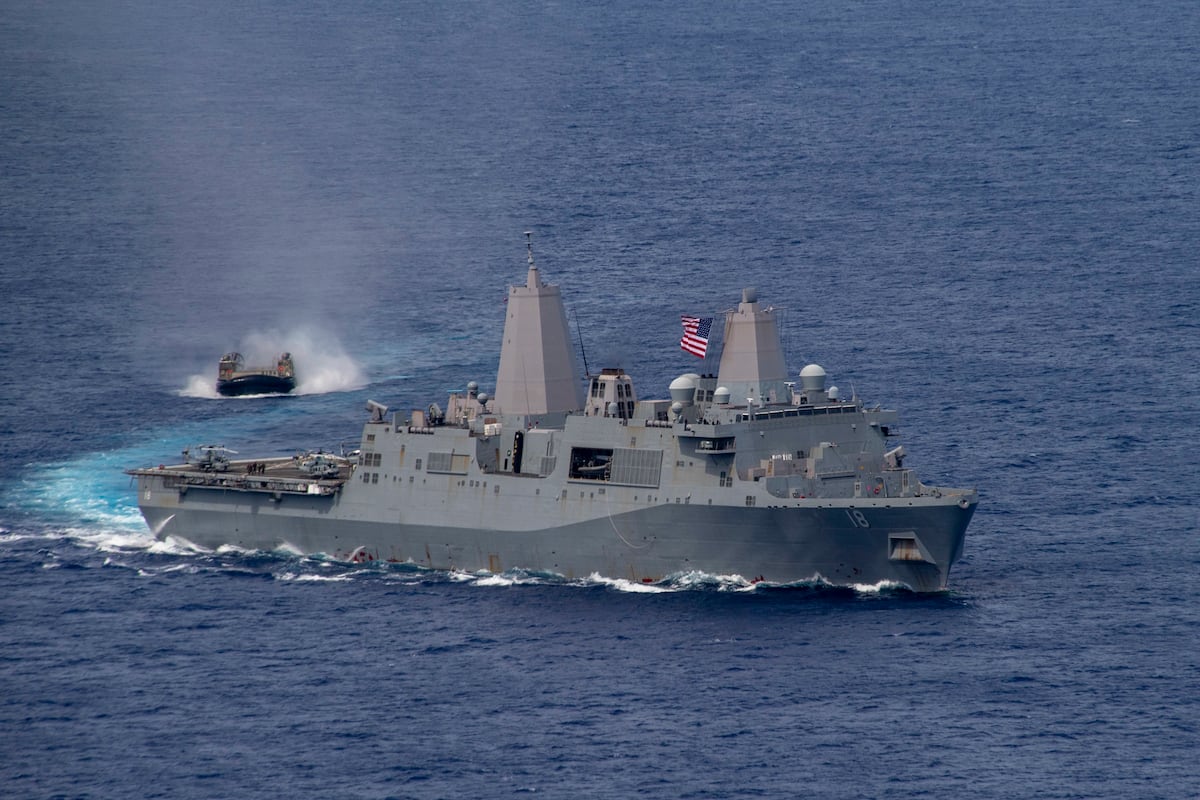

A U.S. Navy command investigation into a fire aboard one of its ships last year didn’t identify a root cause but said human error and poorly placed necessities exacerbated it.
On Aug. 20, 2025, an 11-hour blaze broke out aboard the San Antonio-class amphibious transport dock USS New Orleans off the coast of Okinawa, Japan, leading to approximately $12 million in damage. Sailors successfully extinguished the blaze, leaving two service members with minor injuries.
“As of the signing of this report, the NCIS investigation is ongoing, and the precise ignition source of the fire is unknown,” the report said. “As other causes (e.g., electrical, weather) have been ruled out, NCIS’ initial findings attributed the fire to human interaction, either intentional or due to negligence.”
The fire took an abnormal amount of time to suppress because 100 boxes of toilet paper blocked sprinkler heads inside a special clothing storeroom that would have otherwise helped douse the flames, the investigation found.
The toilet paper acted as kindling for the fire, making it grow larger and increase in duration.
Hazardous materials, such as aerosol cans, that were not supposed to be in the storeroom were also found present after the fire.
The ship’s crew and investigators who responded to the fire also failed to locate the fire promptly, even though an alarm pointed them toward the special clothing storeroom, the report said.
Investigators were finally able to locate the fire in the storeroom, but they were unable to break in as they didn’t have the proper forcible entry equipment.
The report said that if they had these resources at their disposal, as well as proper training, there was a greater likelihood they could’ve addressed the fire at an earlier time.
The investigators were also forced to flee the area outside the storeroom after a firefighting system designed to protect a flammable liquids storeroom nearby deployed too early.
This, coupled with the fact that fire investigators didn’t properly set fire and smoke boundaries, made it so that smoke spread through the ship, and water flooded the forward vacuum, collecting, holding and transfer tank. Setting boundaries can mean closing openings to make sure the fire doesn’t grow.
In addition, the command investigation said that leadership aboard the New Orleans didn’t understand how to properly use the ship’s firefighting system, which included sprinklers and a ventilation system.
Crews should have focused their efforts on the ventilation system, but instead they used too much water when trying to suppress the fire, creating steam, reducing visibility, flooding spaces and making it harder to travel to the origin of the fire.
After the fire, the USS New Orleans returned to its homeport for planned maintenance in November 2025 and rejoined the service in January 2026.
The ship went on to help enforce the U.S. Navy blockade of the Strait of Hormuz after the start of the Iran war.
While the service still looks to figure out what caused the fire, it said it has learned from its mistakes.
“The insights gained from this incident have been integrated into damage control training and inspection requirements across the Navy, helping ensure that Sailors and Marines throughout the force are better prepared to respond when casualties occur in the future,” a Navy spokesperson told Military Times in an emailed statement.
Riley Ceder is a Navy reporter at Military Times, where he covers issues directly affecting service members and their families, as well as breaking news.
Read the full article here
