
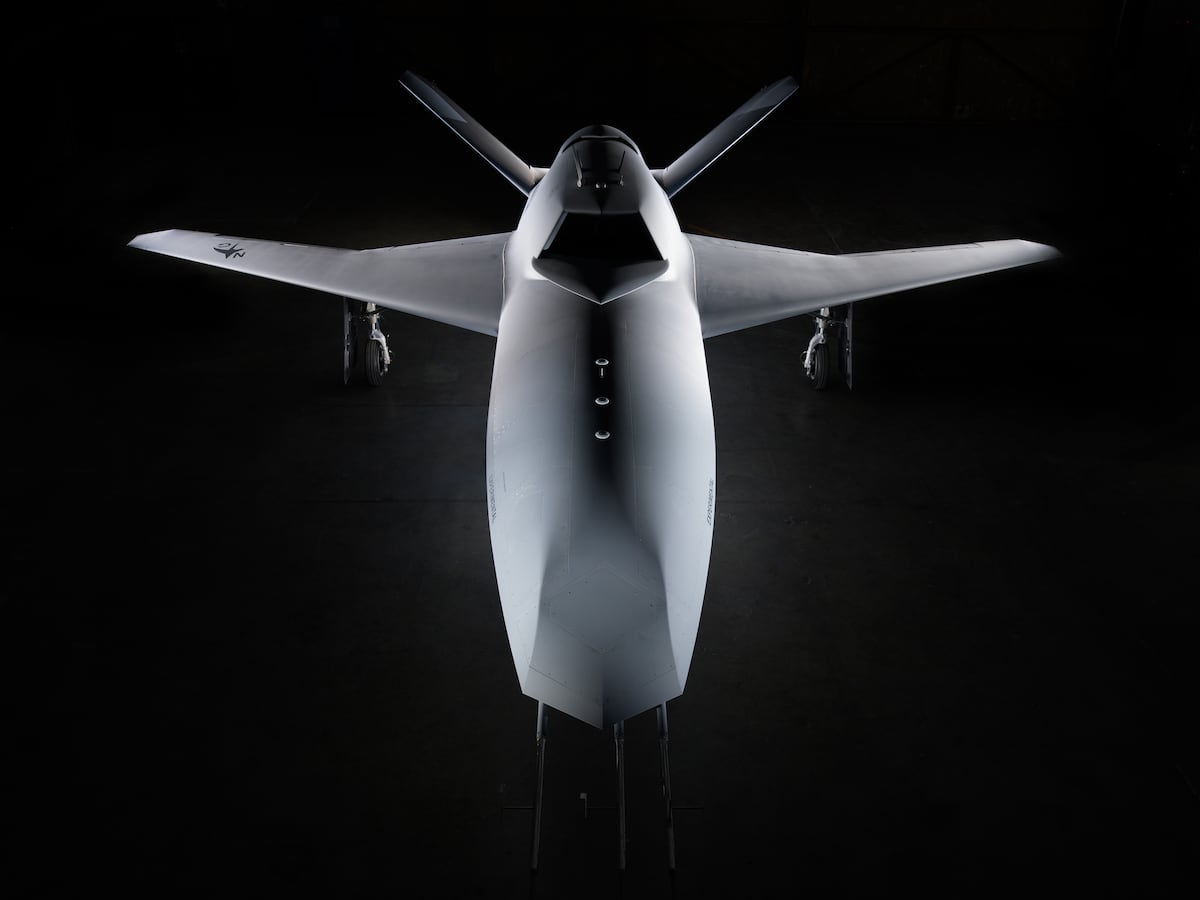

The Air Force in December said Northrop Grumman’s new autonomous drone wingman, known as Talon, is a leading contender to join its collaborative combat aircraft program.
The service also said in a Dec. 22 release that it gave Northrop’s Talon drone the designation YFQ-48A, making it the third CCA to receive an official designation. The Air Force in early 2025 dubbed the first round of CCAs, made by Anduril and General Atomics, the YFQ-44A and YFQ-42A, respectively.
The Air Force wants to create a fleet of CCAs to fly alongside aircraft such as the F-35A Joint Strike Fighter and the next generation F-47 as a way to affordably extend the reach of its manned fighters. CCAs are intended to be semi-autonomous, meaning they can fly and attack on their own with minimal direction from nearby pilots.
CCAs could carry out strike missions, conduct reconnaissance, jam enemy signals or communications, or even act as decoys to lure enemy attacks away from piloted fighters. The Air Force wants CCAs to be affordable enough that it could lose some in combat without breaking its budget. The service has adopted an acquisition strategy focusing on “continuous competition,” to allow defense contractors multiple points to be added to the CCA program.
The Air Force in April 2024 awarded Anduril and General Atomics contracts to develop the first increment of CCAs. Flight tests for those drones began in 2025. Contracts for the second increment of CCAs could be awarded this year.
In the statement, the Air Force said Talon’s designation “highlights the ongoing partnership between the Air Force and Northrop Grumman and acknowledges the continued progress of the YFQ-48A as a strong contender in the CCA program.”
“We are encouraged by Northrop Grumman’s continued investment in developing advanced semi-autonomous capabilities,” Brig. Gen. Jason Voorheis, the Air Force’s program executive officer for fighters and advanced aircraft, said in the Air Force’s statement. “Their approach aligns with our strategy to foster competition, drive industry innovation, and deliver cutting-edge technology at speed and scale.”
The Air Force traditionally uses the F designation to refer to its fighter aircraft, and Q for drones. The prefix Y indicates these CCAs are prototypes, and will be dropped when they move into production.
Northrop Grumman announced Project Talon on Dec. 4, touting its advanced modular manufacturing techniques and improved versatility in the kind of missions it could fly. The company said it would provide advanced collaboration between crewed and uncrewed aircraft, and act as a “force multiplier” in operational missions.
Northrop is also eying Talon for international customers and said it would give the U.S. and other nations “the ability to project power in dynamic threat environments.”
Northrop said it designed, built and got Talon ready to fly in less than two years. The company used its autonomous testbed ecosystem, called Beacon, to test Talon’s avionics software in real-world environments and speed up the aircraft’s development.
Air and Space Forces Magazine reported in December that Northrop Grumman officials said they pitched a CCA design for the Air Force’s first increment, but was not selected, perhaps because of the original design’s cost. Northrop officials told reporters in California that Talon is significantly different from what it first pitched, weighing about 1,000 pounds lighter, using half as many parts and requiring a construction time that is 30% faster, Air and Space Forces magazine reported.
Stephen Losey is the air warfare reporter for Defense News. He previously covered leadership and personnel issues at Air Force Times, and the Pentagon, special operations and air warfare at Military.com. He has traveled to the Middle East to cover U.S. Air Force operations.
Read the full article here
