

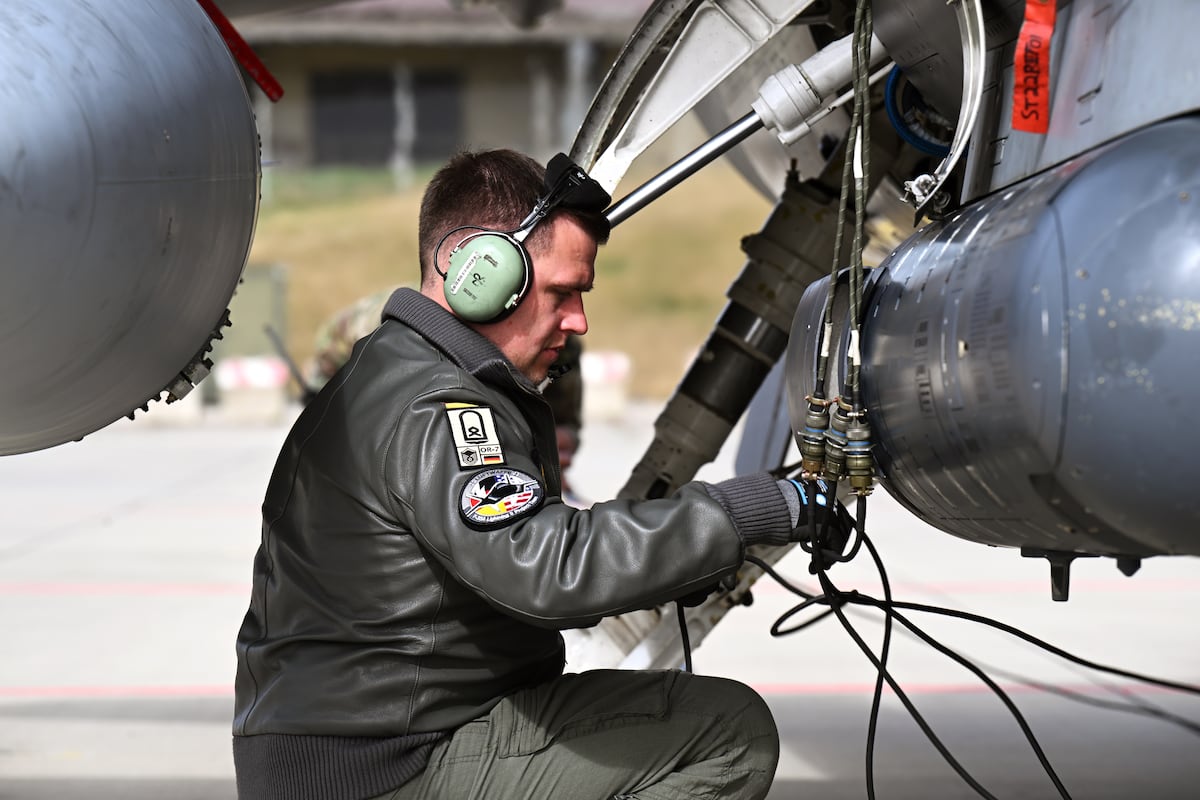

In theory, the fact that the United States and Europe fly many of the same jets should be a blessing. Common aircraft models — such as the F-35 and F-16 — should mean common spare parts, ground support equipment and mechanics who can fix similar planes from different nations.
But the reality is more complicated. Different variants within the same model, incompatible support equipment and a lack of shared data and procedures create barriers to interoperability, researchers with the Rand Corporation think tank warned in a September report.
The picture is even worse for ground equipment.
“Some nations use U.S.-standard SE [support equipment], while others develop their own, which may only be partially compatible,” the report notes. “Adding to this complexity, some NATO members — such as Poland, Slovakia, and Bulgaria — have historically operated Soviet-era fighters like the MiG-29, with SE that is not designed for Western aircraft.”
The problem is more than logistical. The U.S. Air Force’s Agile Employment Concept, or ACE, calls for fighter squadrons to operate from dispersed airbases, which requires mobility and flexibility. Rather than hauling ground crews and support equipment from base to base, it would be simpler if U.S. military planes could be serviced on Dutch or Polish airfields by local mechanics.
The Air Force commissioned the Rand study in 2024 because it was concerned about ACE and interoperability.
“If U.S. aircraft can be serviced at partner airbases using local personnel and equipment — without requiring dedicated U.S. maintenance teams — ACE operations become more agile and scalable,” the report reads.
The study began with questions over cross-servicing between nations that fly the F-35. But after the U.S. changed its policies to ease F-35 cross-servicing, the study expanded to include the F-16 and then the support equipment used by European partners.
Cross-servicing between European nations themselves can be considerable. The Rand report cites an example where Portuguese F-16s deploy to Lithuania almost 1,700 miles away, which would likely involve aerial refueling. But if those jets can stop to refuel at airbases in other nations along the way — and receive quick mandatory inspections after each landing — then they can reach their destinations rapidly without needing tankers.
To some extent, the U.S. is responsible for interoperability issues, the report found. Security concerns limit the ability of allied nations to cross-service F-35s (operational planners should “be aware of this,” the report warns). Different U.S. fighter wings have different policies regarding use of allied support equipment.
And information and lessons learned are not being shared, the report said.
“USAFE’s [U.S. Air Forces in Europe–Air Forces Africa’s] efforts to enhance interoperability face a fundamental challenge: poor communication among key stakeholders, including USAFE wings, HQ USAFE, and enterprise entities like AFLCMC [Air Force Life Cycle Management Center],” according to the report.
A parallel study by Rand in September found issues, such as lack of coordination, with partner nations regarding aircraft arresting systems for landings, fire and emergency services, force protection of airbases and repairing bases after an attack.
Rand recommends that the U.S. Air Force establish units to oversee interoperability with allies. This would be a “a dedicated, echelon-above-wing organization or coordination cell focused specifically on partner interoperability,” the report notes.
The interoperability units “need not be large to be effective,” the report argues. “What they require is a clear mandate, regular interaction with both headquarters and wings, and access to relevant data, planning documents, and decision-makers.”
Solving these problems could reap enormous benefits for the U.S. and NATO air forces, according to Patrick Mills, who co-authored the two Rand studies. Interoperability would make “European airpower far more agile and confident in crisis,” Mills told Defense News.
“Fighter operations are enormously resource-intensive, drawing on base support and skilled maintainers that each nation and operating location has to replicate,” Mills said. “Threats to airfields and the small size of most European fleets mean each nation bears high costs to sustain limited capability. If allied fleets and bases could truly interoperate and integrate, that fragility would largely disappear.”
Read the full article here
