

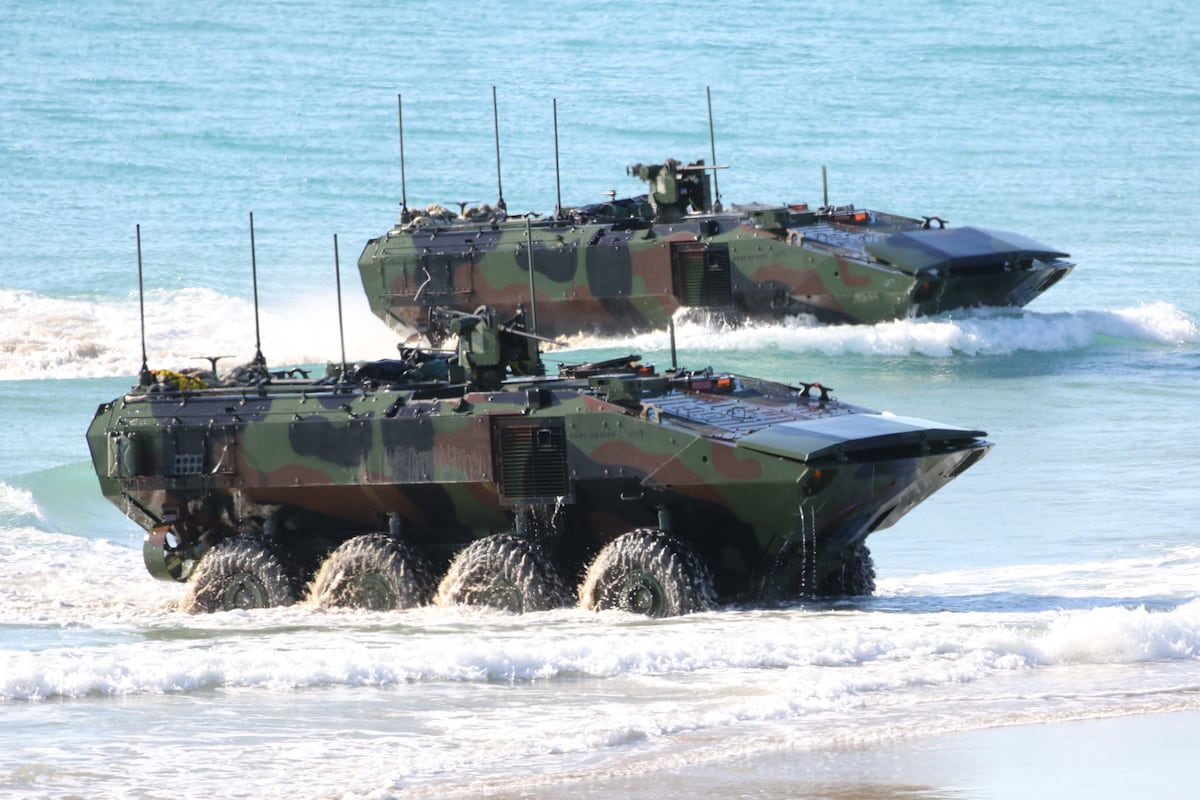

ROCKHAMPTON, Australia — In the dawn light of July 24, Japanese and American amphibious vehicles churned through the sparkling coastal waters of the Coral Sea, before emerging onto the sands of a central Queensland beach in Australia.
Two hours to the east, another amphibious lodgment was occurring simultaneously at Freshwater Beach. This time the main participants were Australia and South Korea.
The two events, part of a combined joint forcible entry operation, formed the culminating activity for Exercise Talisman Sabre 2025, held in Australia from July 13-27. They were the most sophisticated amphibious landings ever attempted in the eleven iterations of Talisman Sabre so far.
“We maintained a high operational tempo during Exercise Talisman Sabre 25, which was designed to provide intense training to ensure our forces are capable, interoperable, deployable on short notice and combat ready,” Rear Adm. Tom Shultz, commander of Expeditionary Strike Group Seven (ESG-7) and therefore in charge of the U.S. amphibious contingent, told Defense News.
Shultz said the Navy “embraced cooperation and interoperability,” demonstrated by interactions with 14 ships and expeditionary forces from six nations.
An important subplot to the July 24 landings was the first ever touchdown of the Marine Corps’ new Amphibious Combat Vehicle in Australia. These 8×8 ACVs are being inducted into the U.S. service as a much-needed replacement for the AAV7A1 family of vehicles that has soldiered on for 50 years.
Marines stopped using the AAV7A1 family for amphibious operations after a fatal accident in California in 2020. The deployment of ACVs with the Okinawa-based 31st Marine Expeditionary Unit – or 31st MEU – thus marked an important return of armored amphibious operations to the Indo-Pacific region.
1st Lt. Brooks Wright, the ACV Platoon commander, said his unit swam five ACVs ashore during Talisman Sabre landings.
Wright described the ACV as a “fabulous vehicle.” He explained that it “adds a lot of combat power for the Marine Corps, and allows us to do a lot of things we haven’t been able to do the last couple of years without the AAV around.”
He said the ACV represented a significant upgrade for the Marines; it does “everything that we advertise that we’re able to do – the ship-to-shore movement, getting troops to shore, and then pushing inland to objectives”.
Lt. Col. Andy Hornfeck, commanding officer of the 1st Battalion, 7th Marines – currently acting as the 31st MEU’s battalion landing team – described four main lines of effort for the formation during Talisman Sabre 2025.
The first was a MEU live-fire assault on Townshend Island using the full repertoire of weaponry available. This included F-35B fighters, AH-1Z Viper helicopters and M777 artillery pieces, for example.
The MEU then transitioned into force integration training with partners, which featured useful “cross-pollination” of skills, according to Hornfeck.
Thirdly, the 31st MEU conducted two assaults in Queensland’s Bowen region, including an air assault and small-boat raid.
The final effort was the combined joint forcible entry operation, where the MEU had British and Dutch personnel attached to the pre-landing reconnaissance force.
Hornfeck said the Marines worked more slowly and deliberately than if they were acting alone, since it was important to stay synchronized with their Japanese partners.
“Fighting as a coalition is challenging,” he acknowledged. Nonetheless, he deemed Talisman Sabre a realistic experience.
Elsewhere, the U.S. Marine Corps’ 2,500-strong Marine Rotational Force—Darwin (MRF-D) conducted a series of “island hopping” movements across the Outback by air.
First, MRF-D captured an airstrip at Timber Creek, 375 miles south of Darwin. Next up was Nackeroo, and finally the MRF-D seized an airfield at Cloncurry.
These efforts mimicked the Pacific island-hopping campaign of World War II, and these are tactics the U.S. military would use against China in the event of a war.
Laced with missiles and troops, the First Island Chain – extending south from Japan through Taiwan and the Philippines to Indonesia – is a natural geographic barrier of islands and land masses that would form a critical line of defense to contain the People’s Liberation Army.
Gordon Arthur is an Asia correspondent for Defense News. After a 20-year stint working in Hong Kong, he now resides in New Zealand. He has attended military exercises and defense exhibitions in about 20 countries around the Asia-Pacific region.
Read the full article here
