

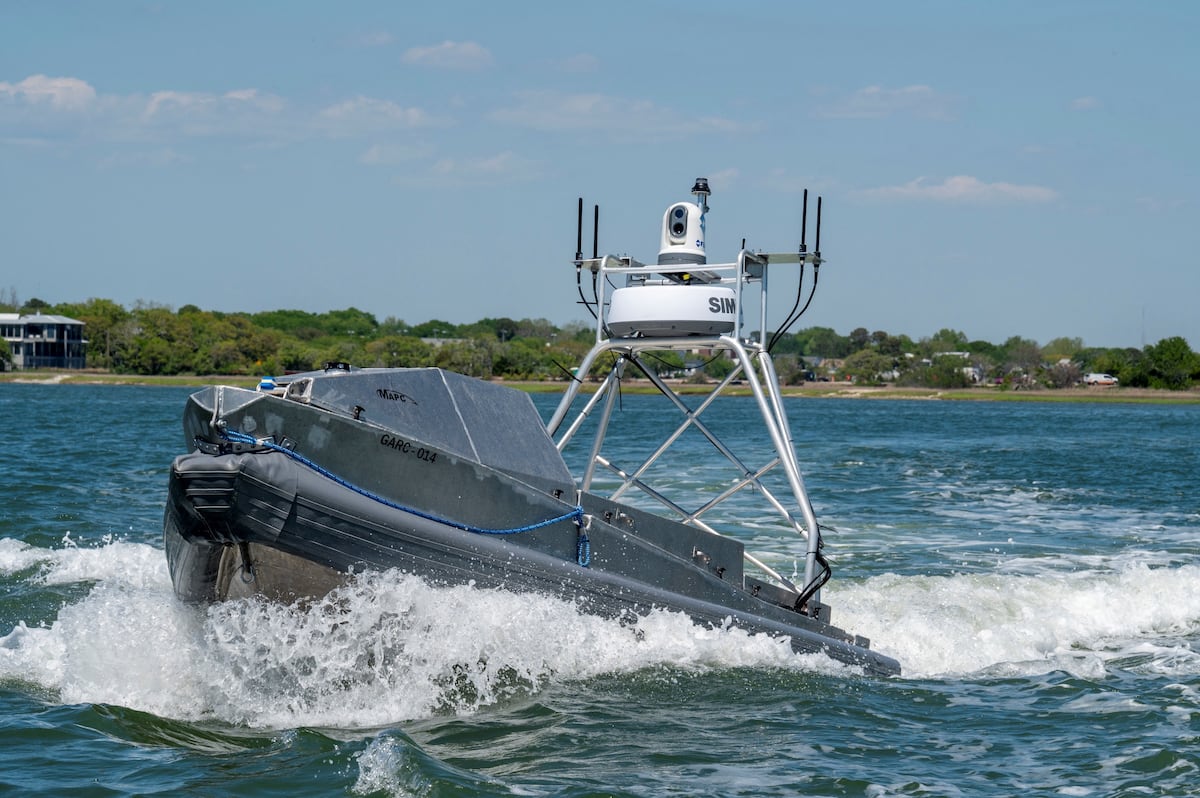

The U.S. Navy needs to reorganize and reimagine the way it invests in autonomous systems if it plans to modernize its approach to warfare effectively, according to a government watchdog.
The U.S. Government Accountability Office on Monday released an unclassified version of a March 2025 classified report that dissects the Navy’s robotic and autonomous systems development. The report further provided recommendations for how to make the vision of a hybrid fleet possible.
“Without rapid action from Navy senior leaders, the Navy risks not meeting the fleet’s urgent needs,” the report said.
In light of recent conflicts in Ukraine and the Middle East, where drones and other unmanned weapons systems have been wielded to devastating effect, the Navy has sought to invest billions of dollars in autonomous systems.
The service is working to field a hybrid fleet comprised of smaller and easily distributable capabilities, large autonomous surface and undersea vessels, as well as traditional platforms such as planes, ships and submarines.
But the Navy has encountered problems in making that come to fruition.
Turnover in senior leadership has led to a muddied set of objectives that has hindered the service’s efforts to successfully spend money on emerging technologies over the last decade, the report found.
With a revolving door of Navy officials in charge of RAS efforts, focus on investing in autonomous systems and changing the organizational structure for that investment has wavered.
Due to an unclear vision and an ineffective system, money was largely funneled toward traditional capabilities like planes, ships and submarines.
Over the past decade, the Navy approached RAS investment by focusing on building out technologies for specific domains, such as the air domain or surface domain or undersea domain.
The platforms were developed within one domain and separated from the others.
But the GAO report notes that compartmentalizing RAS investment by domain isn’t advantageous for development because the new technologies aren’t given room to prosper when they support systems across multiple domains.
Also, when RAS development occurs within one domain, funding for new technologies has to compete with funding for other weapons programs, that are already a priority in specific domains.
The Navy would do better to focus on creating “platform-agnostic” capabilities and spending capital on technologies that support systems across all domains, the GAO said.
The Navy, according to the GAO, could also take a page out of the commercial sector’s playbook by building and refining over and over again at a rapid pace to arrive at a product that can be fielded successfully.
Through an iterative approach, once a product is built the user can provide feedback in real time so the product can be constantly retooled and rebuilt better.
The report concluded that the Navy should begin to manage RAS as a portfolio, in which specific officials would be tasked with clearly defined roles so that concept development, requirement building, analysis for future procurement and development as a whole would be streamlined.
“Portfolio management offers the Navy an approach to develop RAS capabilities by balancing resourcing across multiple efforts and will help facilitate adopting the capability-centric and iterative approaches that commercial companies use to accelerate development,” the GAO report said.
The Navy stood up a new Portfolio Acquisition Executive Robotic Autonomous Systems office in December 2025, with the intent to consolidate 47 disparate programs and expedite unmanned systems development.
The GAO interviewed over 200 Defense Department and Navy officials involved in RAS work, reviewed Navy guidance for implementing RAS and toured naval warfare centers and Navy squadrons tasked with developing RAS technologies, among other strategies, to assess the Navy’s progress.
The GAO provided an initial draft of its classified report to the Defense Department in December 2024.
The Navy, in turn, sent the report back to the GAO in March 2025 with comments and “orally concurred” with the GAO’s recommendations.
Since then, the GAO said the Navy has taken some action to address the recommendations.
Riley Ceder is a reporter at Military Times, where he covers breaking news, criminal justice, investigations, and cyber. He previously worked as an investigative practicum student at The Washington Post, where he contributed to the Abused by the Badge investigation.
Read the full article here
