

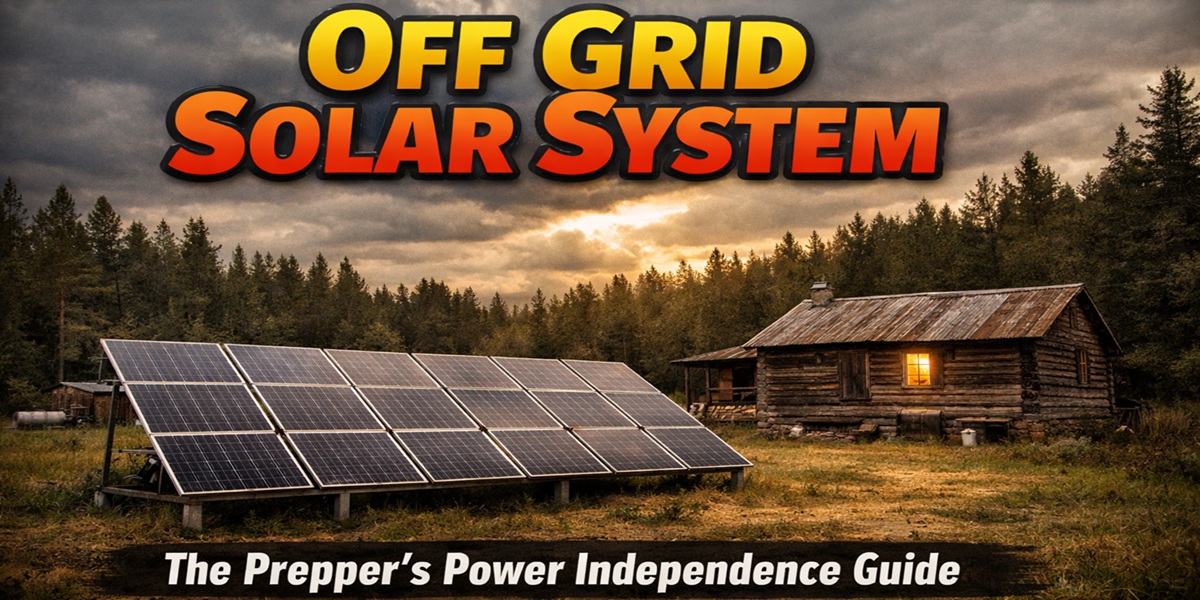

The grid goes down more often than the power company wants you to know. In February 2021, nearly 4.5 million Texas households lost power in the middle of a winter storm, some for more than a week. Hurricane seasons routinely knock out electricity for days or weeks across the Gulf Coast and Atlantic seaboard. Aging infrastructure, cyberattack vulnerabilities, and extreme weather events are not edge cases anymore. They are the pattern.
An off grid solar system is not a hobby project for homesteaders who want lower utility bills. For a serious prepper, it is a core survival asset. It means your refrigerator keeps food cold, your water pump keeps running, your communication devices stay charged, and your home stays functional when the grid around you collapses.
This guide walks you through every component of a functional off grid solar system, how to size it correctly for your actual needs, and the decisions that separate a system built for short-term convenience from one built for long-term resilience.
Why Off Grid Solar Is Different from Backup Solar
Most grid-tied solar installations are designed to reduce electricity bills and feed power back into the utility grid. They work great when the grid is running. The problem is that most grid-tied systems shut down automatically during a power outage as a safety measure to protect utility workers. That means your roof full of solar panels does nothing for you when the power goes out.
An off grid solar system operates completely independently of the utility grid. It generates power, stores it in a battery bank, and delivers it to your loads through an inverter, without any connection to the utility company. Nothing shuts off when the grid fails because your system was never connected to begin with.
For preppers, that distinction is everything. An off grid system is not a supplement to grid power. It is a replacement for it.
The Four Core Components of Every Off Grid Solar System
Every functional off grid solar system has the same four building blocks regardless of size: solar panels, a charge controller, a battery bank, and an inverter. Understanding what each one does and how they interact is essential before you spend a dollar on hardware.
1. Solar Panels
Solar panels are the front end of the system. They convert sunlight into direct current (DC) electricity, which flows into your charge controller and eventually into your batteries. Panel output is measured in watts, and the total wattage of your array determines how much energy you can generate during a day of usable sunlight.
For off grid preparedness purposes, monocrystalline panels are the standard choice. They are more efficient than polycrystalline panels, meaning they produce more power per square foot of surface area. In a fixed installation on your property, efficiency translates directly into needing fewer panels to hit your power target.
Panels are rated under ideal laboratory conditions (standard test conditions, or STC), which means a panel rated at 400 watts will rarely produce exactly 400 watts in real-world deployment. Expect real-world output to run around 75 to 80 percent of rated capacity once you account for temperature, angle, shading, and wiring losses. The National Renewable Energy Laboratory provides regional solar resource maps that show average peak sun hours by location, which is essential data for accurate system sizing.
2. Charge Controller
The charge controller sits between your solar panels and your battery bank. Its job is to regulate the voltage and current coming from the panels to prevent overcharging the batteries. Without it, panels can push excess voltage into a fully charged battery bank and destroy it.
There are two types of charge controllers: PWM (pulse width modulation) and MPPT (maximum power point tracking). MPPT controllers are significantly more efficient, typically converting 93 to 99 percent of available solar power into usable charging current. For any serious off grid installation, MPPT is worth the added cost.
Size your charge controller to handle the maximum output of your panel array plus a 25 percent safety buffer. A 1,000-watt panel array producing around 50 amps at 20 volts would need a controller rated for at least 62.5 amps. Going slightly oversized here leaves room for expanding your panel array later without replacing the controller.
3. Battery Bank
The battery bank is the heart of your off grid system. It stores the energy your panels generate during daylight hours and releases it when the panels are not producing, at night or during overcast weather. Battery capacity determines how long you can run your loads without sun.
Battery storage is measured in kilowatt-hours (kWh). A 10 kWh battery bank, for example, can theoretically supply 1,000 watts of continuous load for 10 hours. But depth of discharge matters. Lead-acid batteries, including AGM and gel variants, should not be discharged below 50 percent of capacity on a regular basis without accelerating battery degradation. Lithium iron phosphate (LiFePO4) batteries can be discharged to 80 or even 90 percent without the same penalty.
For a prepper application, lithium iron phosphate batteries are the preferred chemistry despite their higher upfront cost. They offer a usable capacity advantage, a dramatically longer cycle life (2,000 to 4,000 cycles versus 300 to 500 for flooded lead-acid), better cold-weather performance, and no off-gassing that would require vented storage. A well-managed LiFePO4 bank can last 10 years or more under regular use. The U.S. Department of Energy’s Vehicle Technologies Office has published comparative battery chemistry data that supports these performance characteristics.
How large your battery bank needs to be depends on how many days of autonomy you want, meaning how many consecutive cloudy days your system can carry you through without solar input. A one-day autonomy buffer is a minimum. Three days is a more realistic preparedness standard for weather-related outages. Five to seven days puts you in serious grid-down resilience territory.
4. Inverter
Solar panels and batteries operate on direct current (DC). Most household appliances operate on alternating current (AC). The inverter converts DC power from your battery bank into AC power your devices can use.
For off grid systems, you need a pure sine wave inverter, not a modified sine wave inverter. Modified sine wave inverters are cheaper but produce a stepped approximation of AC power that can damage sensitive electronics, cause motors to run hotter and less efficiently, and create interference with audio equipment. Pure sine wave inverters produce clean AC output identical to grid power and are compatible with all AC loads.
Inverter sizing is based on your peak load, meaning the maximum number of watts your system might need to supply at any single moment. If you plan to run a 1,500-watt microwave, a 500-watt refrigerator, and a few 60-watt lights simultaneously, your peak demand is around 2,100 watts. Size your inverter to handle that peak with room to spare. A 3,000-watt inverter is a common starting point for a whole-home off grid setup.
Some systems use inverter-chargers, which combine a pure sine wave inverter with a battery charger that can accept input from a generator. This gives you the flexibility to top off your batteries with a gas generator during an extended cloudy stretch, keeping your system functional when solar production is limited.
Sizing Your System: Stop Guessing, Start Calculating
The most common mistake preppers make when building an off grid solar system is skipping the load calculation and guessing at component sizes. Undersized systems leave you without power when you need it most. Oversized systems waste money that could have gone to other preparedness priorities.
A proper load calculation takes about 30 minutes and requires nothing more than a notepad and the wattage ratings printed on your appliances.
Step 1: List Your Loads
Write down every electrical device you intend to run. For each device, note its wattage (found on the label or in the owner’s manual) and the approximate number of hours per day you expect to run it. Multiply wattage by hours to get daily watt-hours (Wh) for each device.
A realistic off grid preparedness load list for a small home or cabin might look like this: a refrigerator drawing 100 watts running roughly 8 hours per day (800 Wh), LED lighting at 100 watts for 5 hours (500 Wh), a well pump at 750 watts running 30 minutes per day (375 Wh), phone and radio charging at 50 watts for 2 hours (100 Wh), and a laptop at 60 watts for 4 hours (240 Wh). That totals roughly 2,015 Wh per day, or just over 2 kWh.
Step 2: Calculate Panel Array Size
Divide your daily watt-hour total by the average peak sun hours for your location. If your area averages 4.5 peak sun hours per day and you need 2,015 Wh, you need a panel array producing at least 448 watts. Add 25 percent for real-world losses and you are looking at roughly 560 watts of panel capacity. Rounding up to 600 watts of installed panels gives you appropriate headroom.
Step 3: Calculate Battery Bank Size
Multiply your daily watt-hour consumption by the number of days of autonomy you want. For 3 days of autonomy at 2,015 Wh per day, you need 6,045 Wh of storage. If using LiFePO4 batteries with 80 percent usable depth of discharge, divide by 0.8 to get the required total bank size: 7,556 Wh, or roughly 7.5 kWh of installed battery capacity.
A 48-volt battery bank is standard for systems in this size range. At 48 volts, 7.5 kWh requires about 156 amp-hours (Ah) of capacity. A common configuration would be a pair of 100 Ah 48V LiFePO4 batteries, giving you 200 Ah and approximately 9.6 kWh of total capacity with 7.7 kWh usable.
Installation Considerations for Preppers
A solar system that generates power is useful. A solar system that survives a grid-down scenario and keeps generating power for years without outside maintenance is what preppers actually need. Installation decisions directly affect long-term resilience.
Roof Mount vs. Ground Mount
Roof mounts integrate cleanly with a home’s footprint and are harder to spot from a distance, which matters for operational security in some scenarios. Their downsides are meaningful: panels are harder to clean, inspect, and repair. Damage to the roof from the mount itself creates a new vulnerability. Roof angle and orientation may not be ideal for your latitude.
Ground mounts give you full control over panel angle and orientation, allow easier cleaning and maintenance, and can be adjusted seasonally to optimize winter production. They require more land and are more visible. For a permanent homestead or retreat property where security through obscurity is less of a concern, ground mounts often make more practical sense.
Battery Storage Location
Batteries need to be stored in a temperature-controlled environment. LiFePO4 batteries lose charge capacity in sustained cold below freezing and should not be charged below 32 degrees Fahrenheit without a battery management system that disables charging at low temperatures. Most quality LiFePO4 batteries include built-in BMS protection, but storing the bank in a conditioned space, a basement, insulated outbuilding, or even a well-insulated box, extends battery life and maintains performance in winter.
Keep batteries accessible for inspection and away from flammable materials. Even LiFePO4, which has substantially better thermal stability than lithium cobalt oxide chemistries, should be treated with respect as an energy storage device.
System Protection and Security
Off grid electrical systems need overcurrent protection at every major junction: between the panels and charge controller, between the charge controller and battery bank, and between the battery bank and inverter. Fusing or circuit breakers at each stage protect against wiring faults and prevent catastrophic failures.
From a security standpoint, your battery bank and inverter are high-value hardware that should be stored in a locked space if possible. In an extended grid-down scenario, a functioning power system becomes a visible asset. Keep it out of sight and out of casual conversation.
Three Tiers: Matching Your System to Your Mission
Not every prepper is starting from the same place or working with the same budget. Here is a practical framework for three different levels of off grid solar commitment.
Tier 1: Essential Power (Budget $800 to $2,000)
This is a portable or semi-permanent system focused on critical loads: communication devices, lighting, and phone charging. A 200 to 400-watt panel array with a 20 to 40 amp MPPT charge controller, a single 100 Ah LiFePO4 battery, and a 1,000-watt pure sine wave inverter covers the basics. This tier is appropriate for a bug-out location, a vehicle-mounted system, or as a starting point that you expand over time. It will not run a refrigerator reliably but will keep your radios, lights, and devices operational.
Tier 2: Functional Homestead (Budget $3,000 to $8,000)
This is a whole-home system for a small to medium cabin or retreat property focused on food preservation, water pumping, and standard lighting and device charging. A 1,000 to 2,000-watt panel array, a 40 to 60 amp MPPT charge controller, a 200 to 300 Ah LiFePO4 battery bank at 48 volts, and a 2,000 to 3,000-watt pure sine wave inverter-charger. This tier covers a realistic family’s core needs for extended grid-down periods. A chest freezer, a propane-supplemented refrigerator, water pump, and communications gear all fit within this power budget.
Tier 3: Full Independence (Budget $10,000 and up)
This is a system designed to run a full household with minimal lifestyle changes. A 4,000 to 8,000-watt panel array, 80 to 100 amp MPPT charge controller, a 600 Ah or larger LiFePO4 battery bank at 48 volts, and a 5,000 to 8,000-watt pure sine wave inverter-charger. This tier handles high-load appliances like electric water heaters, HVAC supplementation, power tools, and a full kitchen. It is a serious infrastructure investment that also functions as a long-term utility cost offset if you are in a grid-connected property during normal times.
Maintenance: Keeping Your System Operational for Years
An off grid solar system requires far less maintenance than a generator, but it is not zero-maintenance. A few routine habits extend system life significantly.
Keep panels clean. Dust, pollen, bird droppings, and debris accumulate on panel surfaces and reduce output. In dry climates, this can cut production by 10 to 25 percent over a few months. Clean panels with water and a soft cloth or squeegee on a regular schedule, and after any significant dust or ash event.
Inspect wiring connections at least annually. Thermal cycling, vibration, and weathering can loosen connections over time, increasing resistance and creating hot spots that are both a fire risk and an efficiency loss. Tighten connections, check for corrosion, and replace any weathered wire insulation.
Monitor battery state of health over time. Most quality LiFePO4 battery systems include a battery management system (BMS) with monitoring capability. Track charge cycles and compare current capacity to baseline. A battery that can no longer hold its rated capacity is approaching end of life and should be replaced before it fails during a critical period.
Build Energy Independence the Amish Way
Modern off-grid solar systems may rely on advanced technology, but the mindset behind true resilience is much older. Long before power lines reached rural America, Amish communities built lives that did not depend on fragile infrastructure. Their approach was never about convenience. It was about stability, practicality, and systems that continue working when the outside world becomes unreliable.
The Amish Ways book captures the same principles that make an off grid solar system truly valuable: reduce dependence on centralized systems, design your home to function through disruptions, and build layered resilience so no single failure leaves you vulnerable. Solar power is one part of that strategy. Food production, water security, preservation methods, low-tech skills, and community-centered preparedness are the rest.
Inside The Amish Ways you will discover time-tested strategies for producing food reliably, storing harvests without constant refrigeration, building practical self-sufficiency into daily life, and reducing reliance on systems that fail when you need them most. These are not theoretical ideas. They are methods used successfully for generations in real-world conditions where resilience is not a hobby but a necessity.
If you are investing in an off grid solar system, you are already thinking beyond short-term convenience. Pairing modern power independence with proven low-tech resilience creates a far more durable preparedness plan. The strongest homesteads are not dependent on a single solution. They are built on multiple systems that support each other.
Learn how to design a lifestyle that remains functional whether the grid is stable or not. Discover practical, field-tested strategies that help you produce more, waste less, and rely less on outside supply chains.
Explore The Amish Ways here!
Your Power Supply Is a Survival Asset
A functioning off grid solar system does not just keep the lights on. It powers your refrigerator, your water pump, your communications gear, and your ability to work and maintain security when everything around you is dark. In a serious grid-down scenario lasting weeks or months, that system is one of the most consequential investments you can make.
Start with a real load calculation. Size your components to your actual needs, not to a generic starter kit. Prioritize battery quality because that is where most systems fail first. And plan for expansion from the beginning so you are not locked into components that cannot grow with your preparedness level.
The grid will fail again. It is not a question of if. Build your system before you need it, because once you need it, it is already too late to build it.
You may also like:
 Don’t forget to join the Ask A Prepper WhatsApp Community
70+ Projects to Survive a World Without Electricity (VIDEO)
Solar Panels for Off-Grid Living: How to Build a System That Actually Works
Read This Before You Buy a Solar-Powered Generator
How To Build A Solar Dehydrator
How To Make Your Own Solar Water Heater
Read the full article here
